 BIBLE HOMES
Bible Study · Yeshua
The Secret of the Name Yeshua
YHVH = Yeshuah — a consonant-by-consonant analysisMatthew 1:21 · Isaiah 12:2 · John 1:1
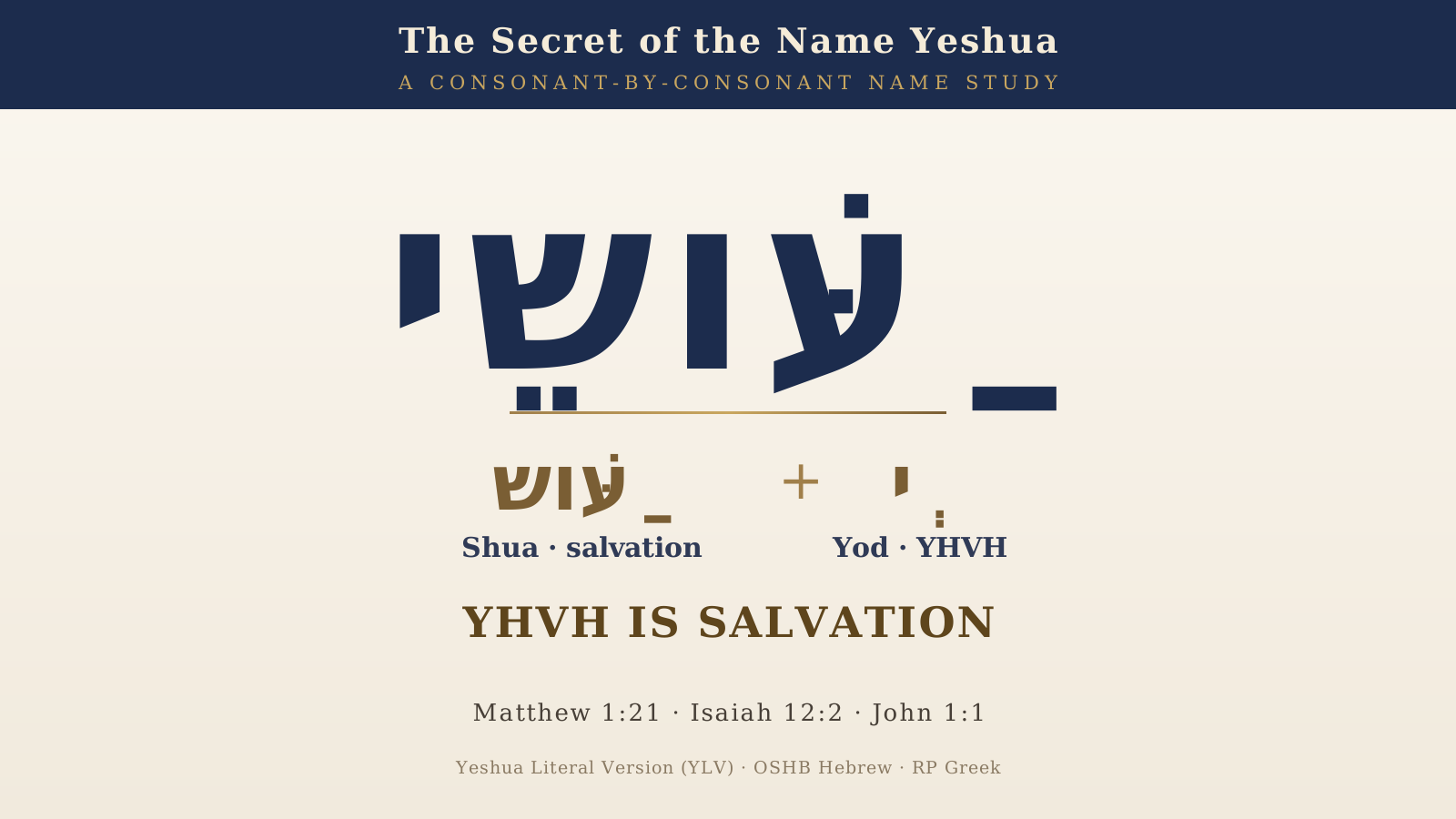
Based on the YLV translation · Hebrew source OSHB (Open Scriptures Hebrew Bible, Westminster Leningrad Codex) · Greek source RP (Robinson-Pierpont Byzantine Majority Text)
This study examines the meaning within the name Yeshua (Jesus) by checking, one by one, the actual consonants and words used in the Hebrew (OT) and Greek (NT) source texts. In each section, what is already widely known and what this study newly proposes from the YLV perspective are marked with the two labels below — so the reader can discern what is common understanding and what is this study's own view.
Content already widely treated in dictionaries, commentaries, and tradition; commonly accepted.
A view this study presents from the YLV standpoint, distinct from mainstream dictionaries and commentary.
First, You Must Know — Two Hebrew Names Behind the English ‘Jesus’
Before we begin, there is one fact to grasp. The Hebrew Yeshua, the root of the name rendered ‘Jesus,’ splits in the OT into two different words. Distinguishing them from the start makes this whole study clear.
| Category | Hebrew | Usage in Scripture |
|---|---|---|
| Salvation Yeshuah (H3444) | יְשׁוּעָה | The word translated ‘salvation.’ A final honorific Heh (ה) is added, so it is written ‘Yeshuah.’ In Isaiah 12:2 it stands in apposition with YHVH Himself. |
| High Priest Yeshua (H3442) | יֵשׁוּעַ | A person's ‘name.’ No final Heh. Exactly the same form as NT ‘Jesus.’ This is the name of the high priest Yeshua in Ezra and Nehemiah. |
This distinction is the backbone of the gospel. Scripture testifies to these two Yeshuas divided at the incarnation.
That Yeshua (H3442) has the same form as NT ‘Jesus,’ that the noun Yeshuah (H3444) means ‘salvation,’ and that both forms occur in the OT — all this is widely found in dictionaries and commentaries.
Reading the final Heh (ה) of Yeshuah (H3444) as an ‘honorific / divine marker’ rather than a ‘feminine ending’ is this study's view. For reference, standard lexicons (Strong's, BLB, etc.) classify this word as a ‘feminine noun,’ so this view is distinct from them.
Before the Incarnation — Salvation Yeshuah, the Word Present in the Beginning
Before coming as a man, He was a person who was with God in the beginning. He is the Word who created heaven and earth (John 1:1–3); the very Yeshuah translated ‘salvation’ (the ‘YHVH = my Yeshuah’ of Isaiah 12:2) is this One. Yeshuah is not a concept, but that living person from before creation.
Why Is the One Named ‘Salvation’ the Word of Creation?
Here we must go one step further. Why is the One who bears the name ‘salvation’ the Word of creation? The answer lies in examining the state in which the first creation was made.
God's first creation was perfect. Only upon the foundation of that perfect creation can there be re-creation. Likewise, a person must first be born before being born again. The first Eden, too, was made flawless and good. That within it stood the tree of the knowledge of good and evil and the command ‘in the day you eat you shall surely die’ (Gen 2:17) was not because the creation was flawed, but because — just as a perfectly born person still moves toward being born again — that perfect creation too was made as the foundation toward the re-creation and eternal life to be fulfilled in Yeshuah (salvation).
‘And It Was Good’ — A Perfect Creation, but Has Its Purpose Been Fully Reached?
A natural question arises here. Genesis 1 says God saw what He made and said ‘it was good (tov),’ and at the end ‘it was very good (tov meod)’ (Gen 1:31). Creation was thus made flawless and perfect. Then does that ‘it was good’ mean the purpose toward which that creation moves — eternal life and re-creation — had already been fully reached? This question is worth pausing on. For ‘good (tov)’ means ‘the making is excellent,’ not ‘its purpose is already fulfilled.’ These two are different. Consider the potter's analogy.
A potter shapes a water cup and is pleased: ‘This is good, well made.’ That is right — the cup's ‘making’ is complete. But the ‘purpose’ for which the cup exists is not yet fulfilled. Its purpose is fulfilled only when water is poured in and drunk. The completion of making (good) and the completion of purpose (use) are different. God's ‘it was good’ is like the potter saying the cup is well made — the making is good and flawless, not that creation's ultimate purpose (the completion of eternal-life salvation) had already arrived.
By this distinction the state of the first creation is clear. In its making it was ‘very good’ and flawlessly perfect, yet the purpose toward which that perfect creation moves — re-creation and eternal life in Yeshuah — was still the next step. It is like a perfectly shaped cup that has not yet held water to drink, and like a perfectly born person still moving toward being born again. So ‘it was good’ does not mean creation's purpose was already finished, but shows that this perfect creation was now setting out toward its purpose (salvation, eternal life).
By contrast, the place of completion toward which creation moves is entirely different. It is not a place where Torah is gone, but the state where the whole Torah is perfectly completed — where Torah is fully realized within the person, and sin, death, and disobedience can no longer exist. This is where the potter's cup finally holds water and fulfills its purpose. Completion is not a lawless state where Torah is abolished, but a state where the whole Torah is perfectly fulfilled. It is the exact opposite of the lawlessness Jesus spoke of: “you who practice anomia (lawlessness/no-Torah), depart from Me” (Matt 7:23). Revelation pictures that completion — no more death, sorrow, or pain (Rev 21:4); no more curse; the tree of life restored (Rev 22:2–3).
If the first creation is a starting point holding the possibility of disobedience and death, and completion is the whole-Torah-perfected state free of sin and death, then what bridges the two is precisely ‘salvation (Yeshuah).’ Every creature was made from the start to receive Yeshuah and reach that completion — to have eternal life in Yeshuah. Creation and salvation are one plan in one Person.
Romans 8:20–22 · 1 Corinthians 15:22, 45Through the first Adam all creation was subjected to the bondage of decay (Rom 8:20–21), yet it groans together, longing for liberation (Rom 8:19, 22).
‘The first man Adam became a living soul; the last Adam a life-giving spirit’ (1 Cor 15:45). As in Adam all die, in Messiah all are made alive (1 Cor 15:22). That last Adam is Yeshuah.
At the stage where receiving Yeshuah (salvation) is complete, sin and death can no longer intrude. The possibility of testing and death present in the first creation is entirely removed, and one lives forever in Yeshuah, having received the perfect Yeshuah — this is the destination toward which creation has aimed from the start. Therefore Yeshuah is creation's beginning and completion, salvation and eternal life itself.
Reading Yeshuah not as an ‘abstract concept of salvation’ but as ‘a person present in the beginning, the Word of creation (John 1:1),’ and seeing the perfect first creation as ‘a foundation toward re-creation and completion in salvation (Yeshuah),’ is this study's view. Standard lexicons define this word as ‘abstract deliverance’; and whereas general creation-theology mostly uses the ‘perfect creation → fall → restoration (going back)’ framework, this study reads it as a perfect creation that, upon that very perfection, moves forward toward re-creation and completion in Yeshuah.
After the Incarnation — High Priest Yeshua, King and High Priest at Once
The name the Word took when incarnate as a boy is the high priest Yeshua (H3442), without the Heh. Here is the astonishing beginning of the gospel. Jesus came as King from the line of David, the tribe of Judah (Matt 1:2–3, Heb 7:14). Yet the name He bore was ‘Yeshua,’ the name of a Levite high priest. Coming by royal lineage yet bearing a high priest's name — this testifies by the name itself that He is King and High Priest at once.
Hebrews 7:14 (YLV)It is evident that our Lord arose from Judah, a tribe about which Moses said nothing concerning priesthood.
Who Is That High Priest Yeshua — and Why Two Forms?
Who then is that ‘high priest Yeshua’? In the first generation back from the Babylonian exile, he is the high priest who led the temple rebuilding together with governor Zerubbabel (son of Jehozadak). Yet Scripture writes this one person in two forms of the name — the same man, spelled differently across books.
| Form | Hebrew | Where It Appears |
|---|---|---|
| Long — Yehoshua (H3091) | יְהוֹשֻׁעַ | Haggai 1:1, 1:12, 1:14 / 2:2, 2:4 · Zechariah 3:1, 3:3, 3:6, 3:8, 3:9 / 6:11 |
| Short — Yeshua (H3442) ※ same form as NT ‘Jesus’ | יֵשׁוּעַ | Ezra 2:2, 3:2, 3:8, 3:9, 4:3, etc. · Nehemiah 7:7, 12:1, 12:7, 12:26, etc. |
What exactly matches NT ‘Jesus’ is the short form (H3442). The name Jesus took at His incarnation is the very form Ezra and Nehemiah used for Zerubbabel's fellow high priest, יֵשׁוּעַ (Yeshua). The same man was also called by the long form Yehoshua in Haggai and Zechariah, but the name the NT inherited is the high priest's short form Yeshua. The One who came as King (tribe of Judah) bore the very name of the high priest who rebuilt the temple — kingship and priesthood held in one name.
Before incarnation = Salvation Yeshuah (יְשׁוּעָה), the Word of creation present in the beginning. After incarnation = High Priest Yeshua (יֵשׁוּעַ), who came as King of Judah yet bore a high priest's name. One Person is King and High Priest.
That the Messiah is both King (of Judah, David's line) and High Priest, and that this is foreshadowed by the crowning of high priest Joshua in Zechariah 6, is traditionally well known. So is the Melchizedek-order argument in Hebrews 7.
1The Angel Set the Name with Its Meaning — Matthew 1:21
Jesus' name was not given by parents but announced with its meaning by the angel before birth. It matters that the angel gave the name and immediately unfolded its meaning.
Matthew 1:21 (YLV)She will bear a son, and you shall call His name Yeshua (Jesus), for He will save His people from their sins.→ alludes to Ps 130:8
Note the structure. After ‘call His name Yeshua’ comes ‘for (hoti) …… He will save.’ That is, the name itself means ‘He saves’, so give that name. Name and mission overlap within one word. Where this overlap comes from is revealed only by examining the Hebrew consonants directly.
2The Hebrew Structure of the Name Yeshua — Down to Each Consonant
The Greek ‘Jesus (Ἰησοῦς)’ renders the Hebrew name יֵשׁוּעַ (Yeshua). Greek has no sound like the Hebrew Ayin, so the ending became -ς; but the root is the Hebrew name. It has four consonants.
2-1. The Four Consonants, Right to Left
Hebrew reads right to left. Yeshua's four consonants, in reading order:
Saying Yeshua is just ‘Yod + yasha’ makes the Vav look missing — it is not. The Vav lives inside ‘Shua (שׁוּעַ),’ the ‘salvation’ part, sounding the ‘u.’ The whole name יֵשׁוּעַ = Yod (YHVH) + Shua (salvation) = ‘YHVH is salvation / YHVH saves.’
The etymology Yeshua = YHVH's name (Yod) + salvation (root yasha), i.e. ‘YHVH saves,’ is a standard understanding widely treated in dictionaries and commentaries.
3‘Shua’ Is ‘Salvation’ — Scripture Shows It Directly
Whether the latter part ‘Shua (שׁוּעַ)’ truly means ‘salvation’ is proven by the text itself in two places, without borrowing any abbreviation. These two proofs are decisive.
3-1. Shua — a Standalone Name (Genesis 38:2)
Genesis 38:2 (background)Judah saw there the daughter of a Canaanite man (ish) named Shua, and he took her and went in to her.
The name of Judah's father-in-law is שׁוּעַ ‘Shua’ (H7770). Its consonants are Shin·Vav·Ayin — exactly ‘Shua.’ The Vav is fully inside the name. This is not an abbreviation of anything, but a word Scripture actually uses as a standalone name, meaning ‘salvation / wealth / abundance.’
3-2. Malki Shua — Two Separate Words in the Text (1 Samuel 14:49)
1 Samuel 14:49 (background)The sons of Saul were Jonathan, Ishvi, and Malki-shua; and the names of his two daughters — the firstborn Merab and the younger Michal.
English Bibles usually write the name of Saul's son as one word, ‘Malchishua,’ but in the Masoretic Text (OSHB) this name stands as two separate words. Rendering the text as it stands — read right to left:
Not only is there a space between them; the Masoretic Text places an atnach accent at the end of the first word (over Shua), marking the break between the two. So this name is not one written-together word, but a name Scripture writes as two words, ‘Malki’ and ‘Shua.’ A lexicon joins them as a headword (מַלְכִּישׁוּעַ) for convenience, but the text's spelling is the two words below.
| Word | Text Form | Meaning |
|---|---|---|
| 1st word — Malki | מַלְכִּי | ‘my king’ — מֶלֶךְ (melek, king) with the possessive suffix ִי (‘-i,’ ‘my’) |
| 2nd word — Shua | שׁוּעַ | ‘salvation’ — the same standalone name as in Gen 38:2 (with the Vav) |
| meaning together | מַלְכִּי שׁוּעַ | ‘My king is salvation’ |
Here ‘Shua’ stands as an entirely separate word meaning ‘salvation.’ It stood alone as a name in Gen 38:2 (3-1), and here again beside ‘Malki.’ So Yeshua's ‘Shua’ is likewise ‘salvation,’ confirmed again by the text. Placing the same principle beside Yeshua:
| Name | First part + Shua | Meaning |
|---|---|---|
| Malki Shua (two words) | Malki (my king) + Shua (salvation) | My king is salvation |
| Yeshua | Ye (YHVH) + Shua (salvation) | YHVH is salvation |
The standalone name ‘Shua’ (Gen 38:2) and ‘Malki Shua,’ written by the text as two separate words (1 Sam 14:49), together prove (1) the Vav is inside ‘Shua’ and (2) ‘Shua = salvation.’ Thus Yeshua = YHVH + salvation can be established from Scripture alone, without borrowing any abbreviation theory.
That ‘Shua’ is an element meaning salvation, that Gen 38:2 has a name ‘Shua,’ and that 1 Sam 14:49 has Malchishua — these are facts found in dictionaries and commentaries.
Using the observation that Malchishua stands as two separate words in the Masoretic Text as an argument for ‘Shua = salvation’ — without borrowing the abbreviation theory — is this study's approach.
4The ‘Abbreviation of Joshua’ Explanation — and the Separate Matter of the ‘Four-Consonant Yeshua’
Today many lexicons and commentaries explain Yeshua (יֵשׁוּעַ) as an abbreviation of Joshua (יְהוֹשֻׁעַ, Yehoshua). This explanation has its own grounds and is valid in itself. In fairness, we look at those grounds first.
4-1. Grounds for the Abbreviation Theory
- The two names share their latter part — both Joshua and Yeshua share the root yasha (ישע, salvation).
- In post-exilic books, the same person (Zerubbabel's fellow high priest) appears as long ‘Yehoshua’ in Haggai/Zechariah and short ‘Yeshua’ in Ezra/Nehemiah — two forms pointing to one man.
- The morphological observation that dropping the middle Heh (ה) in the long form brings its sound near the short form.
So one may indeed say ‘Yeshua is the short form of Joshua,’ and that explanation is valid in itself. Yet, quite apart from it, one thing must be noted — the name the NT inherited and uses is precisely the four-consonant Yeshua. Since the same meaning can be carried by different spellings, ‘sharing the same meaning’ and ‘which exact form the NT's name is’ are two different questions.
4-2. A Matter Separate from the Abbreviation — Same Meaning, Different Form; and Hebrews 4:8
Hebrews 4:8–9 (YLV)If Joshua had given them rest, He would not have spoken later of another day.
So then, a Sabbatismos (Sabbath-rest) remains for the people of God.
The writer of Hebrews states that Joshua (son of Nun) led the people into the land but did not give true rest. Hence ‘another day’ — the rest that still remains (4:9). The premise is clear: Joshua (son of Nun, the man) and the Savior Yeshua are different persons. That the two names share the meaning ‘YHVH's salvation’ is one thing; that the man bearing the name is himself the true Savior is another. Even with the same meaning, the One who actually fulfilled it is Yeshua (Jesus) alone.
The explanation ‘Yeshua = abbreviation of Joshua’ is valid in itself, and the meaning of the name Joshua is correct too. But two things are separate matters — ① since the same meaning can have different spellings, the fact that the name the NT inherited is precisely the four-consonant Yeshua (H3442) is distinct from the abbreviation discussion; ② Hebrews 4:8 distinguishes Joshua (son of Nun, the man) from the Savior Yeshua. So without needing to deny the abbreviation explanation, one can establish the meaning from the name's own structure (Yod = YHVH, Shua = salvation).
The explanation itself — ‘Yeshua is an abbreviation of Yehoshua (Joshua)’ — is the mainstream view adopted by most dictionaries, commentaries, and wikis today.
Without denying the abbreviation explanation itself, treating the fact that the name the NT inherited is precisely the four-consonant Yeshua (H3442) as a separate matter (since the same meaning can have different spellings), and distinguishing Joshua (son of Nun, the man) from the Savior Yeshua by Hebrews 4:8, is this study's view.
5Isaiah 12:2 — YHVH Is My Yeshuah
Having confirmed the name's meaning (YHVH's salvation), we now see whom that ‘salvation’ points to in the OT. Isaiah does not merely set YHVH and ‘salvation (Yeshuah)’ side by side — he declares them to be the same One.
Isaiah 12:2–3 (YLV)Behold, God is my salvation (Yeshuah); I will trust and not be afraid, for YHVH, YHVH is my strength and my song, and He has become my salvation (Yeshuah).
Therefore with joy you will draw water from the springs of salvation (Yeshuah).
Here the word translated ‘salvation’ is יְשׁוּעָה Yeshuah (H3444). It never once describes a feminine object; it always appears as one with YHVH. So the final Heh (ה) is not a feminine ending but an honorific marking a divine reference, written with a final ‘h.’ Isaiah 12:2 nails it twice: ‘God = my Yeshuah,’ ‘YHVH = my Yeshuah.’
YHVH = my Yeshuah. The One the OT calls ‘my salvation’ is none other than YHVH Himself. The name Yeshua (YHVH + salvation) and this word Yeshuah (YHVH's salvation) come from the same root and point to the same reality.
6Yeshuah Is Not an Abstract Noun — the Word Who Really Existed in the Beginning
Reading Yeshuah not as an ‘abstract concept of salvation’ but as ‘a pre-existent person, the Word of creation’ is this study's view. Standard lexicons define this word as ‘abstract deliverance,’ so the discussion below is a theological reading beyond that lexical definition.
Here is something that must be set right. We must not read ‘salvation (Yeshuah)’ as merely an abstract concept meaning ‘to deliver.’ John 1:1 testifies that the ‘salvation’ of the beginning was not a concept but a person who really existed, the Word (Logos).
John 1:1–3 (YLV)In the beginning was the Logos (the Word), and the Logos was with-toward God, and the Logos was God.→ alludes to Gen 1:1
He was in the beginning with God.
All things came into being through Him, and without Him nothing that came into being came into being.
John 1:14 (YLV)And the Logos (the Word) became sarx (flesh) and tabernacled among us; we beheld His glory, the glory of the only-begotten from the Father.
John makes three things clear. (1) That Word ‘was’ in the beginning — a person who existed. (2) That Word was God — meshing exactly with Isaiah 12:2's ‘YHVH = Yeshuah.’ (3) All things came into being through Him — the maker of heaven and earth is this Word. Therefore Yeshuah is not ‘an idea of salvation’ but the very person present from the beginning, maker of all, who at last put on flesh (sarx) and came.
Isaiah 12:2 ‘YHVH = Yeshuah’ → John 1:1 ‘the Word = God, maker of all’ → John 1:14 ‘that Word became flesh.’ The OT's salvation (Yeshuah) was a living person from the start, and He came as the human name Yeshua (Jesus). Not an abstract noun, but One who really existed.
Other NT witnesses say the same.
- Colossians 1:16–17 — all things in heaven and earth were created in Him …… in Him all things hold together.
- Hebrews 1:2–3 — through Him He made the worlds …… He upholds all things by the word of His power.
- 1 John 1:1–2 — that which was from the beginning …… the Logos (Word) of zoe (life) …… that eternal life was manifested.
- 1 John 5:20 — this is the true God and eternal zoe (life).
7NT Witnesses Confirming the Name and the Equation
How the equation of Isaiah 12:2 and the meaning of the name continue through the whole NT, verse by verse.
① The Meaning Declared Again — Luke 1:31
Luke 1:31And behold, you will conceive and bear a son, and you shall call His name Yeshua (Jesus).
It pairs with Matthew 1:21. To Joseph and to Mary alike, heaven set one name — Yeshua, ‘YHVH's salvation.’
② That Baby Is ‘Salvation’ — Luke 2:11, 2:30
Luke 2:11 / 2:30Today in the city of David a Savior has been born for you, who is Messiah (Christ) the Lord.
(Simeon) for my eyes have seen Your salvation,
Holding the baby Jesus, Simeon says, ‘my eyes have seen Your salvation.’ The Yeshuah of Isaiah 12:2 appears as a person seen and held — not an abstraction, but a real existence.
③ Jesus Identifies Himself with YHVH by the Name ‘I AM’ — John 8:24
John 8:24Unless you believe that ego eimi (I AM), you will die in your sins.→ alludes to Exod 3:14; Isa 12:2 (YHVH is my Yeshua)
The ‘ego eimi (I AM)’ Jesus uses is the same expression by which YHVH declared Himself in Exodus 3:14. Jesus declares Himself to be the same One as YHVH, and says that only by believing this does one escape ‘from sins’ — one flow with Matthew 1:21 (He will save His people from their sins). This verse is a place the YLV text itself marks as ‘alludes to Isa 12:2 — YHVH is my Yeshua.’
④ Salvation Is Only in This Name — Acts 4:12
Acts 4:12There is salvation in no one else, for there is no other name under heaven given among men by which we must be saved.
Since the name Yeshua means ‘YHVH saves,’ salvation cannot be found outside that name. The name is the very channel of salvation.
⑤ Calling on YHVH's Name = Calling on Jesus' Name — Romans 10:13
Romans 10:9, 10:13If you confess with your mouth the Lord Yeshua (Jesus) …… and believe in your kardia (heart), you will be saved.
For everyone who calls on the name of the Lord will be saved.→ quoting Joel 2:32
Joel 2:32, quoted in Romans 10:13, originally speaks of ‘whoever calls on the name of YHVH.’ Paul applies it directly to ‘the name of the Lord Jesus.’ Calling on YHVH's name = calling on Jesus' name — Isaiah 12:2's equation alive and moving in the NT.
⑥ The Name Above Every Name — Philippians 2:9–11
Philippians 2:9–11God highly exalted Him and gave Him the name above every name,
that at the name of Yeshua (Jesus) every knee should bow ……→ quoting Isa 45:23
and every tongue confess that Yeshua Messiah is Lord …… to the glory of God the Father.
The Isaiah 45:23 quoted here is YHVH's word: ‘to Me every knee shall bow.’ The worship due to that YHVH is offered at ‘the name of Jesus.’ Again, what belongs to YHVH is confirmed as belonging to Jesus.
8Summary at a Glance — the Gospel Held in the Name
- Yeshua's (יֵשׁוּעַ) consonants are Yod (YHVH) + Shua (salvation). The Vav lives inside ‘Shua.’
- ‘Shua = salvation’ is proven by the standalone name Shua (Gen 38:2) and ‘Malki Shua,’ written as two words in 1 Sam 14:49.
- The ‘abbreviation of Joshua’ explanation is itself valid. Yet the fact that the name the NT inherited is precisely the four-consonant Yeshua is a separate matter (the same meaning can have different spellings), and Hebrews 4:8 distinguishes Joshua (son of Nun, the man) from the Savior Yeshua. The meaning also stands from the name's structure, without going through any abbreviation.
- The name means ‘YHVH saves’ — Matthew 1:21 unfolds exactly that meaning.
- Isaiah 12:2: YHVH = my Yeshuah. The OT's ‘salvation’ is YHVH Himself.
- That Yeshuah is not an abstract noun but the Word who really existed in the beginning (John 1:1), maker of all (John 1:3, Col 1:16), who became flesh (John 1:14).
- Salvation is only in this name (Acts 4:12); everyone who calls on it is saved (Rom 10:13); and at last every knee bows at this name (Phil 2:10).
This Shema, which Israel confesses daily, declares ‘YHVH is one (Echad).’ And this one YHVH came as ‘my Yeshuah (salvation)’ in Isaiah 12:2, and as the high priest's name ‘Yeshua (Jesus)’ in the NT. One YHVH — the Word of creation and salvation, King and High Priest — is what this one name reveals: the wondrous, unsearchable deity of God the Father and God His Son.
The living salvation Isaiah 12:2 declared as ‘YHVH is my Yeshuah’ became, in Matthew 1:21, the name of a baby, ‘Yeshua.’ Every time we call the name Jesus, we confess ‘YHVH saves me,’ and this one name reveals the wondrous, unsearchable deity of God the Father and God His Son.
9Questions for Discussion
- Where does the ‘Vav’ live among Yeshua's four consonants (Yod·Shin·Vav·Ayin)? Explain using Shua (Gen 38:2) and the two words ‘Malki Shua’ (1 Sam 14:49).
- How are ‘Yeshua is an abbreviation of Joshua’ and ‘the name the NT inherited is precisely the four-consonant Yeshua’ two separate matters? (Consider that the same meaning can have different spellings.)
- In your own words, connect Isaiah 12:2's ‘YHVH = Yeshuah’ with John 1:1.
- How does the fact that Yeshuah is not a ‘concept’ but ‘the Word who really existed in the beginning’ change your attitude when you call the name Jesus?
To read the passage itself
Every passage these studies discuss is on this site. All 66 books, one tap away.