Bible Studies · Shabbaton
The Risen Shabbaton
Mia ton sabbaton — one of the sabbatons
Short answer
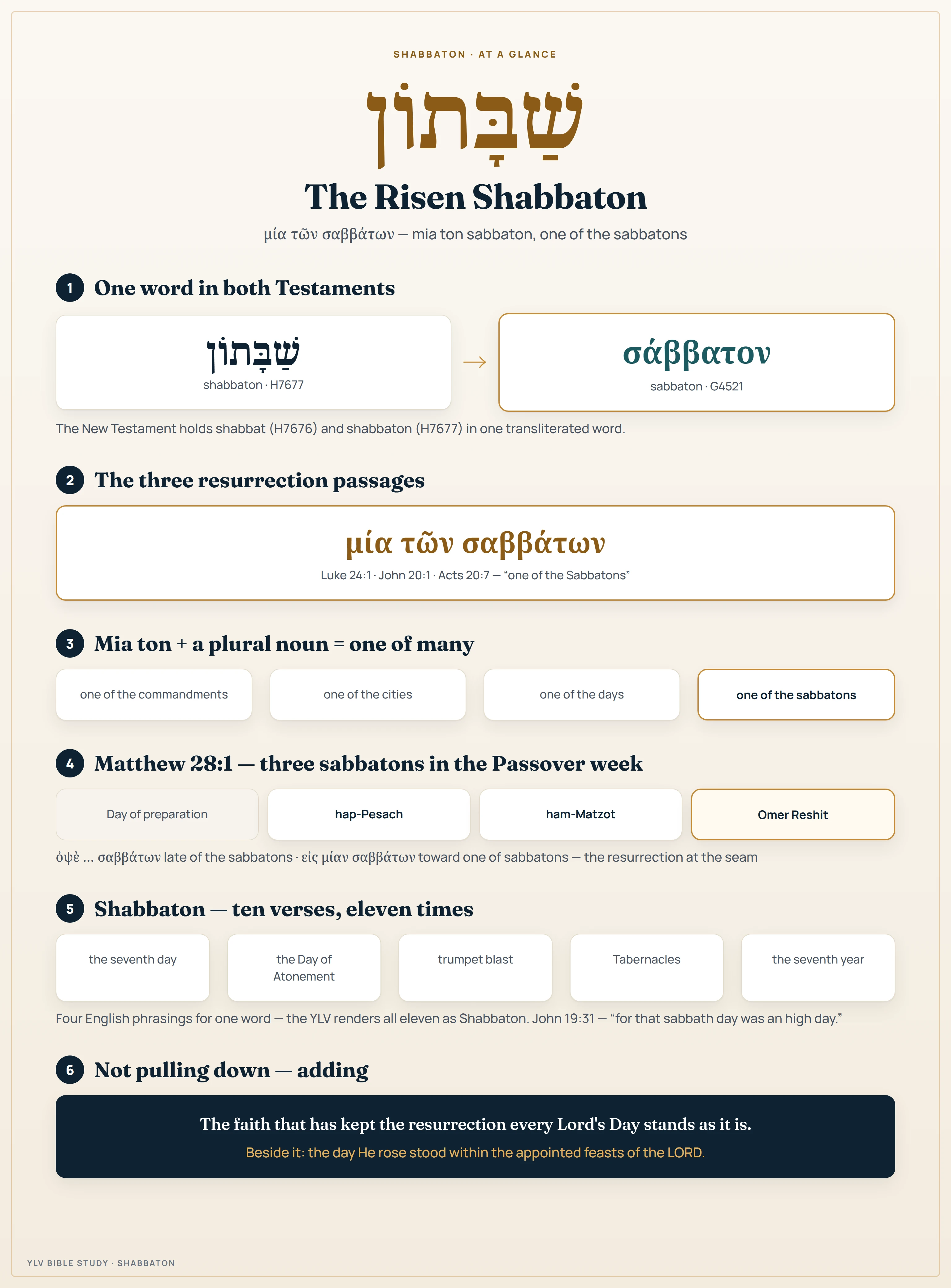
- Luke 24:1, John 20:1 and Acts 20:7 all read mia ton sabbaton (μία τῶν σαββάτων). Mia ton plus a plural noun means “one of many” — what the Greek says is “one of the sabbatons.”
- Shabbaton (שַׁבָּתוֹן, H7677) stands eleven times in ten verses — on the seventh day, the days of holy convocation and the seventh year. The New Testament carries shabbat and shabbaton over in one transliterated word, sabbaton (σάββατον, G4521).
- “The first day of the week” came out of resurrection faith and bore fruit. This study does not pull it down but adds the connection the original languages held: the day He rose stood within the appointed feasts of the LORD.
How to read this study
Every verse is quoted in full from the Yeshua Literal Version, together with the source text. The quotations are not typed by hand — they are filled in from the source JSON, so nothing is shortened or left out.
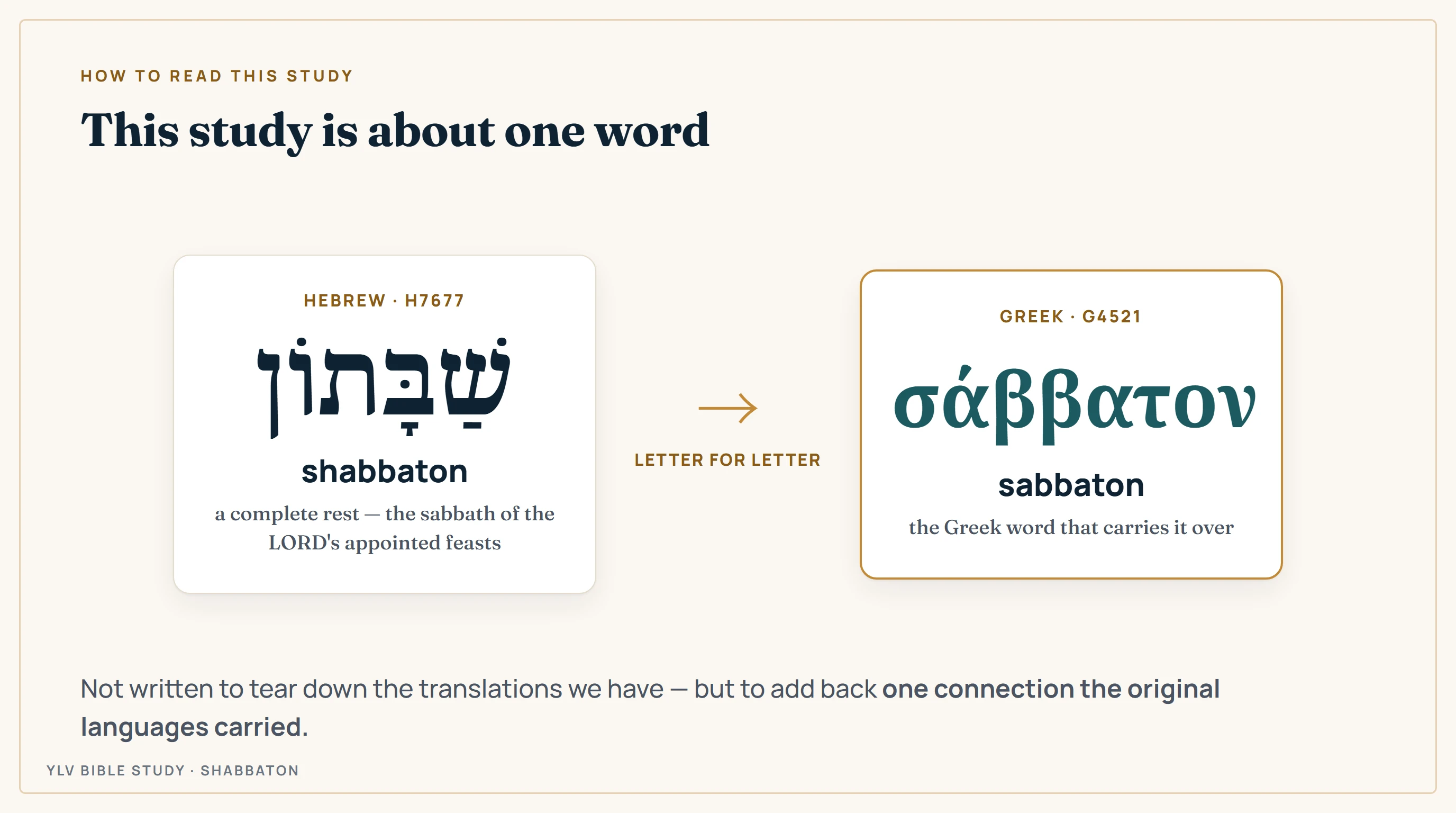
This study is about one word: the Hebrew shabbaton (שַׁבָּתוֹן, H7677) and the Greek sabbaton (σάββατον, G4521) that carries it over letter for letter.
This study is not written to tear down the translations we have. They were made with care upon resurrection faith, and their fruit has reached us. Chapter 6 says so plainly. What this study sets out to do is to add back one connection the original languages carried.
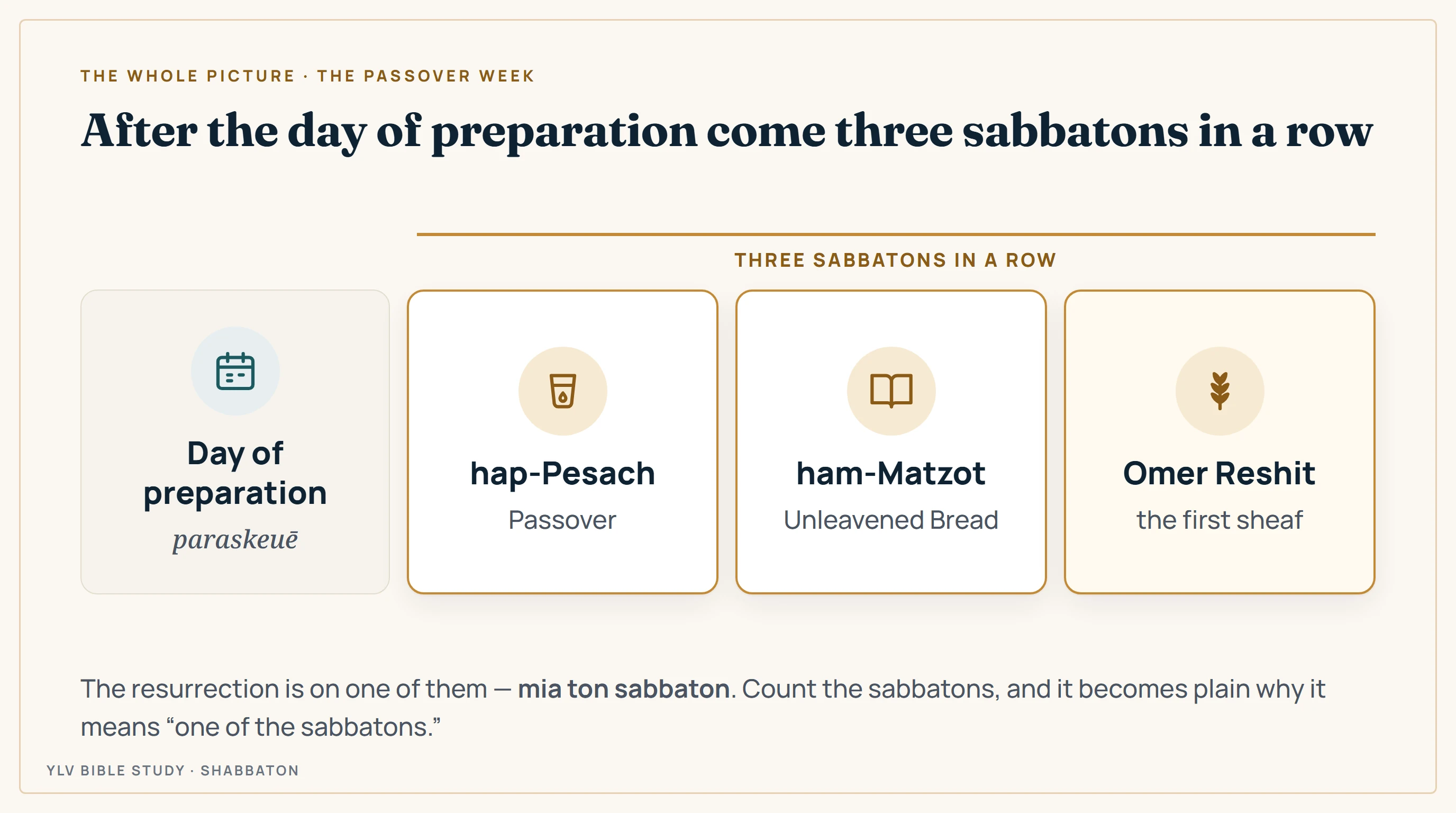
The chart below is the whole picture. Once you count how many sabbatons fall in the Passover week, it becomes plain why mia ton sabbaton means "one of the sabbatons."
1Mia ton Sabbaton — one of the sabbatons
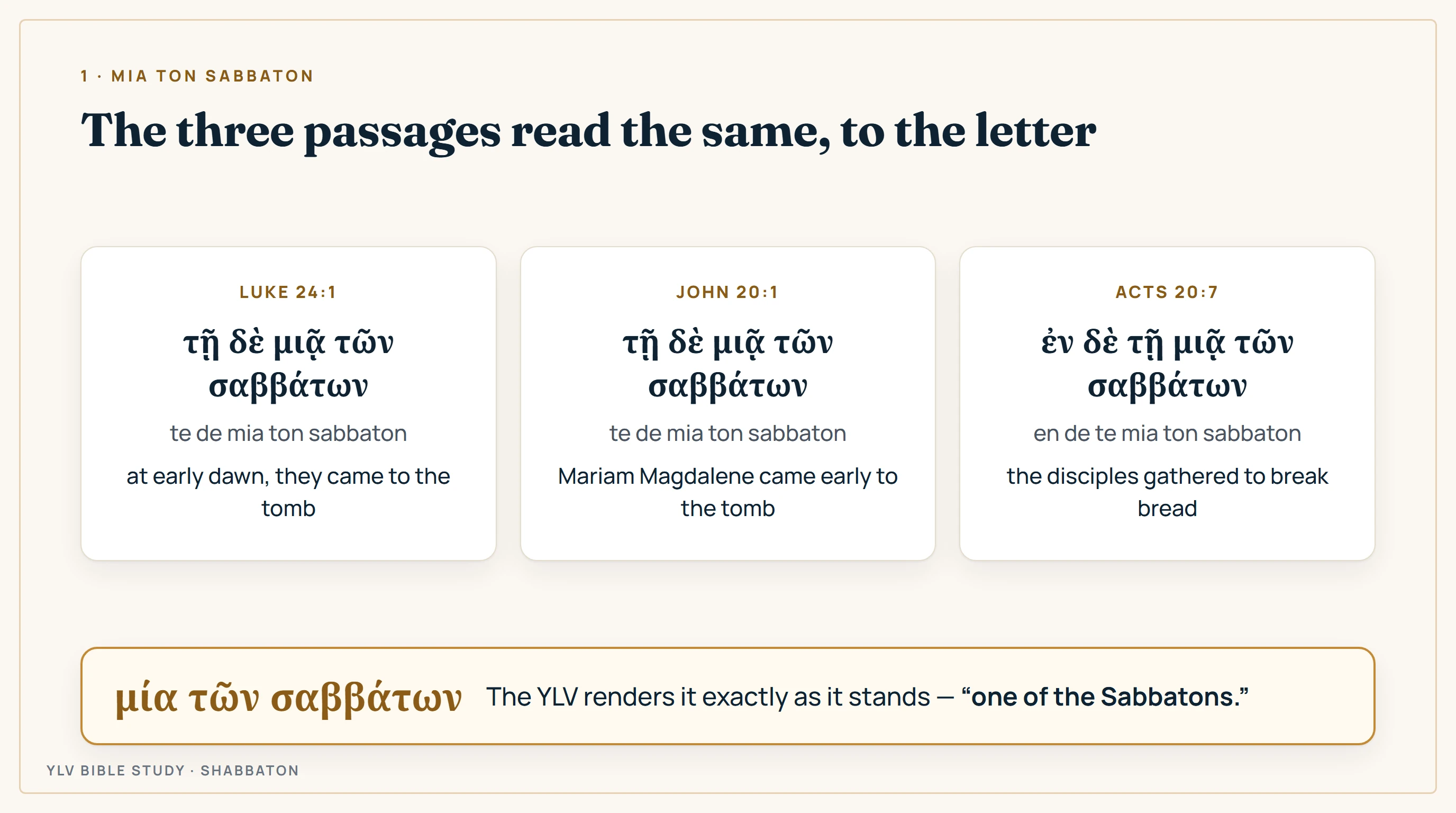
τῇ δὲ μιᾷ τῶν σαββάτων ὄρθρου βαθέος ἦλθον ἐπὶ τὸ μνῆμα φέρουσαι ἃ ἡτοίμασαν ἀρώματα καί τινες σὺν αὐταῖς
Translit.te de mia ton sabbaton
LiteralBut yet one of the Sabbatons(referring to every Moed of Leviticus 23), at early dawn, they came to the tomb bringing the spices which they had prepared, and some others with them.
τῇ δὲ μιᾷ τῶν σαββάτων Μαρία ἡ Μαγδαληνὴ ἔρχεται πρωΐ σκοτίας ἔτι οὔσης εἰς τὸ μνημεῖον καὶ βλέπει τὸν λίθον ἠρμένον ἐκ τοῦ μνημείου
Translit.te de mia ton sabbaton
LiteralBut yet one of the Sabbatons(referring to every Moed of Leviticus 23), Mariam Magdalene came early to the tomb, while it was still dark, and saw the stone already taken away from the tomb.
ἐν δὲ τῇ μιᾷ τῶν σαββάτων συνηγμένων τῶν μαθητῶν κλάσαι ἄρτον ὁ Παῦλος διελέγετο αὐτοῖς μέλλων ἐξιέναι τῇ ἐπαύριον παρέτεινέν τε τὸν λόγον μέχρι μεσονυκτίου
Translit.en de te mia ton sabbaton
LiteralIn yet the one of the sabbatons(referring to every Moed of Leviticus 23), when the disciples were gathered together to break bread, Paul began talking to them, intending to leave the next day, and he prolonged his logos(word) until midnight.
The wording is identical to the letter in all three — mia ton sabbaton.
Matthew and Mark record the same morning, and they too write sabbaton in the genitive plural. Matthew writes it twice in one verse, which the next chapter takes up.
2Matthew 28:1 — sabbaton twice in one verse
Ὀψὲ δὲ σαββάτων, τῇ ἐπιφωσκούσῃ εἰς μίαν σαββάτων, ἦλθεν Μαρία ἡ Μαγδαληνή, καὶ ἡ ἄλλη Μαρία, θεωρῆσαι τὸν τάφον
Translit.opse de sabbaton, te epiphoskouse eis mian sabbaton
LiteralOpse(the latter part of the festival period) yet sabbatons(referring to every Moed of Leviticus 23), as it began to dawn toward one sabbatons(referring to every Moed of Leviticus 23), Mary Magdalene and the other Mary came to look at the grave.
Word breakdown · Matthew 28:1
| Original | Translit. | Gloss | Parsing | Strong |
|---|---|---|---|---|
| Ὀψὲ | opse | after a long time, long after, late | Adverb | G3796 |
| σαββάτων | sabbaton | 'Sabbath (sabbaton)'. Not only the seventh day of the week, but every appointed sabbath of the LORD's feasts (moedim) — the designated days of rest and holy convocation | Noun · Genitive · Neuter Plural | G4521 |
| ἐπιφωσκούσῃ | epiphōskō | to grow light, to dawn | Verb · Present · Active · Participle · Dative · Feminine Singular | G2020 |
| εἰς | eis | into, unto, to, towards, for, among | Preposition | G1519 |
| μίαν | heis | one | Adjective · Accusative · Feminine Singular | G1520 |
| σαββάτων | sabbaton | 'Sabbath (sabbaton)'. Not only the seventh day of the week, but every appointed sabbath of the LORD's feasts (moedim) — the designated days of rest and holy convocation | Noun · Genitive · Neuter Plural | G4521 |
The two ends of one run
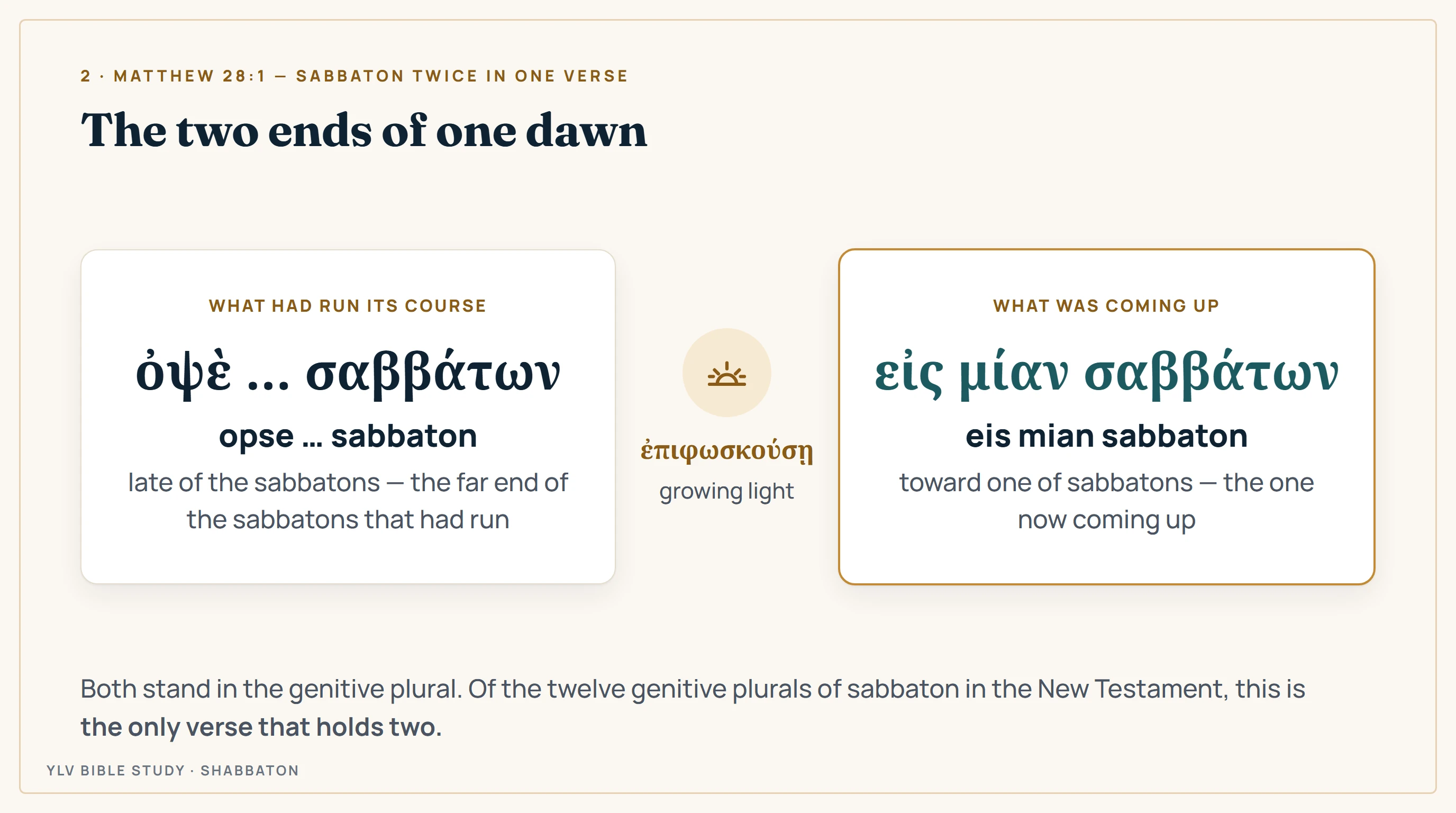
The verse is fixed at a seam. Something has run late; something else is growing light.
| Greek | Reading | Form | What it marks |
|---|---|---|---|
| ὀψὲ … σαββάτων | opse … sabbaton | adverb + genitive plural | late of the sabbatons — the far end of the sabbatons that had run |
| εἰς μίαν σαββάτων | eis mian sabbaton | preposition + accusative singular + genitive plural | toward one of sabbatons — the one now coming up |
ὀψέ (G3796) is an adverb of lateness, and what follows it stands in the genitive: *late of* something. ἐπιφωσκούσῃ (G2020) is the present participle of "to grow light" — the light coming up, not yet full. μίαν (G1520) is the accusative singular feminine of "one," and σαββάτων (G4521) behind it is again genitive plural.
So the noun on both sides of the dawn is the same noun, and on both sides it is plural. What had run late was sabbatons; what was coming up was one of sabbatons.
Read against the chart
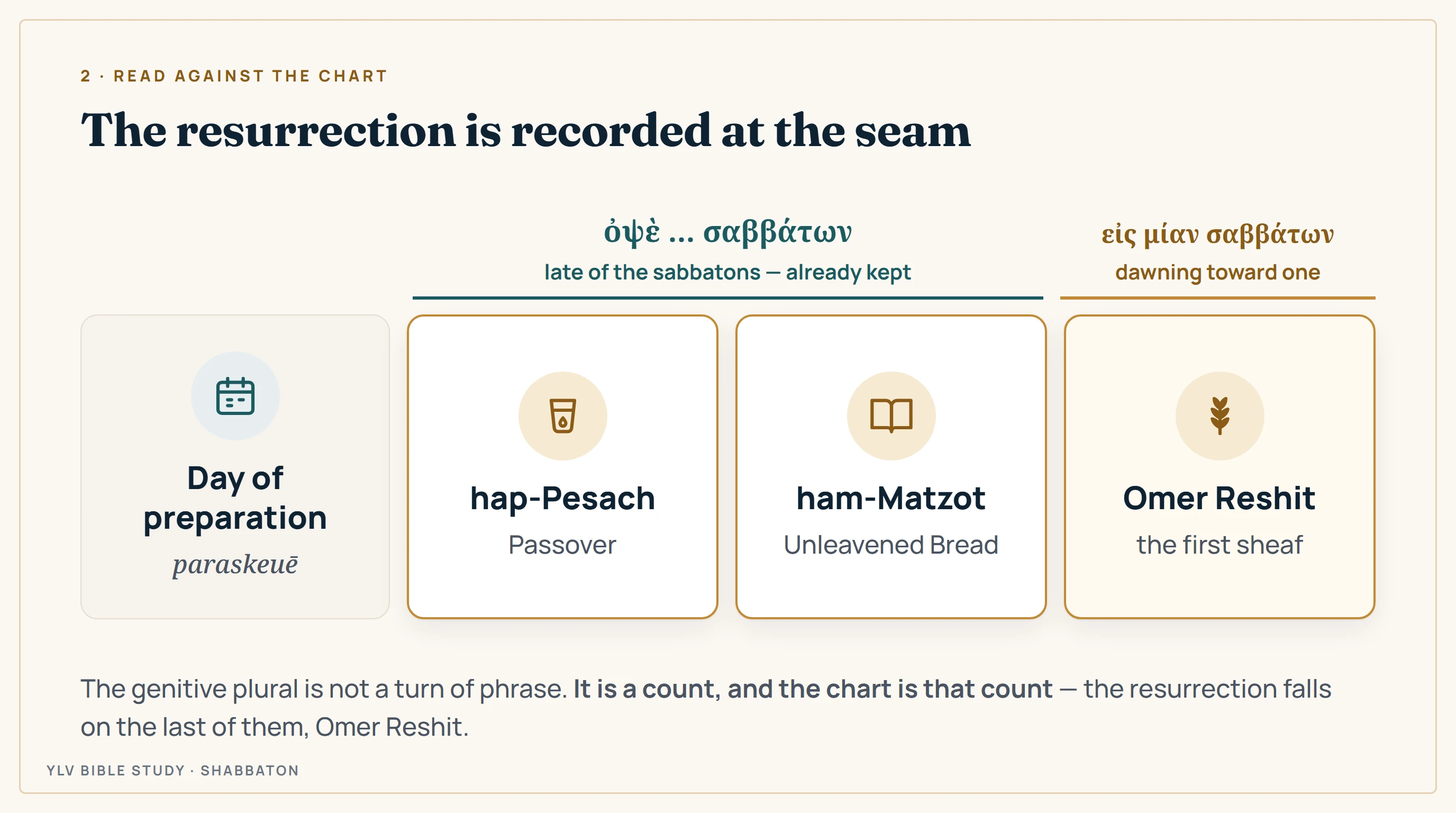
The chart at the head of this study is what makes the plural plain. In that Passover week three sabbatons stand in a row — hap-Pesach, ham-Matzot, and Omer Reshit. They are not one day but a run of days.
Set Matthew's verse on that chart and the two halves fall into place. "Late of the sabbatons" stands at the far end of the run that had already been kept. "Dawning toward one of sabbatons" points ahead to the one still coming — Omer Reshit, the first sheaf. The resurrection is recorded at the seam between them.
The genitive plural is not a turn of phrase. It is a count, and the chart is that count.
The other Gospel that carries it
Mark records the same morning with the same noun in the same case.
| Verse | YLV | Note |
|---|---|---|
| Mar 16:2 | Very early on one of the Sabbatons(referring to every Moed of Leviticus 23) they came to the tomb when the sun had risen. | tes mias sabbaton — one of sabbatons |
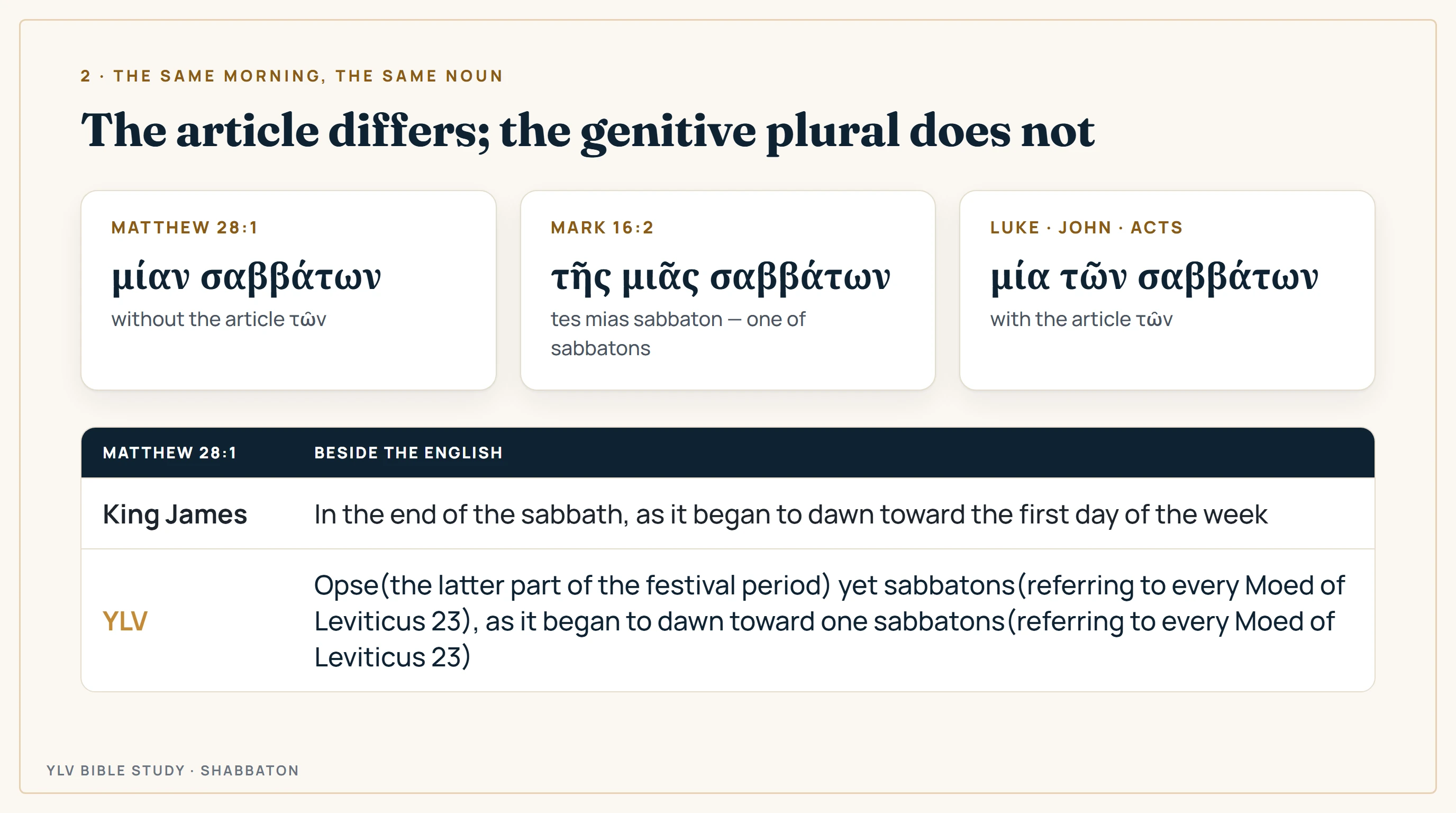
Matthew writes μίαν σαββάτων and Mark τῆς μιᾶς σαββάτων, without the article τῶν that Luke, John and Acts carry. The article differs; the genitive plural σαββάτων does not.
Beside the English
| Matthew 28:1 | |
|---|---|
| Greek | ὀψὲ δὲ σαββάτων … εἰς μίαν σαββάτων |
| King James | In the end of the sabbath, as it began to dawn toward the first day of the week |
| YLV | Opse (the latter part of the festival period) yet sabbatons, as it began to dawn toward one sabbatons |
The King James follows the reading long settled in English, and by it generations have kept the morning of the resurrection. What is set beside it here is only what the Greek numbers: sabbatons, in the plural, on both sides of that dawn.
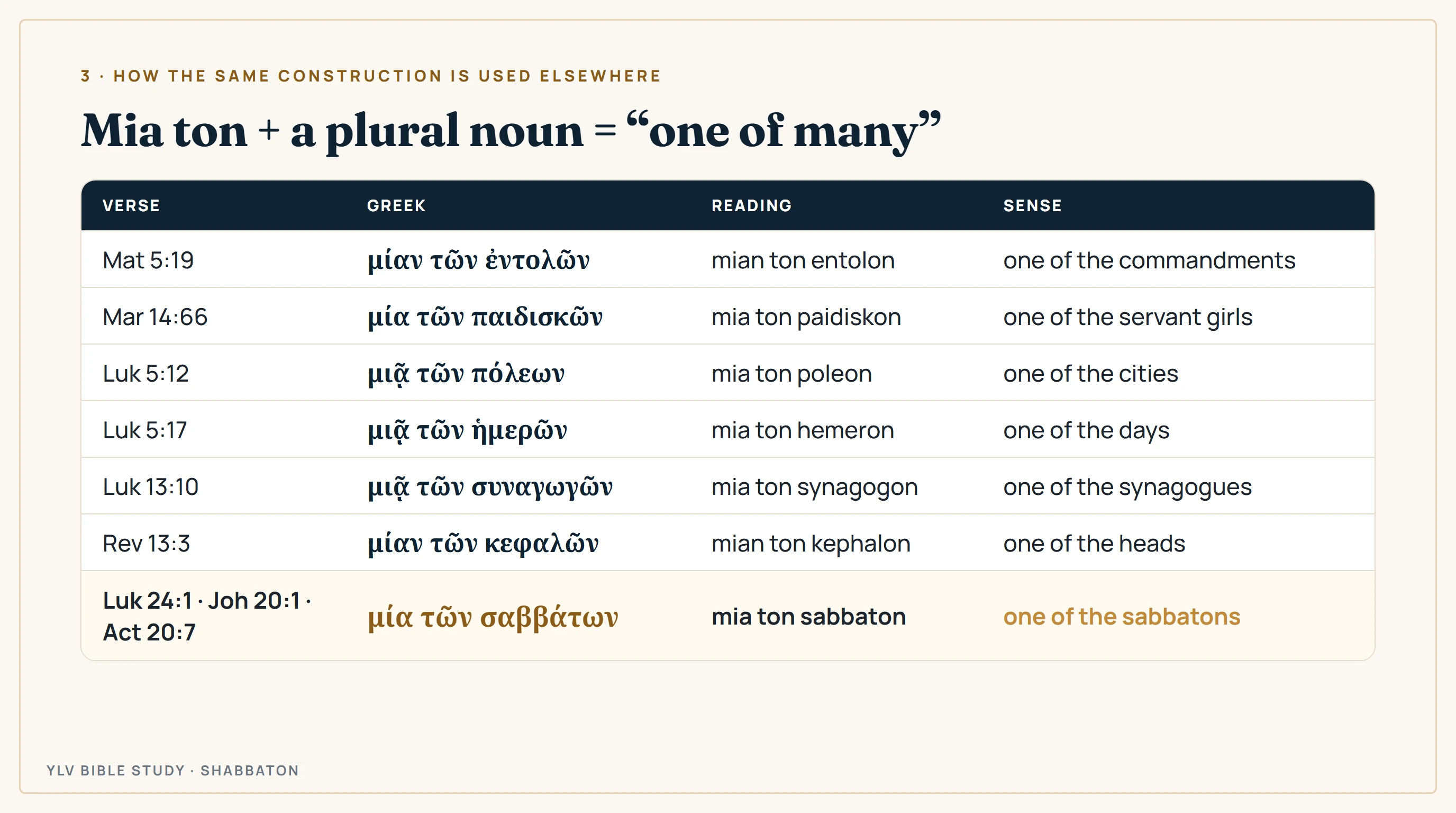
3How the same construction is used elsewhere
| Verse | YLV | Note |
|---|---|---|
| Mat 5:19 | Whoever then breaks one of the least of these commandments and teaches others to do the same will be called least in the kingdom of the heavens; but whoever keeps and teaches them will be called great in the kingdom of the heavens. | mian ton entolon — one of the commandments |
| Mar 14:66 | As Peter was below in the courtyard, one of the servant-girls of the high priest came | mia ton paidiskon — one of the servant girls |
| Luk 5:12 | And it came about that while He was in one of the cities, behold, there was a man full of leprosy; and when he saw Yeshua(Jesus), he fell on his face and begged Him, saying, "Lord, if You are willing, You can make me clean." | mia ton poleon — one of the cities |
| Luk 5:17 | And it came about that on one of those days He was teaching; and Pharisees and teachers of the nomos(law) were sitting there who had come from every village of Galilee and Judea and from Jerusalem; and the dynamis(power) of the Lord was present to heal them. | mia ton hemeron — one of the days |
| Luk 13:10 | Now He was teaching in one of the synagogues on the sabbatons(referring to every Moed of Leviticus 23). | mia ton synagogon — one of the synagogues |
| Verse | Greek | Reading | Sense |
|---|---|---|---|
| Mat 5:19 | μίαν τῶν ἐντολῶν | mian ton entolon | one of the commandments |
| Mar 14:66 | μία τῶν παιδισκῶν | mia ton paidiskon | one of the servant girls |
| Luk 5:12 | μιᾷ τῶν πόλεων | mia ton poleon | one of the cities |
| Luk 5:17 | μιᾷ τῶν ἡμερῶν | mia ton hemeron | one of the days |
| Luk 13:10 | μιᾷ τῶν συναγωγῶν | mia ton synagogon | one of the synagogues |
| Rev 13:3 | μίαν τῶν κεφαλῶν | mian ton kephalon | one of the heads |
| Luk 24:1 · Joh 20:1 · Act 20:7 | μία τῶν σαββάτων | mia ton sabbaton | one of the sabbatons |
The same family holds when the preposition ek (ἐκ) is added.
| Verse | YLV | Note |
|---|---|---|
| Rev 6:1 | And I saw when the Lamb opened one of the seven seals, and I heard one of the four living creatures saying like a voice of thunder, "Come and see." | mian ek ton sphragidon — one of the seals |
| Rev 9:13 | And the sixth angel sounded, and I heard one voice from the four horns of the golden altar before God, | mian ek ton tessaron — one of the four |
The construction used for commandments, servant girls, cities, days, synagogues, heads and seals is the very construction used for sabbatons.
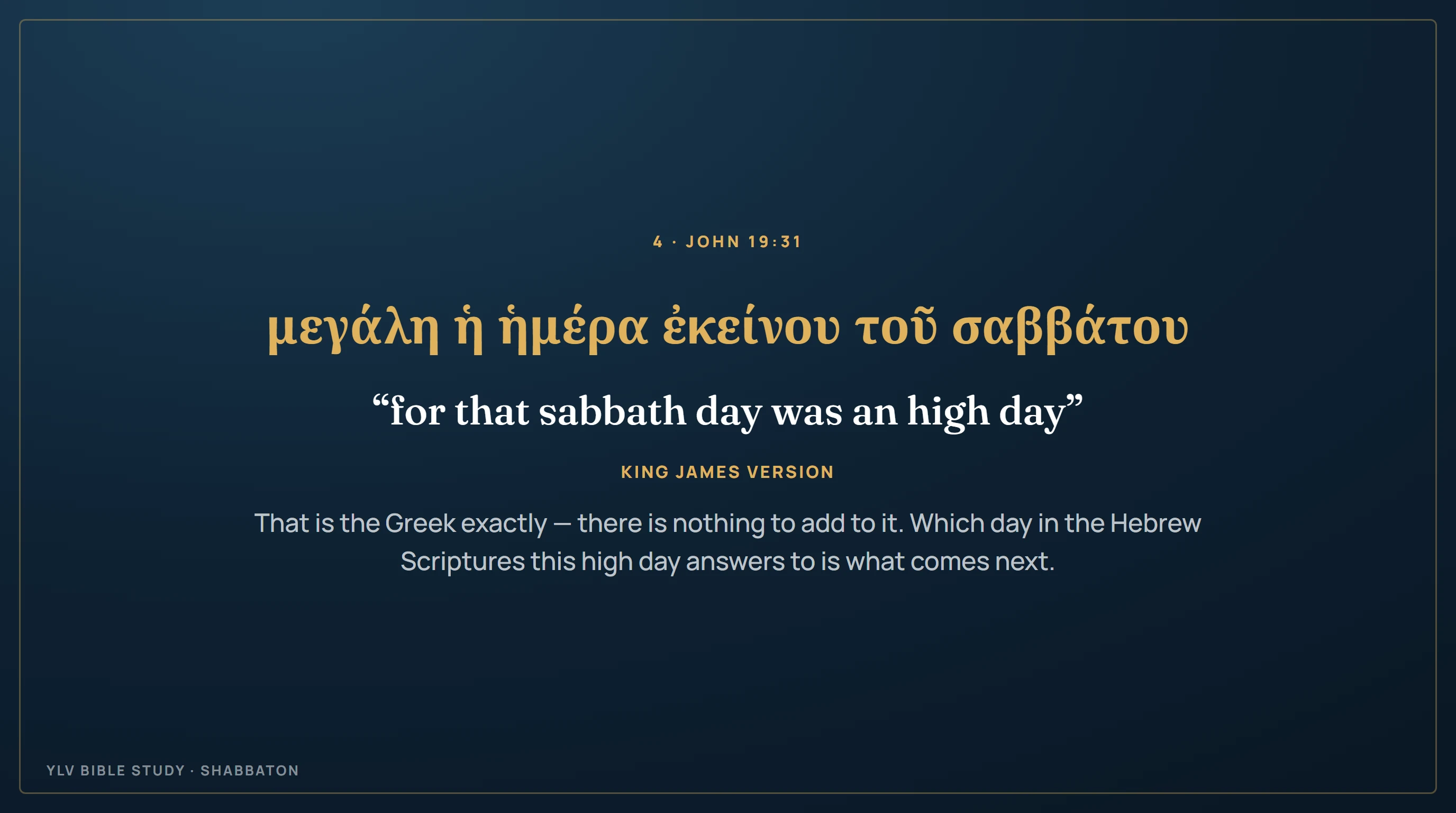
4John 19:31 — "an high day," rendered exactly
οἱ οὖν Ἰουδαῖοι ἵνα μὴ μείνῃ ἐπὶ τοῦ σταυροῦ τὰ σώματα ἐν τῷ σαββάτῳ ἐπεὶ Παρασκευὴ ἦν ἦν γὰρ μεγάλη ἡ ἡμέρα ἐκείνου τοῦ σαββάτου ἠρώτησαν τὸν Πιλάτον ἵνα κατεαγῶσιν αὐτῶν τὰ σκέλη καὶ ἀρθῶσιν
LiteralThen the Jews, because it was the day of preparation, so that the bodies would not remain on the cross on the sabbaton(referring to every Moed of Leviticus 23) 'for that sabbaton(referring to every Moed of Leviticus 23) was a high day', asked Pilate that their legs might be broken and that they might be taken away.
> KJV — The Jews therefore, because it was the preparation, that the bodies should not remain upon the cross on the sabbath day, (for that sabbath day was an high day,) besought Pilate that their legs might be broken, and that they might be taken away.
"For that sabbath day was an high day" — that is the Greek exactly. Which day in the Hebrew Scriptures this high day answers to is what the next chapter takes up.
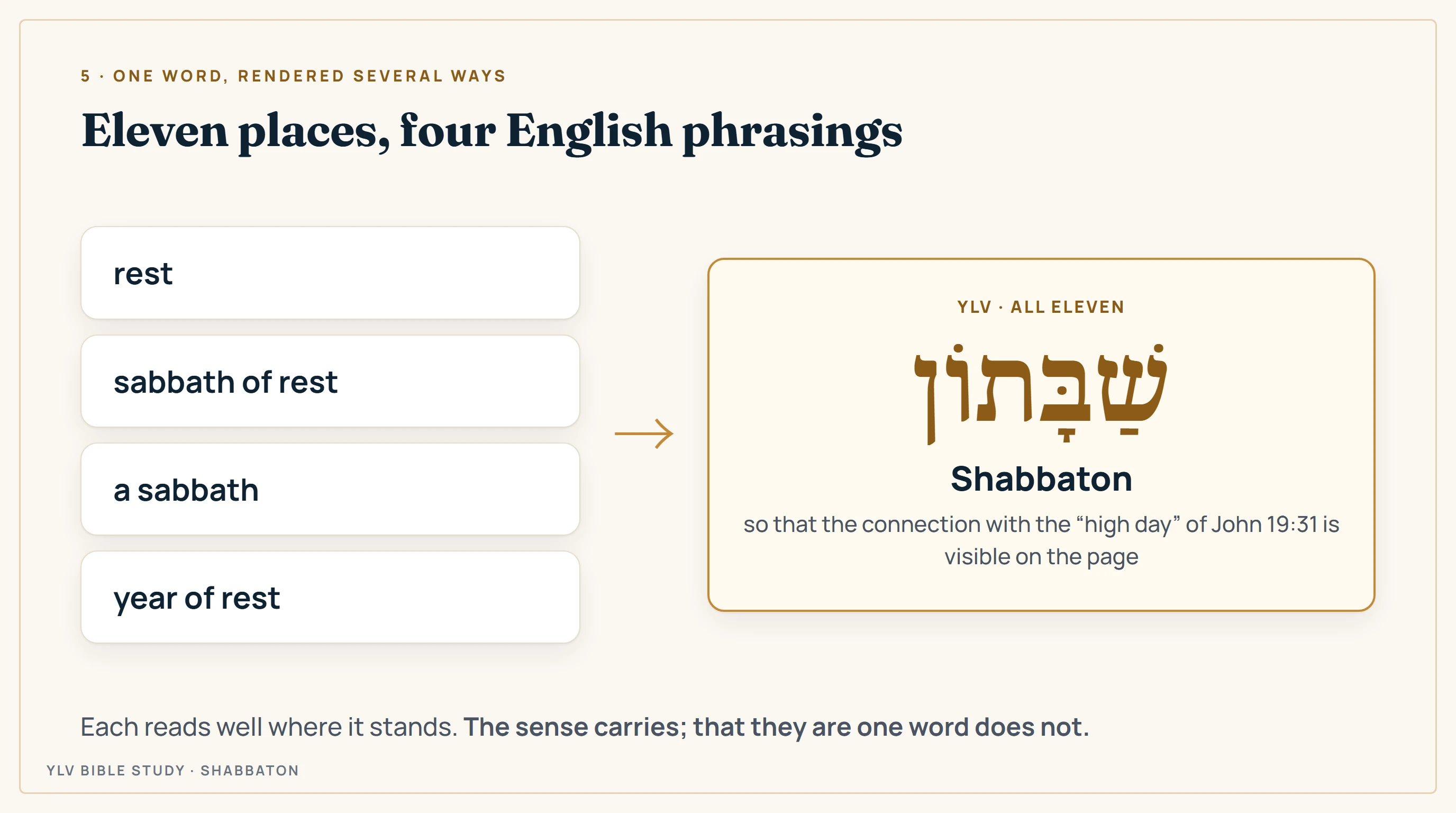
5One word, rendered several ways
| Verse | KJV | YLV |
|---|---|---|
| Exo 16:23 | the rest of the holy sabbath | a Shabbaton |
| Exo 31:15 | the sabbath of rest | a Shabbat of Shabbaton |
| Exo 35:2 | a sabbath of rest | a Shabbat of Shabbaton |
| Lev 16:31 | a sabbath of rest | a Shabbat of Shabbaton |
| Lev 23:3 | the sabbath of rest | a Shabbat of Shabbaton |
| Lev 23:24 | a sabbath | a Shabbaton |
| Lev 23:32 | a sabbath of rest | a Shabbat of Shabbaton |
| Lev 23:39 | a sabbath · a sabbath | a Shabbaton · a Shabbaton |
| Lev 25:4 | a sabbath of rest | a Shabbat of Shabbaton |
| Lev 25:5 | a year of rest | a year of Shabbaton |
One word became four English phrasings — *rest* · *sabbath of rest* · *a sabbath* · *year of rest*. Each was chosen so the sentence would read well.
Each reads well where it stands. Only, once the word is spread this way, a reader who does not look up the Hebrew has no way to see that the "high day" of John 19:31 and these eleven places are the same word. The YLV renders all eleven as Shabbaton so that the connection is visible on the page.
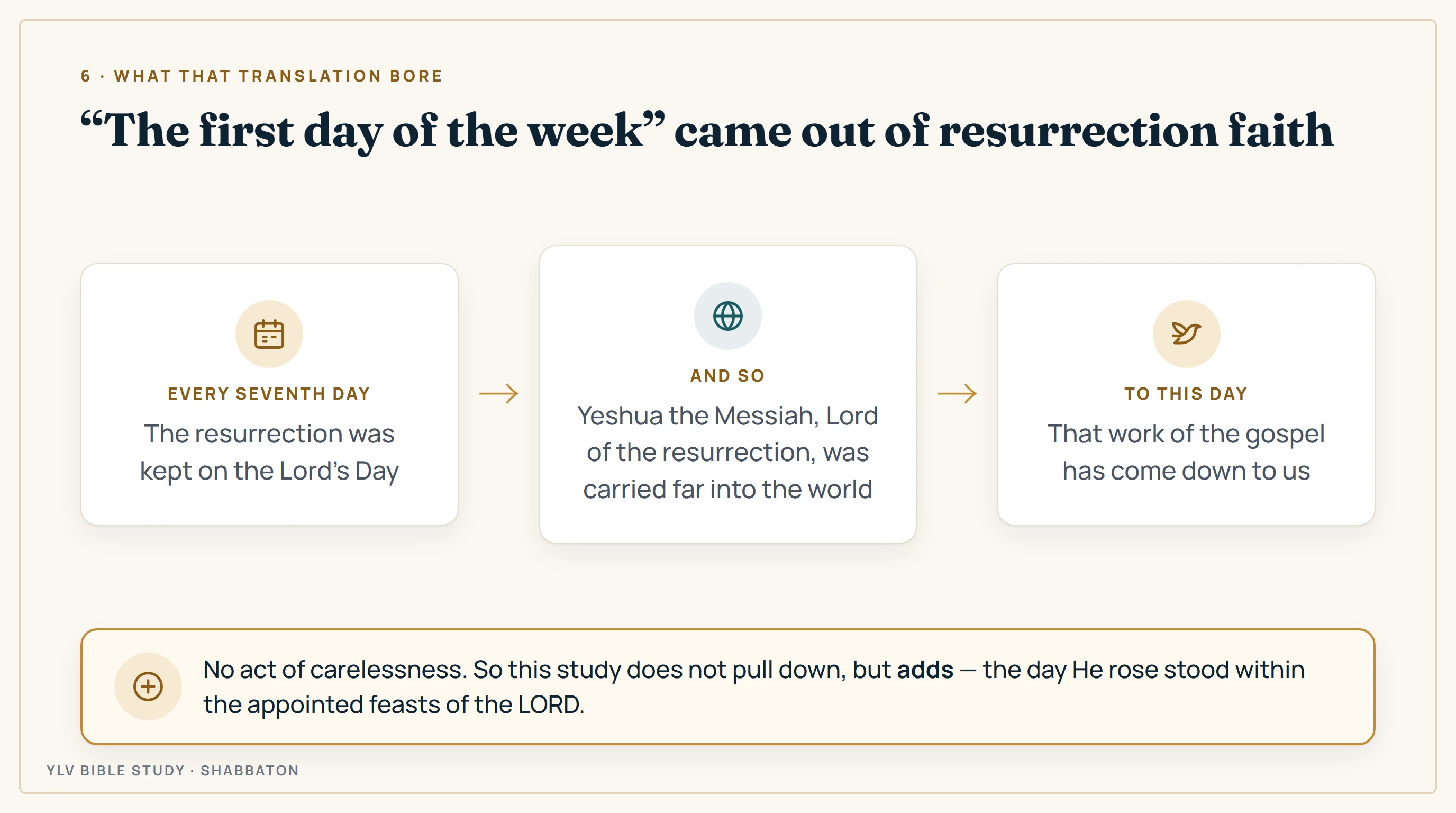
6What that translation bore
And that desire bore fruit.
| What happened | |
|---|---|
| Every seventh day | The resurrection was kept on the Lord's Day |
| And so | Yeshua the Messiah, Lord of the resurrection, was carried far into the world |
| To this day | That work of the gospel has come down to us |
This has to be granted before anything else is said. Upon that translation, which set the resurrection before believers week by week, countless people met the Messiah — and we who read this study stand among its fruit.
So what this study does is not to pull down but to add. Upon that same faith which keeps the resurrection every seven days, it sets one more connection the original languages carried: that the day He rose stood within the appointed feasts of the LORD.
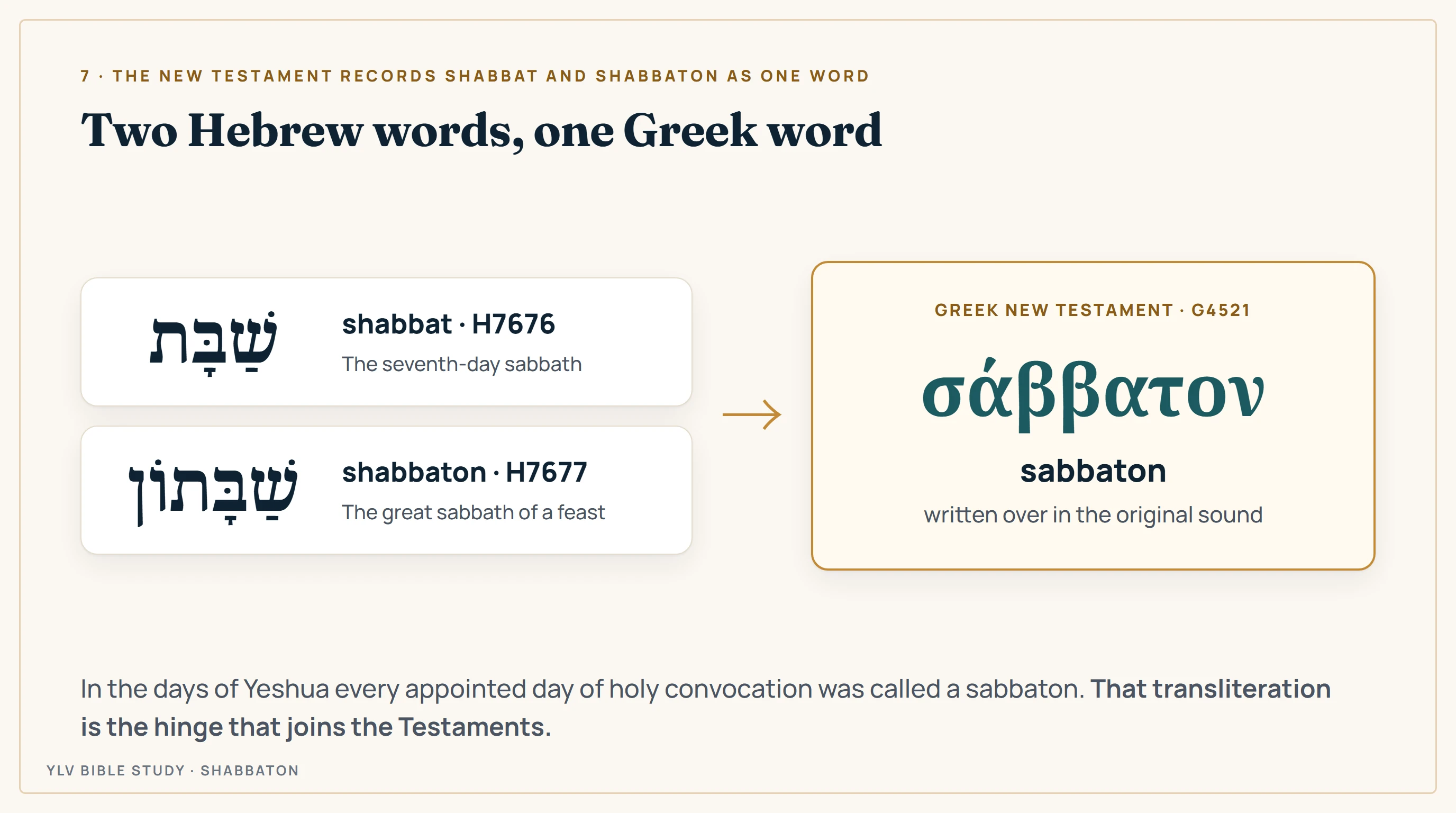
7The New Testament records shabbat and shabbaton as one word
The New Testament holds both in one word, G4521.
| Hebrew | Greek New Testament | |
|---|---|---|
| The seventh-day sabbath | שַׁבָּת shabbat (H7676) | σάββατον sabbaton (G4521) |
| The great sabbath of a feast | שַׁבָּתוֹן shabbaton (H7677) | σάββατον sabbaton (G4521) |
That the Greek did not smooth it over is the point. Because the Hebrew sound was carried across as it stood, a reader of the New Testament met the very word of the Hebrew Scriptures.
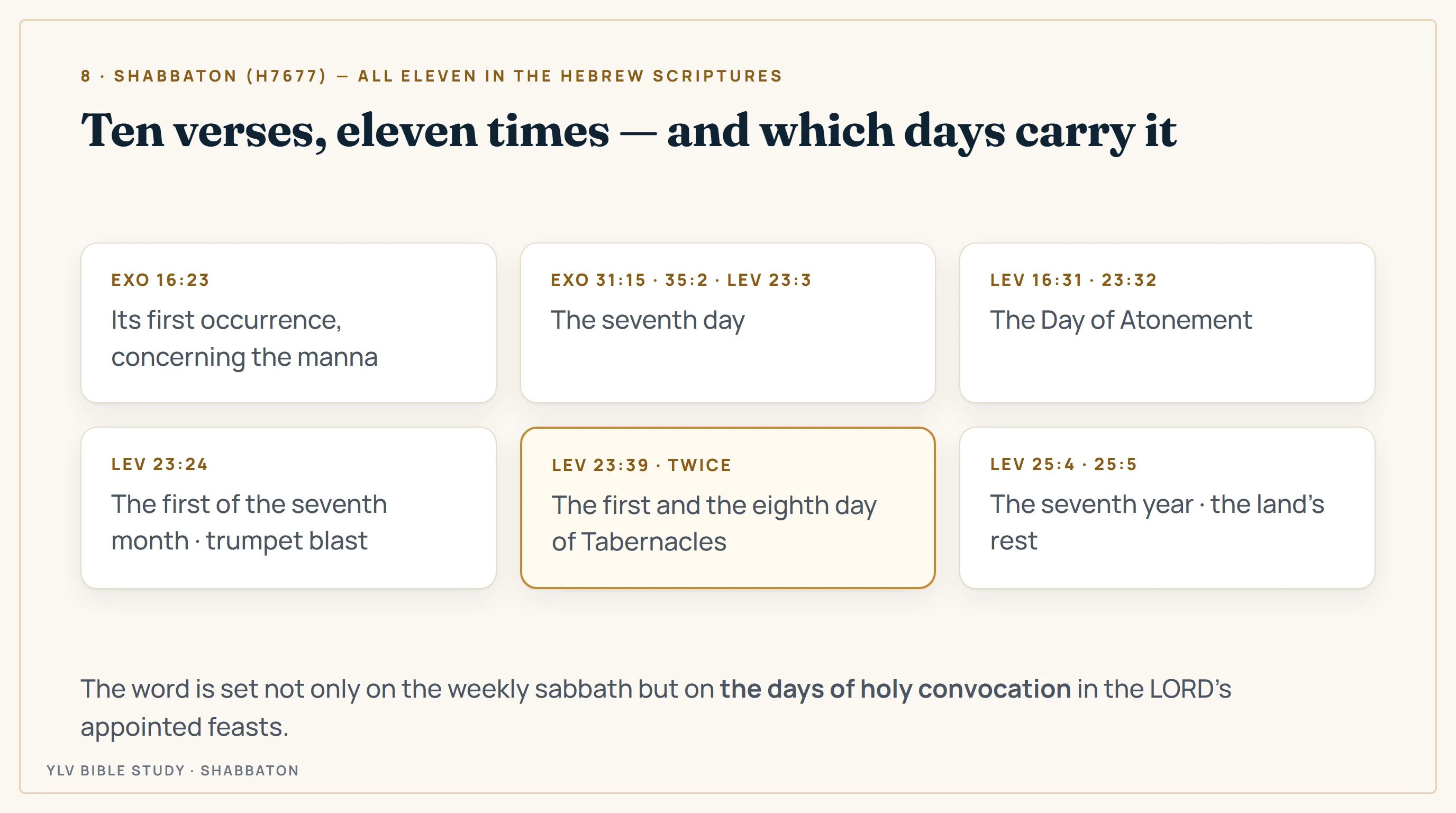
8Shabbaton (H7677) — all eleven in the Hebrew Scriptures
| Verse | YLV | Note |
|---|---|---|
| Exo 16:23 | And he said to them: "This is what YHWH has spoken: Tomorrow is a Shabbaton, a Shabbat of holiness to YHWH. What you will bake, bake, and what you will boil, boil; and all that is left over lay up for yourselves as a charge (mishmeret) until the morning." | its first occurrence, concerning the manna |
| Exo 31:15 | Six days work shall be done, but on the seventh day is a Shabbat of Shabbaton, holy to YHWH; whoever does work on the day of the Shabbat shall surely be put to death. | the seventh day |
| Exo 35:2 | Six days work shall be done, but on the seventh day there shall be for you holiness, a Shabbat of Shabbaton to YHWH; everyone doing work in it shall be put to death. | the seventh day |
| Lev 16:31 | A Shabbat of Shabbaton it is to you, and you shall afflict your souls (nephesh); it is an everlasting statute (chuqqah). | the Day of Atonement |
| Lev 23:3 | Six days work shall be done, but on the seventh day is a Shabbat of Shabbaton, a holy convocation (miqra-qodesh); any work you shall not do; it is a Shabbat to YHWH in all your dwellings. | the seventh day |
| Lev 23:24 | Speak to the sons of Israel, saying: In the seventh month, on the first of the month, shall be to you a Shabbaton, a memorial of trumpet blast, a holy convocation (miqra-qodesh). | the first of the seventh month · trumpet blast |
| Lev 23:32 | A Shabbat of Shabbaton it is to you, and you shall afflict your souls (nephesh); on the ninth of the month in the evening, from evening to evening, you shall shabbat your Shabbat. | the Day of Atonement · from evening to evening |
| Lev 23:39 | But on the fifteenth day of the seventh month, when you gather in the produce of the land, you shall keep the feast (chag) of YHWH seven days; on the first day is a Shabbaton, and on the eighth day a Shabbaton. | the first and the eighth day of Tabernacles — twice in one verse |
| Lev 25:4 | But in the seventh year shall be a Shabbat of Shabbaton for the land, a Shabbat to YHWH; your field you shall not sow, and your vineyard you shall not prune. | the seventh year · the land's rest |
| Lev 25:5 | The aftergrowth of your harvest you shall not reap, and the grapes of your untrimmed vine you shall not gather; a year of Shabbaton it shall be for the land. | a year of Shabbaton |
The days that carry shabbaton — the seventh day, the Day of Atonement, the day of trumpets, the first and eighth days of Tabernacles, and the seventh year. The word is set not only on the weekly sabbath but on the days of holy convocation in the LORD's appointed feasts.
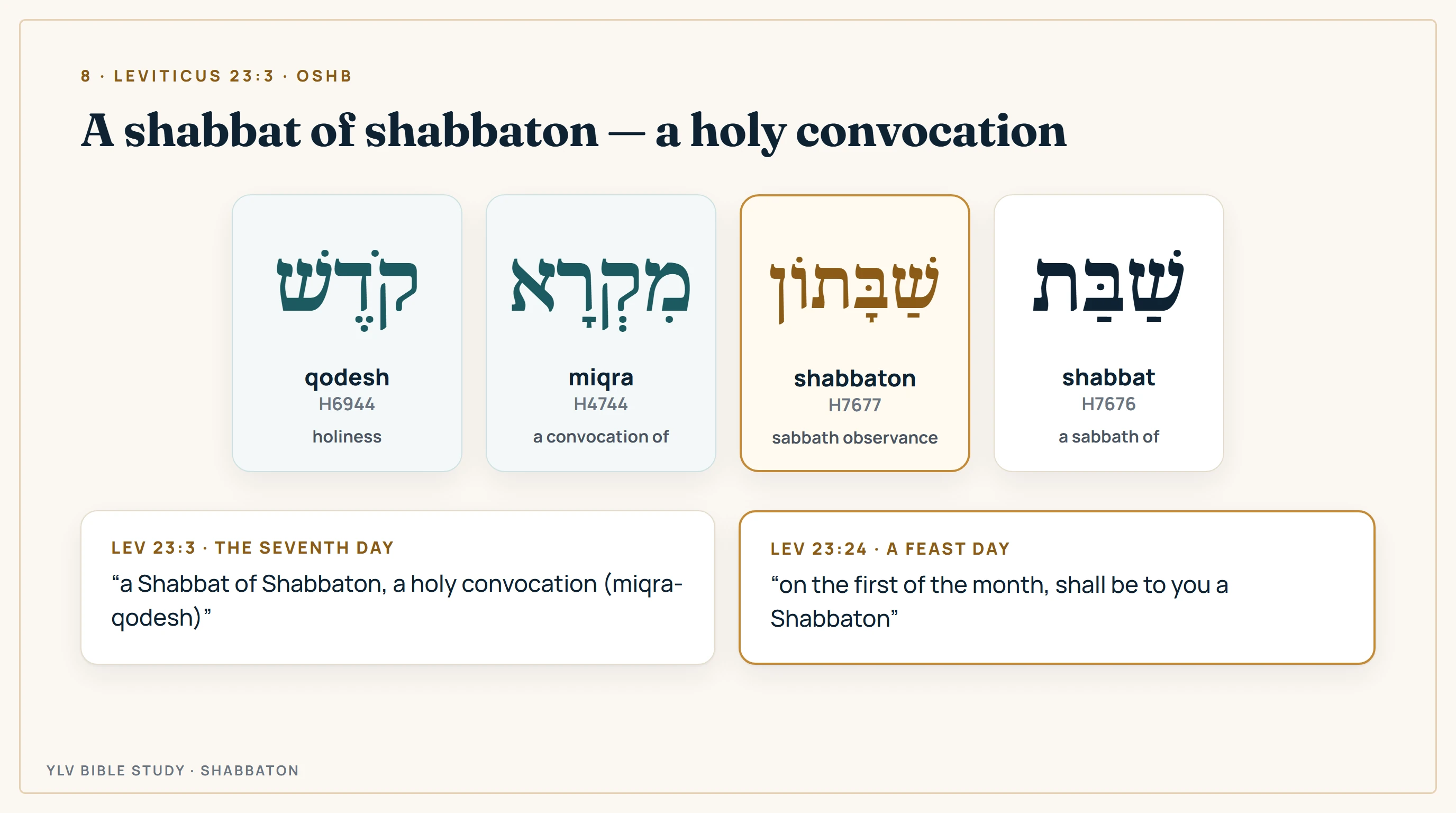
שֵׁ֣שֶׁת יָמִים֮ תֵּעָשֶׂ֣ה מְלָאכָה֒ וּבַיּ֣וֹם הַשְּׁבִיעִ֗י שַׁבַּ֤ת שַׁבָּתוֹן֙ מִקְרָא קֹ֔דֶשׁ כָּל מְלָאכָ֖ה לֹ֣א תַעֲשׂ֑וּ שַׁבָּ֥ת הִוא֙ לַֽיהוָ֔ה בְּכֹ֖ל מֽוֹשְׁבֹתֵיכֶֽם
Translit.shabbat shabbaton miqra qodesh
LiteralSix days work shall be done, but on the seventh day is a Shabbat of Shabbaton, a holy convocation (miqra-qodesh); any work you shall not do; it is a Shabbat to YHWH in all your dwellings.
Word breakdown · 레 23:3
| Original | Translit. | Gloss | Parsing | Strong |
|---|---|---|---|---|
| שַׁבַּ֤ת | shabbâth | a sabbath of | Noun · Common Singular · Construct | H7676 |
| שַׁבָּתוֹן֙ | shabbâthôn | sabbath observance | Noun · Masculine Singular · Absolute | H7677 |
| מִקְרָא | miqrâ' | a convocation of | Noun · Masculine Singular · Construct | H4744 |
| קֹ֔דֶשׁ | qôdesh | holiness | Noun · Masculine Singular · Absolute | H6944 |
Shabbat shabbaton (שַׁבַּת שַׁבָּתוֹן) — a shabbat of shabbaton, and the text at once calls it miqra qodesh (מִקְרָא קֹדֶשׁ), a holy convocation.
דַּבֵּ֛ר אֶל בְּנֵ֥י יִשְׂרָאֵ֖ל לֵאמֹ֑ר בַּחֹ֨דֶשׁ הַשְּׁבִיעִ֜י בְּאֶחָ֣ד לַחֹ֗דֶשׁ יִהְיֶ֤ה לָכֶם֙ שַׁבָּת֔וֹן זִכְר֥וֹן תְּרוּעָ֖ה מִקְרָא קֹֽדֶשׁ
LiteralSpeak to the sons of Israel, saying: In the seventh month, on the first of the month, shall be to you a Shabbaton, a memorial of trumpet blast, a holy convocation (miqra-qodesh).
The first day of the seventh month is a shabbaton. Here it can be seen that the word is set on a feast day, not on the weekly sabbath.
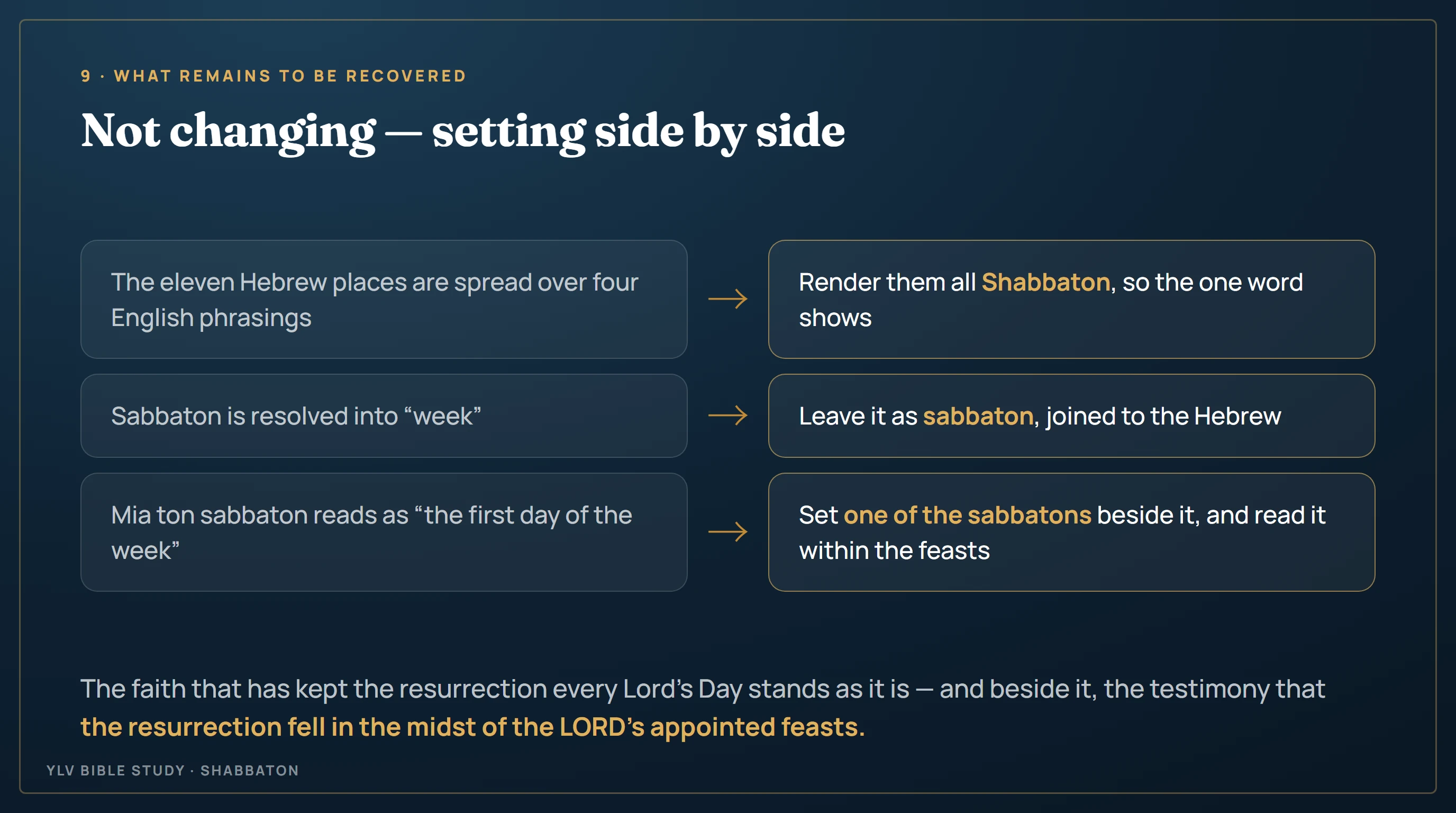
9What remains to be recovered
| As it stands | What may be added |
|---|---|
| The eleven Hebrew places are spread over four English phrasings | Render them all Shabbaton, so the one word shows |
| Sabbaton is resolved into "week" | Leave it as sabbaton, joined to the Hebrew |
| Mia ton sabbaton reads as "the first day of the week" | Set one of the sabbatons beside it, and read it within the feasts |
All three are not a matter of changing but of setting side by side. The faith that has kept the resurrection every Lord's Day stands as it is, and the testimony of the original languages — that the resurrection fell in the midst of the LORD's appointed feasts — is set alongside it.
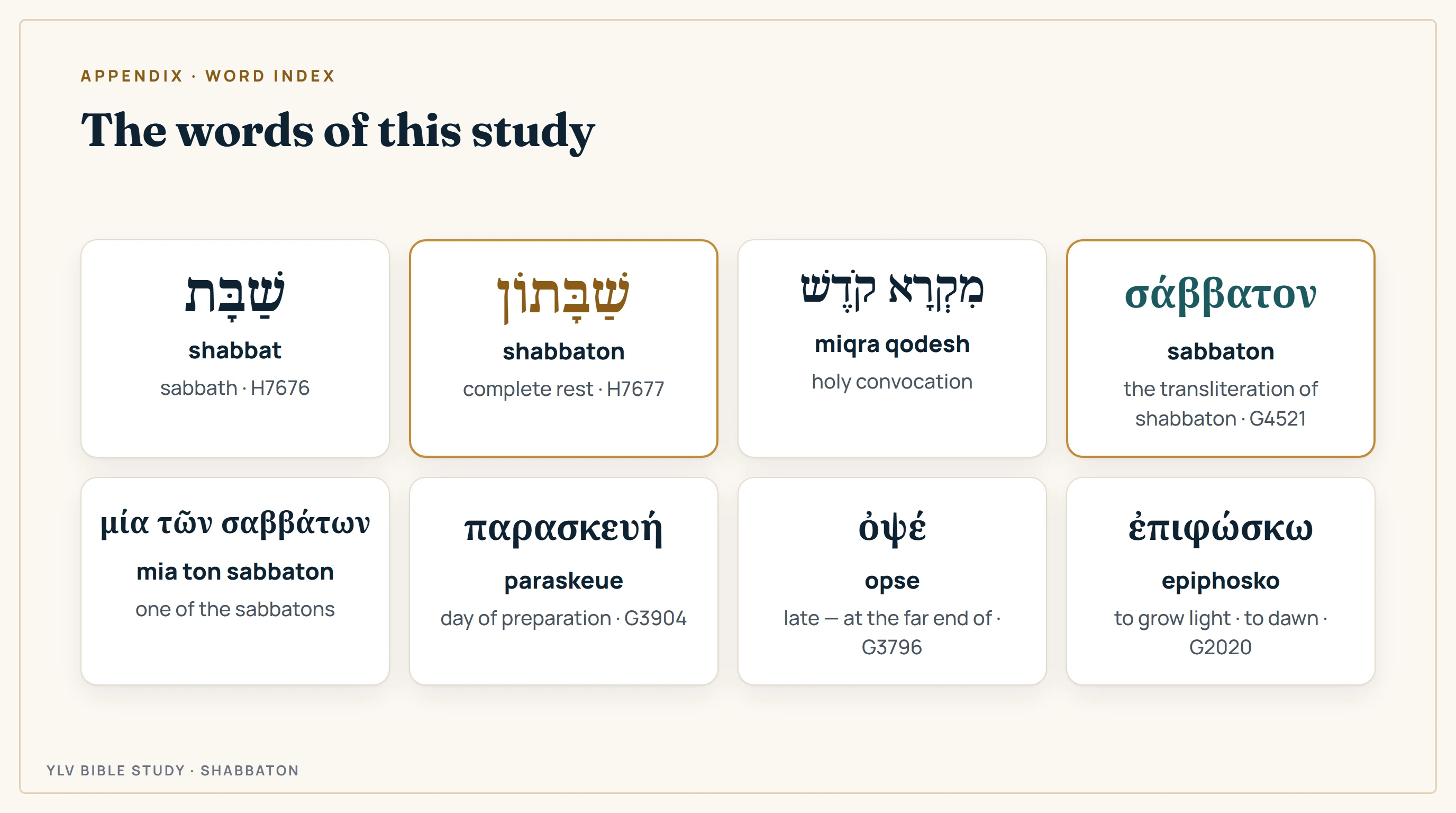
Appendix — Word index
| Word | Reading | Sense | Number | In Scripture | Chapters |
|---|---|---|---|---|---|
| שַׁבָּת | shabbat | sabbath | H7676 | — | 7 · 8 |
| שַׁבָּתוֹן | shabbaton | complete rest · sabbath of a holy convocation | H7677 | 11× / 10 verses | 5 · 7 · 8 |
| מִקְרָא קֹדֶשׁ | miqra qodesh | holy convocation | H4744 · H6944 | — | 8 |
| σάββατον | sabbaton | sabbath · the transliteration of shabbaton | G4521 | — | 1 · 2 · 4 · 7 |
| μία τῶν σαββάτων | mia ton sabbaton | one of the sabbatons | — | Luk 24:1 · Joh 20:1 · Act 20:7 | 1 · 3 |
| παρασκευή | paraskeue | day of preparation | G3904 | — | 4 |
| ὀψέ | opse | late — late of, at the far end of | G3796 | Mat 28:1 | 2 |
| ἐπιφώσκω | epiphosko | to grow light · to dawn | G2020 | Mat 28:1 | 2 |
This study traces one word — shabbaton (H7677) in the Hebrew and sabbaton (G4521) in the Greek. Quotations are from the Yeshua Literal Version; the source texts are OSHB v2.2 (Westminster Leningrad Codex) for the Old Testament and RP2018 for the New, filled in by machine. English comparison readings are from the King James Version (public domain). Chart ⓒ 2024 Ecclesia Corp.
At a glance