 BIBLE HOMES
Bible Study · Yeshua Study, Part Three
What Did Jacob Wait For?
Genesis 49:18 and the first Yeshuah in Scripture“O YHVH, I have waited for Your salvation (Yeshuah).”
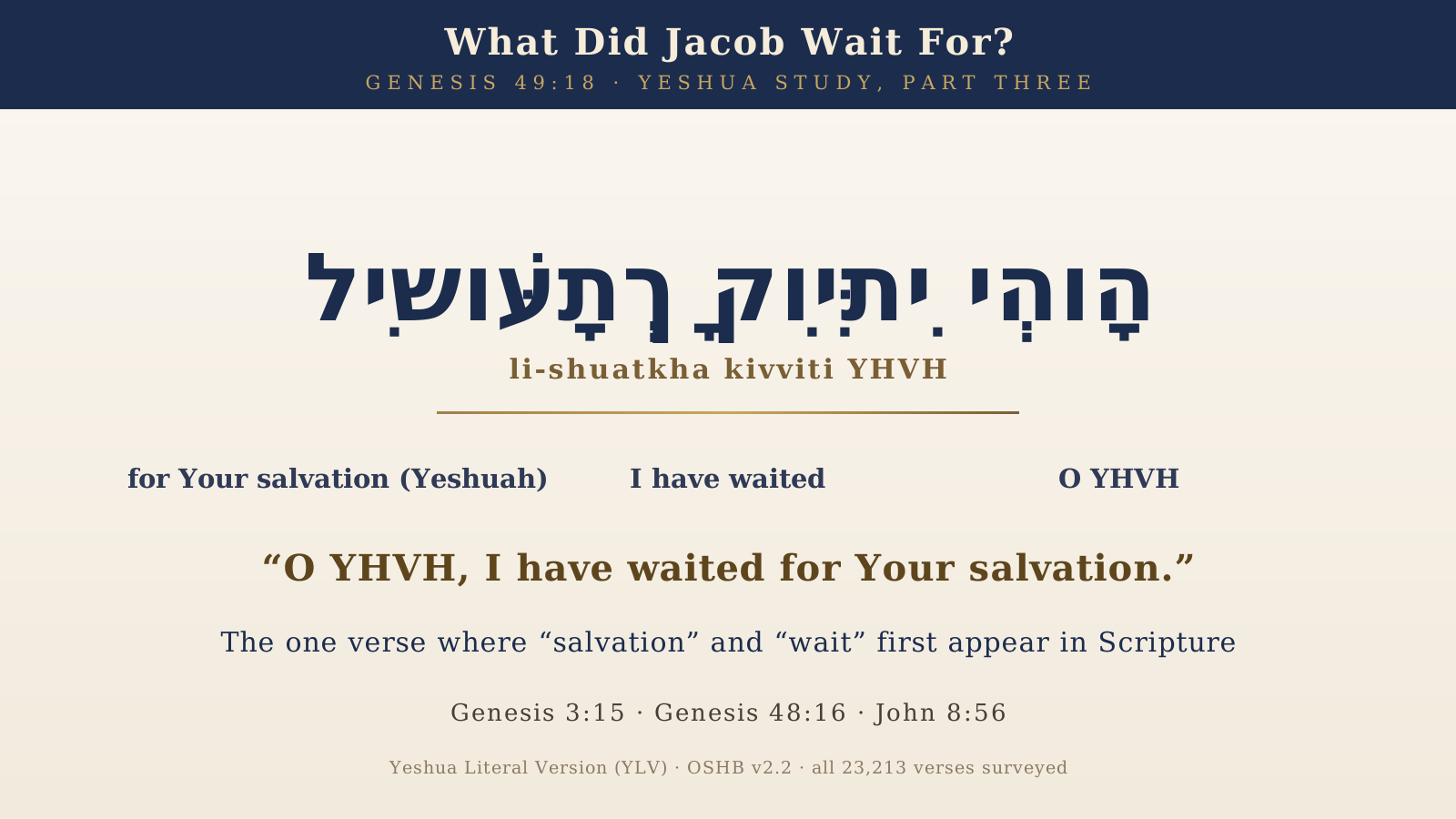
Hebrew source · OSHB v2.2 (Westminster Leningrad Codex) · Transliteration · YLV Rulebook V69
Introduction — The Problem of Three Words
Genesis 49 records Jacob's final words to his twelve sons. Right in the middle of them — between the prophecy about Dan and the prophecy about Gad — a single line breaks in that appears to have nothing to do with its context. It is just three words in Hebrew, and it is the only place where Jacob speaks about himself.
Genesis 49:18O YHVH, I have waited for Your salvation (Yeshuah).
לִישׁוּעָתְךָ קִוִּיתִי יְהוָה
The verse raises two questions. First, why does an old man in the middle of blessing his sons suddenly turn to speak of himself? Second, at a point when neither Torah nor tabernacle nor sacrifice had yet been given, on what basis could Jacob say that he had “waited for salvation”?
This study approaches those questions through the vocabulary of the text — not through Jacob's psychology or later theology. A survey of all 23,213 verses of OSHB v2.2 shows that these three words, and the verse immediately before them, are linked at the level of vocabulary to Genesis 3 and to Jacob's own life. Those links are set out here in order.
Every Hebrew word quoted is given with its transliteration and meaning and broken down morpheme by morpheme, so the argument can be followed with no prior knowledge of Hebrew. Transliteration follows YLV Rulebook V69, and the morphological analysis quotes OSHB tags exactly as they stand.
1The Three Words Broken Down
First, what the verse actually says, word by word. The Hebrew has three words, in the order “for Your salvation — I have waited — O YHVH.”
Two things the verb reveals
First, it is a perfect. Kivviti points to an action already carried out. It is not “from now on I will wait,” but “I have been waiting” — a dying man summing up his entire life in a single verb. Second, it is a Piel (intensive). The intensive stem is used rather than the basic Qal, indicating not a vague expectation but a waiting he never let go of to the end.
In the middle of speaking about his sons' future, Jacob states his entire past in one sentence. There are only four places in Genesis 49 where Jacob uses a first person singular verb, and within the body of the blessings, verse 18 is the only one.
2Two Words That Appear Here for the First Time in Scripture
Two of these three words appear here for the first time in the whole Bible. This is the result of a full survey in canonical order.
| Word | Meaning | Total in OT | First occurrence |
|---|---|---|---|
| Yeshuah (H3444) | salvation | 77× | Gen 49:18 |
| qavah (H6960) | to wait · to hope | — | Gen 49:18 |
| YHVH (H3068) | the name of God | 6,521× | Gen 2:4 |
That is: the place where the word “salvation” and the word “wait” first appear in Scripture is one and the same verse, and that verse is Jacob's last word. From the very start the two words appear paired within a single sentence.
The later uses of Yeshuah show the weight of this first appearance. The second occurrence is Exodus 14:13, where Moses cries out before the Sea of Reeds, “See the salvation (Yeshuah) of YHVH”; the third is Exodus 15:2, the song after crossing the sea, confessing “Yah has become salvation (Yeshuah) to me.”
| Order | Verse | Setting |
|---|---|---|
| 1 | Gen 49:18 | Jacob's last words — I have waited for Your salvation |
| 2 | Ex 14:13 | Before the Sea of Reeds — See the salvation of YHVH |
| 3 | Ex 15:2 | After crossing the sea — Yah has become salvation to me |
The word “salvation” does not begin with the exodus. It first comes from the mouth of one old man a generation earlier, who had not yet even settled in Egypt.
And that first use is not an eyewitness report of an event but a confession of waiting. Jacob opens this word not as a man who had seen salvation, but as a man who had waited for it.
3The Verse Just Before — the Serpent and the Heel
Why verse 18 stands where it does looks different once verse 17 is read. The vocabulary of the sentence Jacob had just spoken about Dan is decisive.
Genesis 49:17 — the prophecy concerning DanDan shall be a serpent (nachash) by the way, a viper by the path, that bites the heels (aqev) of the horse, so that its rider falls backward.
יְהִי דָן נָחָשׁ עֲלֵי דֶרֶךְ שְׁפִיפֹן עֲלֵי אֹרַח הַנֹּשֵׁךְ עִקְּבֵי סוּס
| Hebrew | Translit. | Meaning | Note |
|---|---|---|---|
| נָחָשׁ | nachash | serpent (H5175) | The same word as the serpent of Gen 3:1 |
| עִקְּבֵי | iqqevei | the heels of… (H6119) | The stem aqev + plural construct ending |
A full survey shows that the only place in the whole Old Testament where these two words occur together in a single verse is Genesis 49:17 — and the scene where that combination first appeared is Genesis 3.
Genesis 3:15 — a verse fixed by Rulebook §12.7…and between your seed and Seed-H(Seed of YHWH) (Zarah) — He shall bruise your head, and you shall bruise His heel (aqev)
The two words of Genesis 3 come back to life, unchanged, in Genesis 49:17.
| Verse | Serpent · heel | Content |
|---|---|---|
| Gen 3:14–15 | נָחָשׁ · עָקֵב | The serpent bruises His heel — the promise |
| Gen 49:17 | נָחָשׁ · עָקֵב | A serpent bites the heel — the only verse holding both |
| Gen 49:18 | — | O YHVH, I have waited for Your salvation (Yeshuah) |
nachash = serpent · aqev = heel
Jacob describes a serpent biting a heel, and in the very next breath says that he has waited for salvation. The promise of Genesis 3:15 spoke of a bruised heel and a bruised head together. The moment he put the biting of the heel into words, he can be read as having turned toward the other half of that promise.
4The Name Jacob Itself
There is one more layer here. Aqev, the word for heel, is the word that makes up Jacob's own name.
Genesis 25:26And afterward his brother came out, with his hand holding Esau's heel (aqev); so his name was called Jacob (Yaaqov).
וְיָדוֹ אֹחֶזֶת בַּעֲקֵב עֵשָׂו וַיִּקְרָא שְׁמוֹ יַעֲקֹב
The name followed Jacob all his life. After losing the birthright, Esau says, “Is he not rightly named Jacob? For he has supplanted me these two times” (Gen 27:36) — and the verb rendered “supplanted,” עָקַב aqav, shares a root with aqev. Aqev occurs only 13 times in the whole Old Testament, and four of those are in Genesis.
| Verse | Content |
|---|---|
| Gen 3:15 | The serpent shall bruise His heel — the promise |
| Gen 25:26 | He grasped Esau's heel, so he was called Jacob — the name |
| Gen 49:17 | A serpent bites the horse's heel — the last words |
| Gen 49:19 | The final word of the prophecy about Gad is also “heel” |
Jacob is the man of the heel. He was born grasping a heel and was named for it, he supplanted his brother just as that name said, and he carried the name all his life.
And in Genesis 3:15 the heel is precisely what was appointed to be bitten by the serpent. Jacob names the very point his own name marks as the place of bruising — and confesses that it was there that he waited for salvation.
5What Jacob Learned Over a Lifetime
Which returns us to the question raised in the introduction. In an age with no Torah and no tabernacle, on what basis did Jacob know salvation? The text leaves the answer within his own life.
① He inherited the promise
The promise of Genesis 3:15 was given to Adam, and Jacob stands as the one who received that promise through Abraham and Isaac. His own prophecy concerning Judah says as much: “The scepter shall not depart from Judah… until Shiloh comes” (Gen 49:10).
② He experienced having his name changed
At the ford of the Jabbok he receives a new name — “Your name shall no longer be called Jacob, but Israel” (Gen 32:29). It is the event in which the one who grasped a heel became the one who wrestled and prevailed, and Jacob understood it as something received rather than achieved by his own strength.
③ He knew the Redeemer
In the chapter immediately before the blessings, Jacob calls God by this name.
Genesis 48:16The Angel who has redeemed me (goel) from all evil — may He bless these boys.
הַמַּלְאָךְ הַגֹּאֵל אֹתִי מִכָּל רָע
This is the first place the word goel appears in Scripture (the second is Ex 6:6). That is, the two words “redeemer” and “salvation” both make their first appearance in Scripture in Jacob's final two chapters.
| Word | Meaning | First occurrence | Speaker |
|---|---|---|---|
| goel (H1350) | the One who redeems | Gen 48:16 | Jacob |
| Yeshuah (H3444) | salvation | Gen 49:18 | Jacob |
Jacob knew it not through an institution or a document but through his own life. He knew to call the One who delivered him from evil his goel, and he handed that language on to his sons. The vocabulary of salvation begins with Jacob — not because he invented the words, but because he needed names for what he had lived through.
6What He Was Waiting For
The last question to ask is whether what Jacob waited for was an event or a person. The grammar of the text has something to say about this.
Li-shuatkha means “Your salvation,” carrying a second person suffix. Jacob says he waited not for salvation in the abstract but for the salvation that belongs to YHVH. And the sentence ends by calling on YHVH by name. The salvation and the One to whom that salvation belongs stand within a single breath.
As Part Two established, Yeshuah is a word that appears in the text in apposition with God Himself.
Isaiah 12:2Behold, God (El) is my salvation (Yeshuah); I will trust and not be afraid — for Yah YHVH is my strength and song, and He has become salvation (Yeshuah) to me.
Here God is not the One who gives salvation but is salvation. The same structure appears in Exodus 15:2 and Psalm 118:14 — the three places in the whole Old Testament where Yah and Yeshuah stand in the same verse.
Read in that light, Jacob's sentence says that what he waited for was not some event that would befall his descendants, but the salvation belonging to YHVH itself — inseparable from the seed (Zarah) that the promise of Genesis 3:15 pointed to. And in Genesis 3:15 the pronoun that takes up that seed is the masculine הוּא hu.
What Jacob waited for was not an improvement in his circumstances. As he lay dying, in the middle of speaking to his sons about land and prosperity, he makes clear that this was not what he had waited for all his life.
What he held on to to the very end was the One promised in Genesis 3:15 — He who would crush the serpent's head from the very place where the serpent had bitten His heel. He is the One who became flesh as Yeshua: the Word who was with God in the beginning, that is, Yeshuah.
7Summary
What the survey of the text established is as follows.
| Grounds | Finding |
|---|---|
| Grammar of Gen 49:18 | The verb kivviti is perfect and Piel (intensive), pointing to a waiting that spanned a whole life |
| First occurrence | The place where Yeshuah (salvation) and qavah (to wait) first appear in Scripture is this one verse |
| Genesis 49:17 | The only verse in the OT holding both serpent and heel — the vocabulary of Gen 3:14–15 |
| Jacob's name | Yaaqov derives from aqev (heel), and four of the 13 occurrences of aqev are in Genesis |
| Genesis 48:16 | The first appearance of goel (redeemer) in Scripture, spoken by Jacob |
| Result of Part Two | Yeshuah appears in apposition with God (Ex 15:2 · Isa 12:2 · Ps 118:14) |
This evidence does not directly prove what was in Jacob's mind. But where the text has placed this verse is unmistakable. At precisely the point where the vocabulary of Genesis 3:15 comes back to life, immediately after the scene of a heel being bitten, the first “salvation” in Scripture is set down. Jacob had inherited that promise; his own name was one of the words in it; and he knew to call the One who delivered him his goel.
Genesis 49:18O YHVH, I have waited for Your salvation (Yeshuah).
לִישׁוּעָתְךָ קִוִּיתִי יְהוָה
The One Jacob waited for is the seed (Zarah) promised in Genesis 3:15 — the Word who was with God in the beginning and became flesh as Yeshua, that is, Yeshuah. And that this waiting was not Jacob's alone, Yeshua Himself made plain.
John 8:56Your father Abraham rejoiced to see My day; and he saw it and was glad.
Ἀβραὰμ ὁ πατὴρ ὑμῶν ἠγαλλιάσατο ἵνα ἴδῃ τὴν ἡμέραν τὴν ἐμήν, καὶ εἶδεν καὶ ἐχάρηAbraam ho patēr hymōn ēgalliasato hina idē tēn hēmeran tēn emēn, kai eiden kai echarēSource · Robinson-Pierpont Byzantine Majority Text 2018 (RP2018)
Abraham saw that day; and his grandson Jacob confessed that he had waited for it.
To read the passage itself
Every passage these studies discuss is on this site. All 66 books, one tap away.