 BIBLE HOMES
Bible Study · Passover & Resurrection
Passover & Resurrection
The crucifixion and resurrection of Yeshua, read through the biblical reckoning of days.
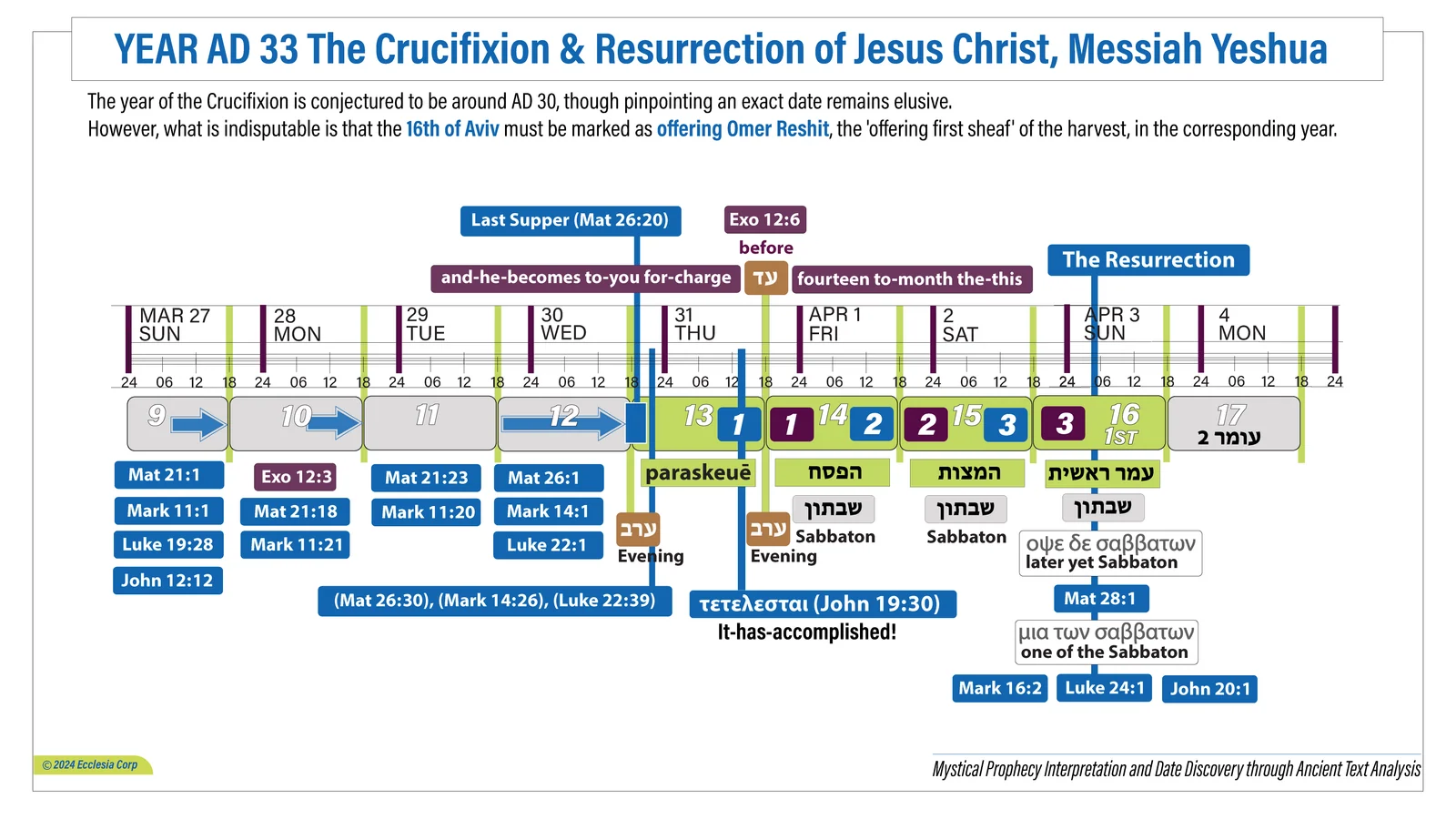
ⅠThe Biblical Reckoning of Days and Yeshua's Crucifixion and Resurrection
To rightly understand Yeshua's crucifixion and resurrection, we must apply the biblical way of reckoning days.
Yeshua foretold "three daytimes and three nights" (Matthew 12:40), and this must agree with Scripture's own timetable.
ⅡThree Daytimes and Three Nights: The Biblical Reckoning of Yeshua's Death and Resurrection
The sign of Jonah was fulfilled exactly as it stands. Astonishingly, even the order of time matches precisely, just as the sign of Jonah.
In the Hebrew text, "daytime" comes first and "night" follows — this proves how precisely Scripture was given.
- Nisan 12, daytime – The disciples prepare the Passover
- Nisan 13, evening – The Last Supper (the biblical day begins)
- Nisan 13, daytime – Crucifixion (first daytime of death)
- Nisan 14, evening – Buried in the tomb (first night of death)
- Nisan 14, daytime – Yeshua is in the tomb (second daytime of death)
- Nisan 15, evening – Yeshua is in the tomb (second night of death)
- Nisan 15, daytime – Yeshua is in the tomb (third daytime of death)
- Nisan 16, evening – Yeshua is in the tomb (third night of death)
- Nisan 16, dawn – Resurrection! (the morning of the first-sheaf wave offering)
The day Yeshua rose is the day the first sheaf of the harvest is offered as a wave offering.
Yeshua the Messiah is the firstfruits of the resurrection. Yet Easter itself is not the Feast of Firstfruits (Yom HaBikkurim).
We must not misunderstand the expression "firstfruits of the resurrection." Because Yeshua is God, He gives the fruit at the appointed time, the moedim (Kairos); He Himself does not need any process of ripening. Therefore He does not become one of the sheaves harvested from the field.
Rather, Yeshua is the One who opened the way for each individual's spirit to be resurrected when they repent and receive Him by faith.
The moment anyone truly repents and receives Yeshua by faith, his spirit is resurrected (awakened).
The state of having truly repented and received Yeshua is itself the spiritual resurrection. But at this point faith has only begun — like grain harvested from the field but not yet threshed. That is, the stage before being separated into wheat and tares begins from the very moment the spiritual resurrection occurs. A person whose spirit has not been resurrected cannot even enter the threshing floor.
And after passing seven Sabbaths, on the fiftieth day — that is, Yom HaBikkurim (the Feast of Firstfruits) — one must receive the Holy Spirit.
Only then does one become a saint who bears the fruit of the Holy Spirit. But as Yeshua said, whoever does not bear fruit will be cut down and thrown into the fire.
Saints who have been spiritually resurrected must go through the process of threshing on the threshing floor in order to become the wheat that enters the storehouse of heaven. But the all-knowing God knows each life through and through. Therefore, knowing every path each has walked since the spiritual resurrection, the saints who will take part in the first resurrection are already determined beforehand.
To become, following Messiah Yeshua, the complete fruit of the resurrection, one must work out salvation with fear and trembling. Only then does the sleeping soul awaken and put on a glorious new body, becoming a being in whom spirit, soul, and body are fully resurrected. Scripture calls this the first resurrection (Revelation 20:5).
ⅢWhy Each Person's Spirit Is Resurrected First, and Easily
Because each person's spirit must awaken first for faith to begin and for the Holy Spirit to be received, each person's spirit is the first to be easily resurrected (awakened).
Matthew 11:30"My yoke is easy and my burden is light."
Mark 12:27"God is not the God of the dead, but of the living. Therefore you are greatly mistaken."
John 11:25–26"Yeshua said to her, 'I am the resurrection and the life. The one who believes in me will live even though he dies; and whoever lives and believes in me will never die. Do you believe this?'"
ⅣUnderstanding the Days and Times of Scripture
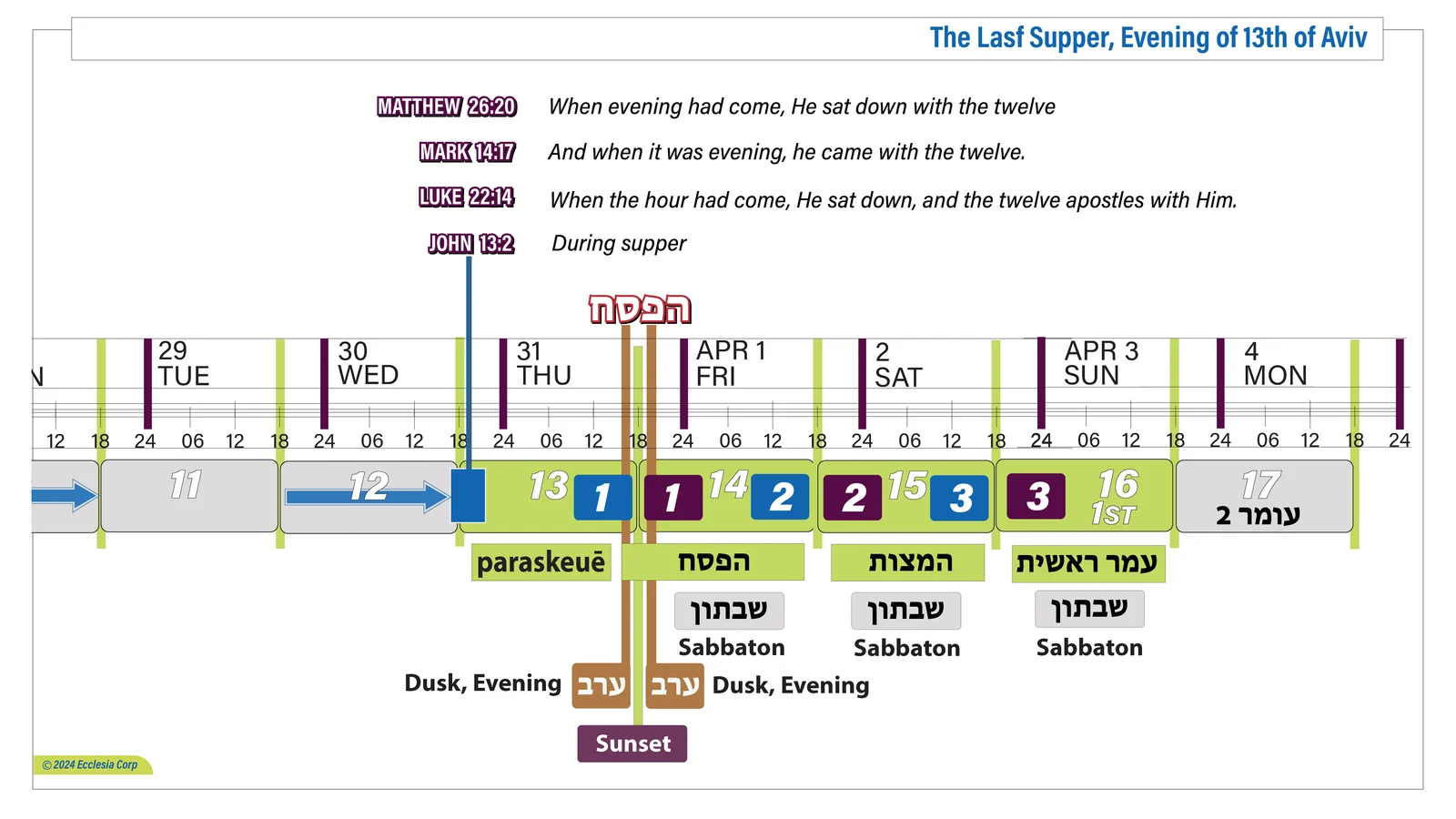
Yeshua commands His disciples to prepare the Passover meal (Matthew 26:17, Luke 22:8-13).
This was not yet the Passover; it was the time of preparing for the Last Supper that would take place on the evening of Nisan 13.
The evening of Nisan 13 begins.
Yeshua eats the Last Supper with His disciples (Matthew 26:26-30).
After the meal He prays in the garden of Gethsemane (Matthew 26:36-46).
That night, Judas Iscariot leads the Roman soldiers, betrays Yeshua, and He is arrested (Matthew 26:47-56).
Yeshua is interrogated before the high priest Caiaphas and the Sanhedrin (Matthew 26:57-68).
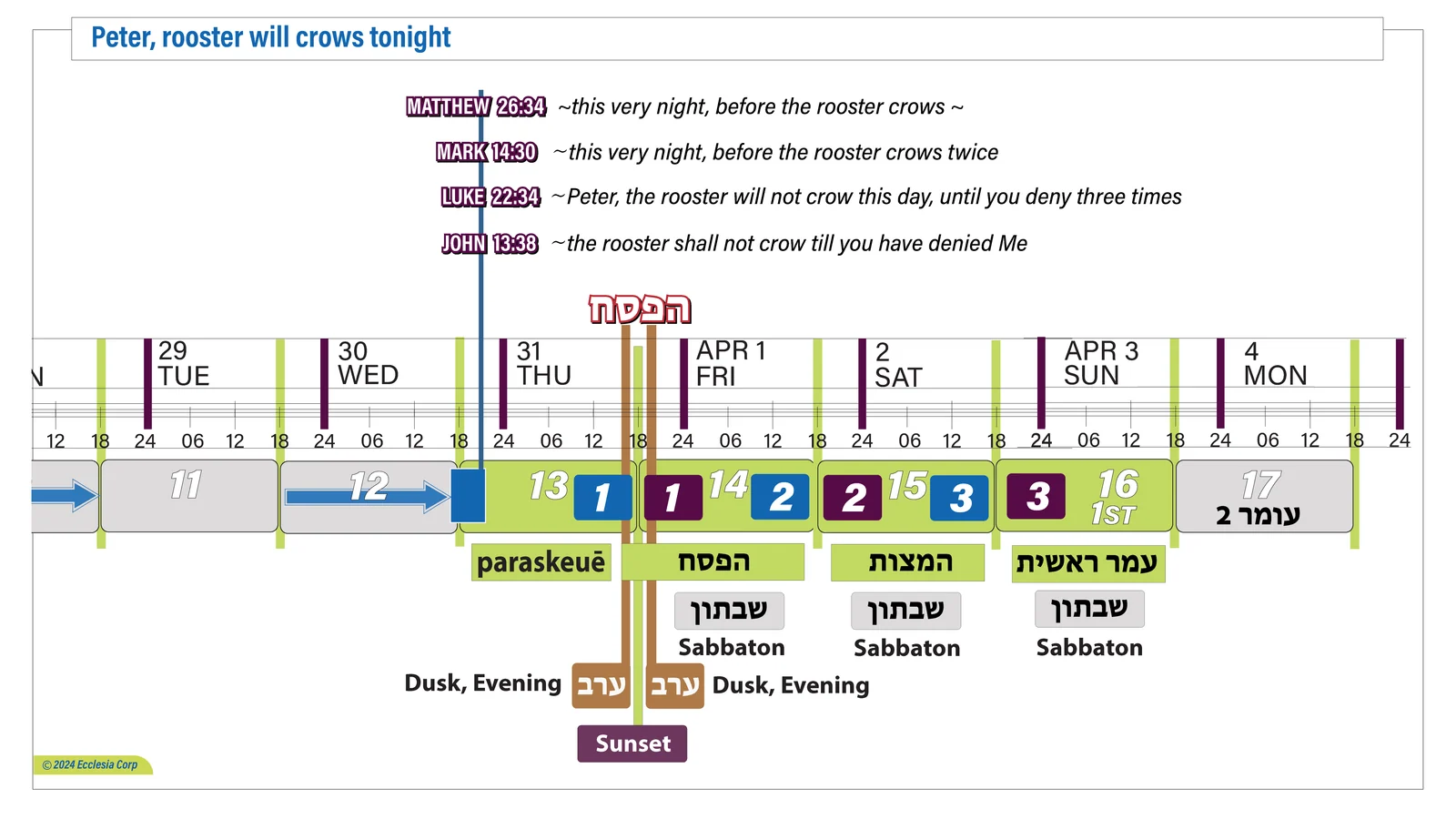
Peter denies Yeshua three times (Matthew 26:69-75).
At dawn Yeshua stands before Pilate (Matthew 27:1-2).
He is sent to Herod and then returned to Pilate (Luke 23:6-12).
Pilate sentences Yeshua to death (John 19:16).
In the morning He carries the cross to Golgotha (Matthew 27:31-33).
He is nailed to the cross (Matthew 27:35).
At 9 a.m. (the third hour) Yeshua is nailed to the cross (Mark 15:25).
From noon, the sixth hour (12), darkness covers the whole land (Matthew 27:45).
At 3 p.m. (the ninth hour) Yeshua dies (Matthew 27:50).
Yeshua's body is taken down before the sun sets.
Joseph of Arimathea asks Pilate to hand over the body (Matthew 27:57-58).
Nicodemus brings spices, and they wrap the body in linen and lay it in a new tomb (John 19:39-42).
The tomb is sealed, and the Passover's great Sabbath (the high Sabbath) begins (Luke 23:54).
The second daytime in which Yeshua is in the tomb begins.
The second night in which Yeshua is in the tomb begins.
The third daytime in which Yeshua is in the tomb begins.
The third night in which Yeshua is in the tomb begins.
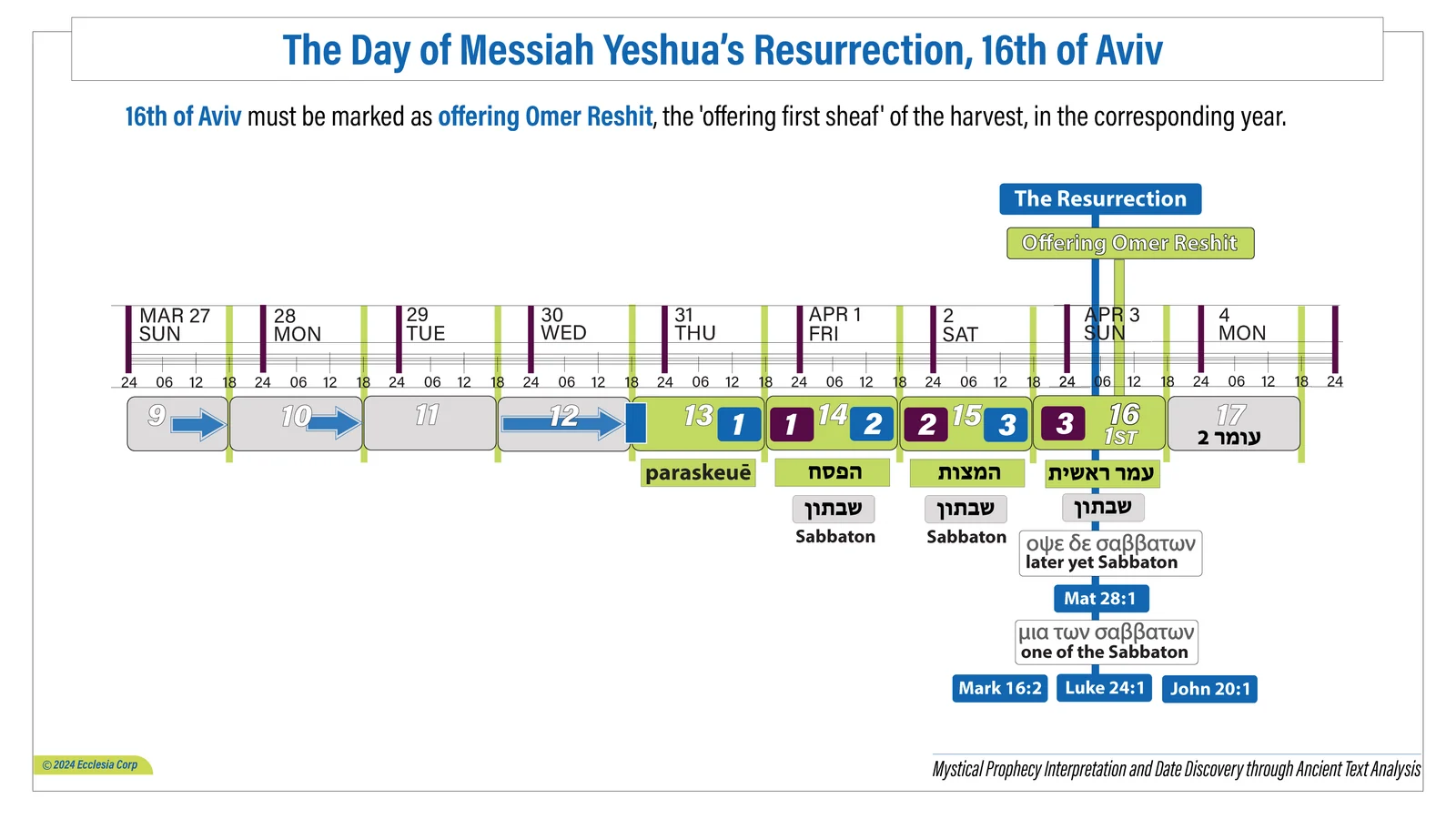
Before the dawn breaks, on the morning of the firstfruits wave offering, Yeshua rises (Matthew 28:1-6).
Thereby the prophecy of "three daytimes and three nights" (Matthew 12:40) is completely fulfilled.
Yeshua first appears to Mary Magdalene, and afterward to the disciples (John 20:11-18, Luke 24:13-35).
He is the firstfruits of the resurrection, the risen Messiah (1 Corinthians 15:20-23).
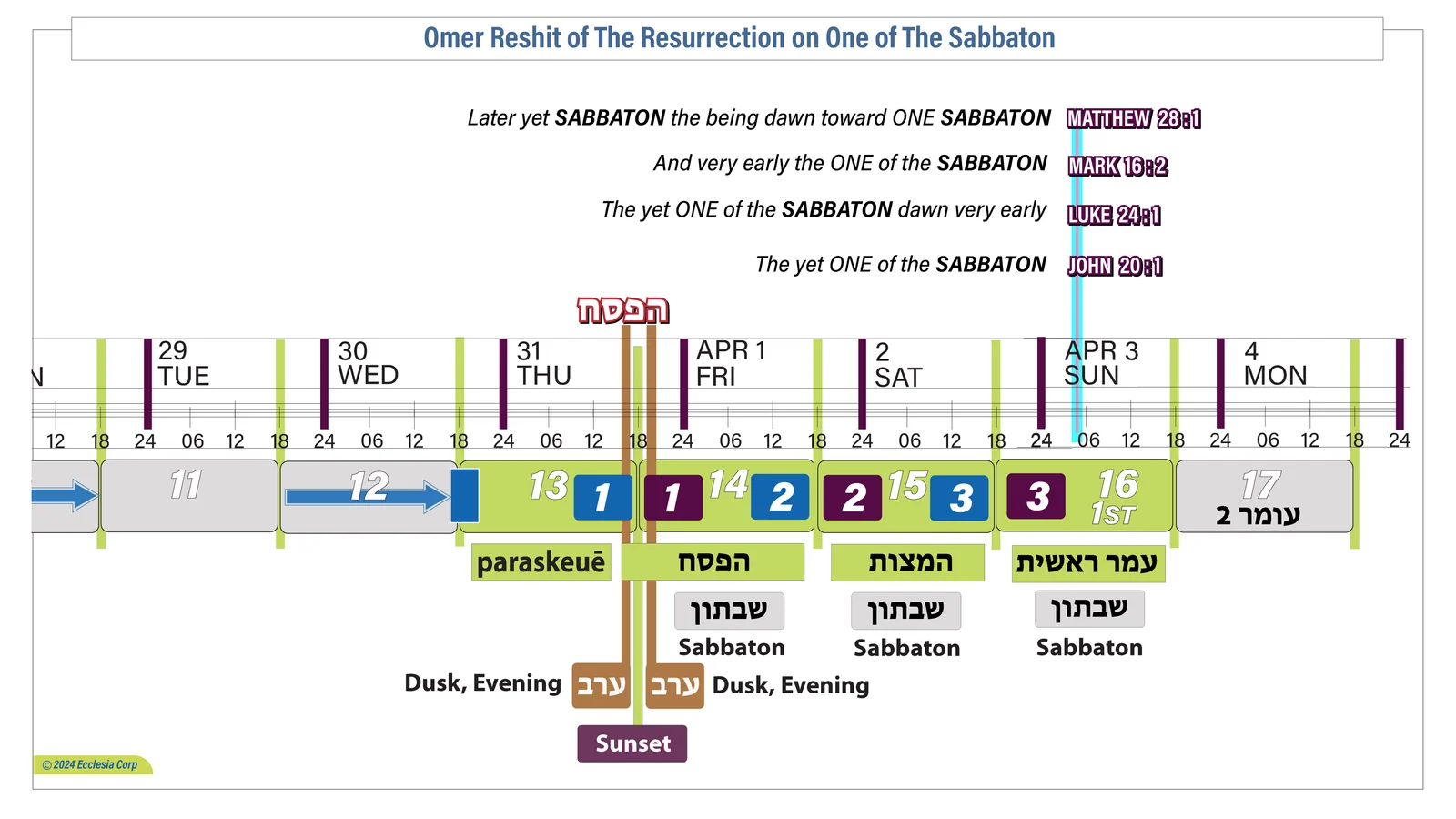
ⅤThe Biblical Day and the Biblical Reckoning of Dates
1. The concept of the biblical day
In Scripture, a day proceeds "from evening until the evening of the next day comes." The boundary of a day is NOT "the moment the sun sets."
Genesis 1:5 – "And there was evening and there was morning, the first day." [analyze]
Therefore a day proceeds in the order "evening → daytime," and the modern concept of "midnight (00:00)" does not apply.
To think that the biblical day ends as the sun sets is the greatest miscalculation. Fall into this contradiction and you cannot reckon biblical time correctly.
Then, when is evening? When an evening-like atmosphere appears, that is evening. In the afternoon, as the sun declines — and even before it has set — the moment an evening atmosphere appears, that is evening; and then it is unconditionally a new day.
This was the reality in Yeshua's day. When Joseph of Arimathea asked for Yeshua's body, it was still the declining daytime, and He was laid in the tomb before the sun set. Therefore, after the sun had gone down, the evening was already well advanced (that is, the new day was already well underway).
2. The method of reckoning dates
The new day (evening) begins at the moment the sun declines and an evening atmosphere sets in; the "moment of sunset" is not the boundary.
For example, "the evening of Nisan 14" begins before sunset, from the moment an evening atmosphere sets in during the afternoon. After the sun has gone down, that evening is already well advanced.
The flow of biblical dates
- When the sun declines and an evening atmosphere sets in (still before sunset) — the new day (evening) begins.
- The sun goes down — the new day (evening) is already well advanced.
- Night — a time-period of the day.
- Dawn — the next period.
- Morning (sunrise) → noon (daytime) → and when an evening atmosphere sets in again in the afternoon, that day closes and continues into the next.
3. The biblical reckoning applied
When understanding the events of Yeshua's crucifixion and resurrection, the biblical reckoning of dates must be applied.
Since Yeshua foretold "three daytimes and three nights (Mt 12:40)," this must be fitted to the biblical reckoning of dates.
Applying the biblical reckoning to Yeshua's death and resurrection
- Nisan 13 evening – the Last Supper (the biblical day begins)
- Nisan 13 daytime – died on the cross (first daytime)
- Nisan 14 evening – laid in the tomb (first night)
- Nisan 14 daytime – in the tomb (second daytime)
- Nisan 15 evening – in the tomb (second night)
- Nisan 15 daytime – in the tomb (third daytime)
- Nisan 16 evening – in the tomb (third night)
- Nisan 16 dawn – Resurrection! (the morning of the wave offering)
The biblical day proceeds in the order "evening → daytime."
It is not that "the day ends/begins when the sun sets" — the moment the evening atmosphere sets in is already the new day.
Only by applying the biblical reckoning of dates is Yeshua's resurrection rightly understood.
Ignore the biblical concept of time and apply a "midnight-based day," and error arises.
ⅥOpse de Sabbaton (Matthew 28:1)
(ὀψὲ δὲ σαββάτων, later yet Sabbaton)
Opse de sabbaton does not mean simply "after the Sabbath," but the later part of the festival period that contains three consecutive Sabbaths — that is, the third Shabbaton — and it makes even clearer that Yeshua rose on the day of the Omer Reshit wave offering (the dawn of Nisan 16).
What Christians need to correct
- The day of the Omer Reshit wave offering (Nisan 16) is also a Shabbaton (שַׁבָּתוֹן).
- The resurrection "is something that occurred during the Shabbaton (the resting festival period). It begins before the morning of the wave offering, around the time when dawn is about to break."
- After the resurrection, the schedule of the wave offering began. And the Feast of Unleavened Bread continues.
This crucial insight corrects the misunderstanding that Yeshua rose after a single Sabbath. In reality, He rose on the third of three consecutive Sabbaths; this is the Greek transliteration "sabbaton" (Σάββατον), following the Hebrew Scriptures, which record the feasts as "shabbaton" (שַׁבָּתוֹן).
This was expressed as "ὀψὲ δὲ σαββάτων" (opse de sabbaton), and is translated into English as "later yet Sabbaton."
This perfectly fulfilled the prophetic timetable.
To read the passage itself
Every passage these studies discuss is on this site. All 66 books, one tap away.