 BIBLE HOMES
Bible Study · Opse
Opse — The ‘Evening’ Words of the New Testament
ὀψέ · ὀψίας · ἑσπέρα — an exhaustive survey of all 20 occurrences
The "Evening" Word Group in the Koine New Testament
An Exhaustive Survey of All 20 Occurrences in the New Testament — Distinguishing Three Words and Their Time Frames
A Comparative Study of Three Greek Source Texts: Nestle Greek NT 1904 · Scrivener’s TR 1894 · Byzantine RP2018
— Key Question: Do these words truly mean "after sunset," or do they mean "the afternoon, while the sun is still up"? —
Introduction: Two Essential Backgrounds for Understanding This Study
This study exhaustively surveys all 20 occurrences of three Greek words translated as "evening" in the Koine New Testament—ὀψέ (opse), ὀψίας (opsias), ἑσπέρα (hespera)—in order to determine, through linguistic science, what time of day these words actually indicate. To do so, two essential backgrounds must be understood.
Introduction 1: The Daily Rhythm of That Era — A Day Governed by Sunlight
In first-century Israel, there was no electricity. There were no streetlights. The only indoor lighting available was small clay lamps fueled by olive oil. The Roman naturalist Pliny the Elder (AD 23–79) wrote about lamp wicks, noting that the oil itself gives off only a dim light. The Roman satirist Juvenal (first century) also wrote of returning home "led only by the moon or a small candle," testifying to the deep darkness of nighttime roads.
In this environment, people’s daily lives naturally followed the cycle of sunlight. They rose before sunrise to prepare, worked when the sun came up, wound down their activities as the sun declined, and went to bed when darkness fell. Professor A. Roger Ekirch, a historian at Virginia Tech, in his landmark work At Day’s Close: Night in Times Past (2005), documented preindustrial sleep patterns through more than 2,000 historical sources. People went to bed relatively soon after sunset, slept for about four hours ("first sleep," primus somnus), briefly woke around midnight for a period of activity, then slept again for about 3–4 hours ("second sleep"), and rose before sunrise. A UCLA research team studying three preindustrial societies in Tanzania, Bolivia, and Namibia also found that people fell asleep on average 3.3 hours after sunset, with an average sleep duration of about 6.25 hours.
This is the essential background for understanding most passages where "opsias (evening)" is used in the New Testament. The daily life of people at that time wound down naturally as the sun declined. This was not a rigid cutoff of "only until sunset!"—rather, it encompassed the entire natural latter part of the day, flowing from afternoon through early evening. Mark 1:32 illustrates this perfectly—"when opsias came, when the sun was setting"—that is, within the broad time frame called opsias, the specific moment of sunset is additionally described.
Introduction 2: The System of Festival and Date Reckoning — Precise Sunset Observation by Sundial
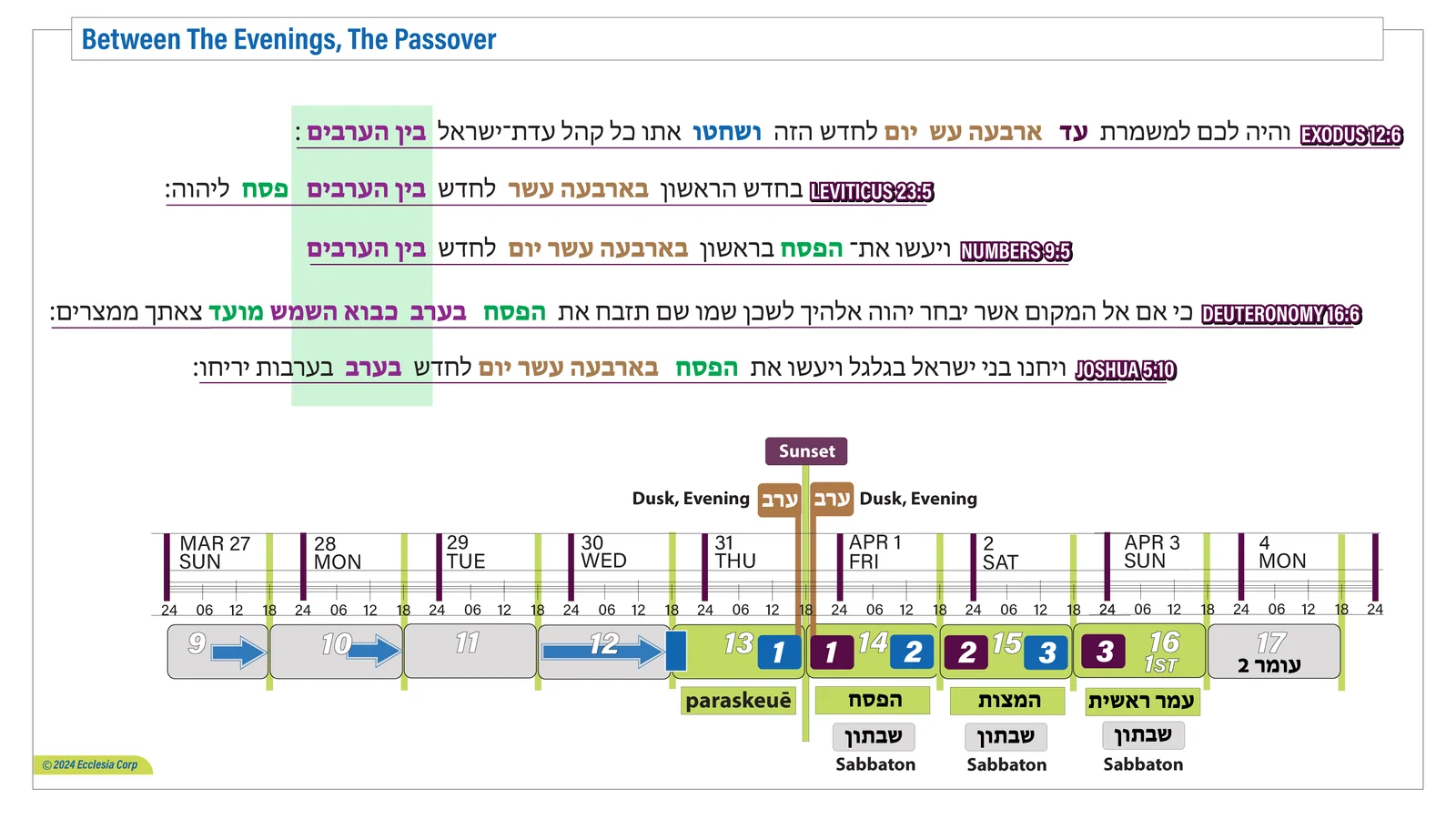
In the biblical system of time, a day differs from the modern concept. As the recurring structure in Genesis 1 shows—"And there was evening, and there was morning—the first day"—the biblical day began at evening (around sunset) and ended in the late afternoon, just before the next evening. This is because the arrival of evening unconditionally marked the beginning of a new day. A common misunderstanding among commentators is the assumption that evening appears twice within a single day—at both its beginning and its end. However, the arrival of evening always marks the start of a new day.
This date-change system was not mere custom. The Temple had a sundial, and Temple officials observed the precise moment when the sun touched the horizon to proclaim the start of a new day. The Mishnah also records the procedure by which Temple officials observed and proclaimed sunset. Archaeologically, ancient sundial artifacts have been discovered in Jerusalem.
Just as modern people measure precise time with electronic clocks, the ancient Israelites used sundials and direct visual observation to determine sunset and sunrise precisely, and used these as the basis for calculating the beginning and end of festivals, and the beginning and end of the Sabbath. In this system, sunset was not "roughly around evening" but an observable, precise reference point. In a sense, it was even more accurate than modern timekeeping—because a sundial directly observes the actual position of the sun.
Introduction 3: The Core of This Study — Two Contexts in Which ὀψέ/ὀψίας Are Used
With these two backgrounds understood, it becomes clear that ὀψέ (opse) and ὀψίας (opsias) are used in the New Testament in two entirely different contexts.
Context A: The Rhythm of Daily Life — The Latter Part of the Day / Afternoon–Early Evening
Mark 11:19, 13:35, and the majority of the 14 occurrences of ὀψίας are used within the natural flow of everyday life. People worked when the sun was up, wound down their activities as the sun declined, and this flow naturally included the setting of the sun. It encompasses the entire natural latter part of the day, extending from afternoon through early evening.
Context B: The System of Festival and Date Reckoning — The Latter Part of a Festival Period
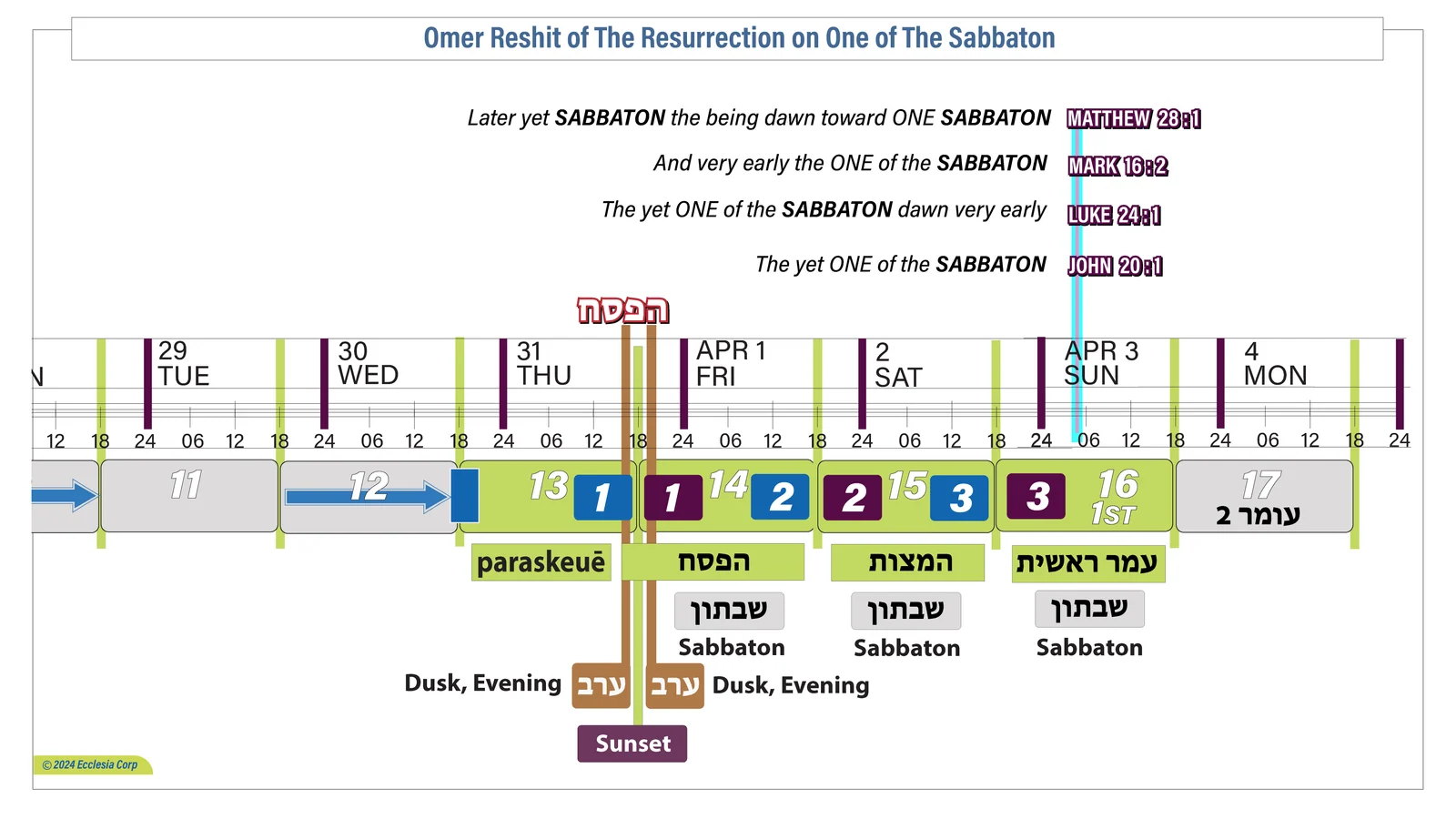
Ὀψὲ δὲ σαββάτων in Matthew 28:1 belongs to an entirely different context. Here, σαββάτων (sabbatōn) does not refer to "a single day" but to the consecutive festival days comprising Preparation Day, Passover, the Feast of Unleavened Bread, and the Firstfruits Wave Offering day. Ὀψὲ denotes the latter part of this festival period. Because festival date reckoning was a system that precisely applied sunset and sunrise via sundial, this is not about "daily rhythm" but the more precise meaning of "the latter part of a period."
This study takes the distinction between these two contexts as its central axis and exhaustively analyzes all 20 occurrences of every Greek word translated as "evening" in the Koine New Testament.
The core error modern readers make lies precisely in failing to distinguish these two contexts. Interpreting ὀψίας in daily-life passages as "after sunset" and then reading ὀψέ in Matthew 28:1 as "after," or conversely, reducing the precise festival-reckoning structure of Matthew 28:1 to merely "afternoon"—both errors arise from failing to make this contextual distinction.
Part I: The Usage of ὀψέ in the Koine New Testament — A Linguistic-Scientific Analysis
An exhaustive survey of all 3 occurrences of ὀψέ (opse) in the New Testament — Matthew 28:1 · Mark 11:19 · Mark 13:35
Chapter 1: Basic Concept — What Is ὀψέ?
1.1 The Basic Meaning of the Word
ὀψέ (opse) is a temporal adverb derived from the Indo-European root *hep- ("after, later"). The core meaning of this word is "the latter part of a given period." The crucial point is that one is still within that period—it does not mean after the period has ended. In Context A, it means "the latter part of the day / afternoon–early evening"; in Context B, it means "the latter part of a festival period."
1.2 Morphology — Part of Speech Classification
When we examine the official morphological classifications by scholars, ὀψέ is uniformly classified as an adverb in all three passages.
| Passage | Strong’s / BibleHub | Bill Mounce | SR GNT |
|---|---|---|---|
| MAT 28:1 | Adv (Adverb) | adverb | — |
| MAR 11:19 | Adv (Adverb) | adverb | — |
| MAR 13:35 | Adv (Adverb) | adverb | D-··· (Adverb) |
1.3 The Critical Evidence from Thayer’s Lexicon
"When ὀψέ is followed by a genitive, it is always partitive, denoting the 'late portion' of the period specified by the genitive, and therefore still belonging to it."
Chapter 2: The Sequential Connective Usage of δέ (de)
2.1 Evidence from the Genealogy in Matthew 1
In Matthew 1, δέ is used a remarkable 44 times. The function of δέ: a sequential transition linking what comes first in time to what follows. Abraham de Isaac, Isaac de Jacob—this pattern is used 44 times.
Ἀβραὰμ ἐγέννησεν τὸν Ἰσαάκ, Ἰσαὰκ δὲ ἐγέννησεν τὸν Ἰακώβ...
2.2 Applied to Matthew 28:1 [Context B]
Ὀψὲ → δὲ → σαββάτων — (latter part) → then → (sabbatōn). The pattern is identical to the genealogy. In conclusion, in "opse de sabbatōn," "opse" precedes the sabbatōn. The Omer Reshit (the firstfruits wave offering) recorded in Leviticus 23:9–15 is a festival observed in the morning after sunrise. By contrast, the time of Yeshua’s (Jesus’s) resurrection was at dawn. "Opse de sabbatōn" is a factual expression pinpointing this exact time. To explain in full:
1. "Opse" denotes the latter part of the consecutive festival days (sabbatōn)—the moadim consisting of Preparation Day, Passover, the Feast of Unleavened Bread, and the Firstfruits Wave Offering day.
2. "De" indicates that "opse" is positioned in time before the "sabbatōn."
3. "Sabbatōn" describes the Omer Reshit (the firstfruits barley wave offering), which would be offered shortly, in the morning.
Chapter 3: A Comparative Analysis of Three Source Texts
3.1 Matthew 28:1 [Context B: The Latter Part of the Festival Period]
| Source Text | Greek Text |
|---|---|
| Nestle 1904 | Ὀψὲ δὲ σαββάτων, τῇ ἐπιφωσκούσῃ εἰς μίαν σαββάτων, ἦλθεν Μαριὰμ ἡ Μαγδαληνὴ καὶ ἡ ἄλλη Μαρία θεωρῆσαι τὸν τάφον. |
| Scrivener TR 1894 | Ὀψὲ δὲ σαββάτων, τῇ ἐπιφωσκούσῃ εἰς μίαν σαββάτων, ἦλθε Μαριὰ ἡ Μαγδαληνή, καὶ ἡ ἄλλη Μαρία, θεωρῆσαι τὸν τάφον. |
| RP2018 | οψε δε σαββατων τη επιφωσκουση εις μιαν σαββατων ηλθεν μαρια η μαγδαληνη και η αλλη μαρια θεωρησαι τον ταφον |
3.2 Mark 11:19 [Context A: The Latter Part of the Day / Afternoon–Early Evening]
| Source Text | Greek Text |
|---|---|
| Nestle 1904 | Καὶ ὅταν ὀψὲ ἐγένετο, ἐξεπορεύοντο ἔξω τῆς πόλεως. |
| Scrivener TR / RP2018 | Καὶ ὅτε ὀψὲ ἐγένετο, ἐξεπορεύετο ἔξω τῆς πόλεως. |
Contextual evidence: Mark 11:20 — "And in the morning, passing by..." The time sequence: ὀψέ(11:19) → πρωᾐ (11:20). If ὀψέ meant after sunset, it would mean they went outside the city in the dark.
3.3 Mark 13:35 [Context A: The Latter Part of the Day / Afternoon–Early Evening]
| Source Text | Greek Text |
|---|---|
| Nestle 1904 | γρηγορεῖτε οὖν· οὐκ οἴδατε γὰρ πότε ὁ κύριος τῆς οἰκίας ἔρχεται, ἢ ὀψὲ ἢ μεσονύκτιον ἢ ἀλεκτοροφωνίας ἢ πρωᾐ· |
| Scrivener TR 1894 | γρηγορεῖτε οὖν· ... ὀψέ, ἢ μεσονυκτίου, ἢ ἀλεκτοροφωνίας, ἢ πρωᾐ· |
| RP2018 | ... οψε η μεσονυκτιου η αλεκτοροφωνιας η πρωι |
Chronological order of the four time-points:
| Order | Greek | Transliteration | Meaning |
|---|---|---|---|
| ① | ὀψέ | opse | Latter part of the day / afternoon–early evening |
| ② | μεσονύκτιον | mesonuktion | Midnight |
| ③ | ἀλεκτοροφωνίας | alektorophonias | Cockcrow |
| ④ | πρωᾐ | proi | Dawn / Morning |
①opse → ②midnight → ③cockcrow → ④dawn is clearly a chronological progression. Rather than simply reducing ὀψέ to "evening," understanding it as an expression encompassing the latter part of the day through early evening covers every time-point without omission.
Chapter 4: The Order of the Biblical Day
In the Bible, a day is structured in the following order: Evening (erev) → Night → Dawn → Morning (boqer) → Noon → Afternoon (= the latter part of the day). ὀψέ corresponds precisely to "the latter part of the day (afternoon–early evening)" in Context A, and to "the latter part of consecutive festival days" in Context B.
Chapter 5: A Comprehensive Analysis of Matthew 28:1 — The Time of the Resurrection [Context B]
Ὀψὲ δὲ σαββάτων, τῇ ἐπιφωσκούσῃ εἰς μίαν σαββάτων
"The latter part (Ὀψὲ), still (δέ) of the sabbatōn (σαββάτων), at the dawning (τῇ ἐπιφωσκούσῃ) toward one of the sabbatōn (εἰς μίαν σαββάτων)"
The fact that all three major source texts (Nestle 1904, TR 1894, RP2018) use the identical ὀψέ confirms that this analysis is a universal conclusion independent of any particular manuscript tradition.
Part II: ὀψίας · ἑσπέρα — A Comprehensive Analysis of the Remaining 17 Occurrences
Chapter 1: Three "Evening" Words — Entirely Different Words
| Greek | Transliteration | Part of Speech | Count | Basic Meaning |
|---|---|---|---|---|
| ὀψέ | opse | Adverb | 3x | The latter part of a given period |
| ὀψίας | opsias | Adjective | 14x | The late hour of the day (same root, different part of speech) |
| ἑσπέρα | hespera | Noun | 3x | Evening (entirely different etymology) |
Chapter 2: An Exhaustive Analysis of All 14 Occurrences of ὀψίας (opsias) [Context A: Daily Life]
2.1 Core Principle: People of That Era Moved Under Sunlight
In first-century Israel, there were no streetlights. All human activities were entirely dependent on sunlight. This single, simple fact alone enables us to determine the time of day for each of the 14 passages where ὀψίας appears.
2.2 Exhaustive Analysis of All 14 Occurrences
| Passage | Activity | Began After Sunset | Began Before Sunset | Basis for Determination |
|---|---|---|---|---|
| MAT 8:16 | Bringing the sick | X | O | Activity that began in the afternoon |
| MAT 14:15 | Sending people to buy food | X | O | Began while shops were still open |
| MAT 14:23 | Going up the mountain to pray | X | O | Went up the mountain in the afternoon |
| MAT 16:2 | "The sky is red and overcast" | X | O | A vivid sunset requires the sun above the horizon |
| MAT 20:8 | Paying workers their wages | X | O | Wages settled while the sun was still up |
| MAT 26:20 | Taking seats for the Passover meal | X | O | Preparation began in the afternoon; meal around sunset |
| MAT 27:57 | Requesting the body | X | O | Requested before the Sabbath began |
| MAR 1:32 | Bringing the sick + "when the sun set" | X | O | Decisive evidence: sunset occurs within opsias |
| MAR 4:35 | Crossing the sea by boat | X | O | Departed in the afternoon |
| MAR 6:47 | The boat in the middle of the sea | X | O | Time elapsed since pre-sunset departure |
| MAR 11:11 | Walking on foot to Bethany | X | O | Travel began in the afternoon |
| MAR 14:17 | Arriving with the Twelve | X | O | Arrived in the afternoon |
| MAR 15:42 | Beginning burial preparations | X | O | Prepared before the Sabbath began |
| JOH 20:19 | The disciples gathered; Yeshua appears | X | O | Gathered in the afternoon on the day of the resurrection |
Legend: O = Applicable (green) X = Not applicable (red) — All 14 occurrences describe situations that began before sunset. Not a single one describes a situation that newly began after sunset.
Chapter 3: Decisive Evidence
3.1 Decisive Evidence: Mark 1:32
ὀψίας δὲ γενομένης, ὅτε ἔδυ ὁ ἥλιος
"When opsias came, when the sun was setting" — Mark adds separately "when the sun was setting" after ὀψίας. If ὀψίας itself already meant "after sunset," there would be absolutely no need to say "when the sun was setting" again. Conversely, if ὀψίας means "the latter part of the day (afternoon–early evening)," then "when the latter part of the day came, when the sun was setting" is perfectly natural.
3.2 The Science of Sunset: Matthew 16:2
"πυρράζει γὰρ ὁ οὐρανός" — "for the sky is red" — When the sun is still above the horizon, passing through the atmosphere at a low angle, the entire sky blazes with vivid red—this is the true spectacle of sunset.
Chapter 4: ἑσπέρα (hespera) — 3 Occurrences — An Entirely Different Word
| Passage | Key Greek | Translation |
|---|---|---|
| LUK 24:29 | πρὸς ἑσπέραν ἐστίν | "It is toward evening, and the day is far spent; stay with us." |
| ACT 4:3 | ἦν γὰρ ἑσπέρα ἤδη | "For it was already hespera (evening)." |
| ACT 28:23 | ἀπὸ πρωᾐ ἕως ἑσπέρας | "From morning until evening." |
This word is entirely separate from ὀψέ/ὀψίας and must not be confused with them.
Appendix: Complete Concordance of ὀψέ
| Passage | Text | Content |
|---|---|---|
| MAT 28:1 | Nestle | Ὀψὲ δὲ σαββάτων, τῇ ἐπιφωσκούσῃ εἰς μίαν σαββάτων... |
| TR | Ὀψὲ δὲ σαββάτων, τῇ ἐπιφωσκούσῃ εἰς μίαν σαββάτων... | |
| RP2018 | οψε δε σαββατων τη επιφωσκουση εις μιαν σαββατων ηλθεν μαρια... | |
| Literal | Still in the latter part, at the dawning toward one of the sabbaton, Mary Magdalene and the other Mary came to see the tomb. | |
| MAR 11:19 | Nestle | Καὶ ὅταν ὀψὲ ἐγένετο, ἐξεπορεύοντο ἔξω τῆς πόλεως. |
| TR/RP | Καὶ ὅτε ὀψὲ ἐγένετο, ἐξεπορεύετο ἔξω τῆς πόλεως. | |
| Literal | And when the latter part of the day (afternoon–early evening) came, they went out of the city. | |
| MAR 13:35 | Nestle | γρηγορεῖτε οὖν· οὐκ οἴδατε γὰρ πότε ὁ κύριος τῆς οἰκίας ἔρχεται, ἢ ὀψὲ ἢ μεσονύκτιον ἢ ἀλεκτοροφωνίας ἢ πρωᾐ· |
| TR/RP | γρηγορεῖτε οὖν· ... ὀψέ, ἢ μεσονυκτίου, ἢ ἀλεκτοροφωνίας, ἢ πρωᾐ· | |
| Literal | ...whether in the latter part of the day (afternoon–early evening), at midnight, at cockcrow, or at dawn. |
Comprehensive Conclusion
1. What the Evidence of 20 Occurrences of Three Words Tells Us
ὀψέ (opse, 3 occurrences): An adverb meaning "the latter part" of a given period. A point still within that period. In Context A (daily rhythm), it means "the latter part of the day / afternoon–early evening"; in Context B (festival reckoning), it means "the latter part of a festival period."
ὀψίας (opsias, 14 occurrences): An adjective meaning the latter part of the day [Context A]. Of these, 13 must be read as the afternoon (approximately 3:00–6:00 PM) time frame for the context to make sense. The remaining 1 occurrence also had its starting point before sunset.
ἑσπέρα (hespera, 3 occurrences): A noun of entirely different etymology. It must not be confused with ὀψέ/ὀψίας.
2. The Decisive Evidence of Mark 1:32
The fact that Mark adds "when the sun set (ὅτε ἔδυ ὁ ἥλιος)" separately after ὀψίας proves that ὀψίας itself does not mean "after sunset."
3. Implications for Matthew 28:1 [Context B]
If ὀψέ and ὀψίας, derived from the same root, consistently mean "the latter part of a given period—a point still within that period" across all 17 occurrences (3+14) in the entire New Testament, then Ὀψὲ δὲ σαββάτων in Matthew 28:1 must also be read by the same principle:
Not "after the Sabbath was over," but "in the latter part of the sabbatōn (Sabbaths)—while still within the Sabbath period"—and simultaneously, an expression that records with great precision the exact time just before the Omer Reshit (the firstfruits barley wave offering), which was offered in the morning.
This is not an interpretation based on any particular theological stance, but a fact of linguistic science consistently demonstrated by the context of 17 passages in which the same word was used by the same author—the Holy Spirit, as the single guiding source of inspiration.
In conclusion, all of Scripture was written in accordance with the temporal definition of a day established in Genesis, and this fact must remain central when interpreting the times and dates presented in the Bible. Furthermore, as actually applied in the daily life of the era when Yeshua (Jesus) was active, the order was as follows: A day begins at evening and continues into night, deep night, dawn, morning, noon, afternoon, and late afternoon—at which point the day comes to a close. Within a single day, evening occurs only once. A day does not end at evening; rather, when evening comes, a new day begins.
— End of Comprehensive Analysis of the "Evening" Word Group in the Koine New Testament —
To read the passage itself
Every passage these studies discuss is on this site. All 66 books, one tap away.