 BIBLE HOMES
Bible Study · The Last Supper
The Last Supper and Three Days, Three Nights
Reconstructing Yeshua's Final Week as the Biblical Text Declares
Introduction
For centuries, Western church tradition has taught that Yeshua's Last Supper took place on "Thursday evening," that his crucifixion occurred on "Friday afternoon," and that his resurrection came on "Sunday morning." This framework has become so deeply embedded in Christian consciousness that many people assume it is precisely what the Bible itself says. Yet when we examine the biblical text with care, a number of problems emerge that this traditional scheme simply cannot resolve.
The most immediately striking problem is the one sign Yeshua himself declared. In Matthew 12:40, Yeshua said, "For as Jonah was three days and three nights in the belly of the great fish, so will the Son of Man be three days and three nights in the heart of the earth." Yet no matter how one calculates it, "Friday afternoon death — Sunday morning resurrection" cannot yield three days and three nights. The maximum possible is roughly one and a half days and two nights.
The second problem lies in John's precise timestamps. The Gospel of John explicitly states that the Last Supper occurred before the Passover (John 13:1), and that Yeshua's trial and crucifixion took place on the Preparation Day of the Passover (John 19:14). John records that the Jewish leaders refused to enter Pilate's headquarters so as not to defile themselves — because they had not yet eaten the Passover (John 18:28). All of this points to Yeshua's crucifixion happening before the time of the Passover sacrifice.
The third problem is the word choice of the Gospel writers themselves. If the Last Supper was part of the Passover meal, the bread broken at that meal would necessarily have been unleavened bread (matzah). Yet Matthew, Mark, and Luke consistently use not ἄζυμος (azumos, "unleavened"), the technical term for matzah, but ἄρτος (artos), the ordinary word for leavened bread. If this word choice was deliberate and precise — not careless — then the meal was not the Passover itself, but rather a meal eaten before Passover began.
This study takes these three threads — the sign of three days and three nights, John's time markers, and the Gospel writers' vocabulary — and examines them against the biblical text itself and the testimony of the ancient church. What emerges is a picture of Yeshua's final week that is remarkably coherent from within: consistent with John's Gospel, the Synoptic accounts, the promise of Matthew 12:40, the festival calendar of Leviticus 23, and the careful word choices of the Evangelists — all without contradiction.
1How the Bible Defines "A Day"
The foundation of this entire discussion is a precise understanding of how the Bible divides a day. Getting this one principle right resolves an enormous amount of confusion surrounding the Last Supper.
1-1. Evening First, Morning After
The creation account in Genesis 1 establishes the Bible's foundational framework for reckoning a day. After God completed the work of the first day, the text says:
Genesis 1:5"And there was evening, and there was morning — the first day."
Evening → Night → Dawn → Morning → Daytime (end of that day) → The next day begins (evening)
This is not merely a literary expression. It is the basic unit by which the Bible counts days throughout its entirety. A day begins at evening, moves through night, dawn, and morning into the daytime, and concludes when that daytime ends. The moment that daytime ends, the next day's evening immediately commences. In other words, a biblical day begins at evening and concludes when the following daytime is complete.
1-2. Evening Is Simply Evening — When It Arrives, the New Day Has Come
To understand this principle correctly, remember this: evening is simply evening. Whether the sun has fully descended below the horizon or is still touching it is not the essential point. The moment the quality of evening begins to settle in, that is already evening, and already a new day.
A common misunderstanding is the mechanical idea that "the day changes at the precise instant the sun fully sets." But this is a later theoretical construct developed by legal scholars for administrative convenience — it is not what the biblical text actually says. Consider the reality of nature: the most vivid and deep sunset colors appear before the sun has completely vanished. That time itself is already unmistakably evening; it is not daytime.
When the Bible records in Genesis 1:5, "there was evening, and there was morning," it is saying exactly this: "evening becomes" refers not to a specific astronomical moment, but to the arrival of evening as a state. When evening arrives, the new day has come.
This principle speaks directly to a matter of spiritual attentiveness. A posture of "waiting for the precise astronomical moment when the sun fully disappears before deciding to pay attention" is not what Scripture teaches. The biblical posture is to perceive when the time is beginning to arrive and to respond immediately.
Yeshua's words in Matthew 24:38 are telling. Describing the generation before Noah's flood, he says they were "eating and drinking, marrying and giving in marriage." The Greek word translated "eating," ἐσθίοντες (esthiontes), does not carry the neutral meaning of "consuming food for sustenance" — it implies a consuming, repetitive indulgence, a preoccupation with sensory pleasure. Those people failed to perceive that evening was already deepening upon them; absorbed in eating and drinking, they kept on, and on, and missed the moment.
The biblical concept of a day is therefore not merely a method of timekeeping. It connects to the spiritual capacity to discern the hour.
1-3. The Distinction Between Lived Days and Festival Days
One further distinction is essential. The "lived day" — the day as human experience flows through it — is not the same as the "festival day" as the Bible defines it. In a lived day, a person wakes in the morning, goes about their activities, and eventually goes to bed in the evening. But a festival day begins at evening and concludes when the following daytime ends.
The overlap between these two is precisely where confusion arises. A person living through a normal day reaches evening and sits down to dinner. But at that very moment of dinner, the biblical calendar has already moved into the next day. The weekly Sabbath, the Passover, the Feast of Unleavened Bread, the Feast of Weeks — every appointed time operates by this principle.
- The biblical day begins when evening arrives and concludes when the following daytime ends.
- Evening is simply evening. The moment even a hint of evening settles in, the new day has already begun.
- The day as humans experience it (the "lived day") differs from the day as the Bible's festival calendar defines it.
- At the same dinner hour: by the feeling of lived experience it is "tonight," but by the biblical calendar it is already "tomorrow."
When we hold this principle in view and re-read the Gospel accounts, the timestamps that have long seemed confusing fall into place with remarkable clarity.
2There Is No Command to Eat Unleavened Bread Beginning on the 13th of Abib
To rightly understand the Last Supper, we must first examine the Torah's regulations for Passover and the Feast of Unleavened Bread with precision. The decisive question is: From what day must unleavened bread be eaten?
2-1. The Torah's Command — Beginning the Evening of the 14th
Exodus 12:18 defines precisely when the obligation to eat unleavened bread begins and ends:
Exodus 12:18"In the first month, on the fourteenth day of the month at evening, you shall eat unleavened bread, until the twenty-first day of the month at evening."
Based on the principle established in the previous chapter, "the evening of the 14th" marks the beginning of the 14th. When evening arrives, the 14th has begun — and from that very evening, unleavened bread must be eaten. This obligation continues for exactly seven days, until the evening of the 21st.
2-2. Leviticus 23's Further Clarification
Leviticus 23:5–6"In the first month, on the fourteenth day of the month at evening, is the LORD's Passover. And on the fifteenth day of the same month is the Feast of Unleavened Bread to the LORD; for seven days you shall eat unleavened bread."
Two points must be distinguished clearly. First, Passover is the appointed time that corresponds to the beginning (evening) of the 14th. Second, the seven-day festival of Unleavened Bread runs from the evening of the 14th through the evening of the 21st. The obligation to eat unleavened bread begins, as Exodus 12:18 specifies, from the evening of the 14th — that is, together with the Passover lamb eaten on Passover evening, the eating of unleavened bread commences and continues throughout the seven days that follow.
2-3. There Is No Obligation to Eat Unleavened Bread on the 13th
Here the decisive fact emerges: nowhere in the Bible is there any command to eat unleavened bread beginning on the 13th of Abib (Nisan). A thorough search of Exodus 12, Leviticus 23, Numbers 28, and Deuteronomy 16 — every passage dealing with Passover and Unleavened Bread — reveals no mention of the 13th. There is no commandment in the Torah to remove leaven or begin eating unleavened bread on the 13th.
The customs surrounding the 13th are rabbinic in origin. The practice of searching for and removing leaven (bedikat chametz) during the 13th in preparation for the obligation beginning the evening of the 14th is a genuine and well-documented Jewish tradition. But it is a preparatory practice developed to fulfill the Torah's command — not the Torah's direct command itself.
2-4. The Evening of the 13th — The Last Leavened Meal
Applying these regulations to the practical realities of ancient household life reveals something natural and clear: the evening of the 13th (the beginning of the 13th) was the time when Jewish households could consume the last of their leavened food.
The reason is simple. In an age without refrigeration, leftover food could not be kept. Bread and fermented foods in particular would begin to spoil within a day. Since only unleavened bread could be eaten from the evening of the 14th onward, whatever leavened food remained had to be eaten or disposed of before then. The natural pattern was: during the daytime of the 12th, food is prepared; when evening descends and the 13th begins, the household shares a final leavened dinner. Then through the daytime of the 13th, any remaining leavened items are fully consumed or burned, and when evening descends again and the 14th (Passover) begins, the household enters the unleavened-bread regime.
- The final evening before the unleavened bread obligation mandated by Torah for the evening of the 14th
- A Jewish household's last leavened meal
- The threshold meal before entering the Passover–Unleavened Bread festival period
- The turning point at which all leavened items are cleared, preparing for the unleavened-bread regime beginning the next evening
3What the Word Choice Declares — ἄρτος vs ἄζυμος
We now turn to the Greek original. What was broken at the Last Supper? The word each Gospel writer chose to use gives a precise answer.
3-1. Two Different Words
- ἄρτος (artos, bread) — the common, everyday word for bread; ordinarily refers to leavened bread. Plural: ἄρτοι (artoi, breads).
- ἄζυμος (azumos, unleavened) — a technical term meaning "without leaven." Used specifically to designate unleavened bread. The neuter plural τὰ ἄζυμα (ta azuma) also refers to the Feast of Unleavened Bread itself.
These two words are used with clear distinction throughout the biblical text. If a Gospel writer wanted to specify unleavened bread, he had to choose ἄζυμος. If he meant ordinary bread, he chose ἄρτος.
3-2. When the Feast Is in View: ἄζυμος
When the Gospel writers refer to the Feast of Unleavened Bread itself, they use ἄζυμος precisely. Matthew 26:17 is a clear example:
Matthew 26:17 — GreekΤῇ δὲ πρώτῃ τῶν ἀζύμων... ("Now on the first day of the Unleavened Bread festival...")
Here τῶν ἀζύμων (ton azumōn) is the genitive plural of ἄζυμος. Matthew uses this technical term with exactness when referring to the festival.
3-3. The Bread at the Last Supper Is ἄρτος
Yet in the very next scene — the decisive moment when Yeshua takes bread at the table and gives it to his disciples — all four independent Gospel accounts use not ἄζυμος, but ἄρτος:
Mt 26:26 · Mk 14:22 · Lk 22:19 · 1 Cor 11:23[Matthew 26:26] ...λαβὼν ὁ Ἰησοῦς τὸν ἄρτον... ("Yeshua took the bread...")
[Mark 14:22] ...λαβὼν ὁ Ἰησοῦς ἄρτον... ("Yeshua took bread...")
[Luke 22:19] ...λαβὼν ἄρτον, εὐχαριστήσας ἔκλασεν... ("taking bread, he gave thanks and broke it...")
[1 Corinthians 11:23] ...ὁ κύριος Ἰησοῦς... ἔλαβεν ἄρτον ("The Lord Yeshua... took bread...")
Four independent witnesses all use ἄρτος. This is not coincidence. The fact that even Paul's tradition, transmitted to Gentile churches, uses the same word, means that the apostolic tradition itself testifies that the bread was ordinary bread.
3-4. Confirming Evidence
Consistently throughout the Gospels and the rest of the New Testament, ἄζυμος is used whenever actual unleavened bread or the Feast of Unleavened Bread is in view. Mark 14:1 records that "the Passover and the Feast of Unleavened Bread [τὰ ἄζυμα] were two days away." Luke 22:1 notes that "the Feast of Unleavened Bread [ἡ ἑορτὴ τῶν ἀζύμων] drew near, which is called the Passover." Acts 12:3 and 20:6 also use τὰ ἄζυμα for the feast. And Paul in 1 Corinthians 5:7–8 uses both ἄζυμος and ἄρτος in deliberate contrast.
The New Testament writers knew the difference between these two words and applied them consistently. When unleavened bread or the unleavened festival is in view: ἄζυμος. When ordinary bread is in view: ἄρτος. And at the Last Supper, every account says ἄρτος.
If the Last Supper had been a Passover meal, the Gospel writers would necessarily have written ἄζυμος. They all wrote ἄρτος. The original text itself testifies that this meal was not the Passover, but the final leavened meal of the evening of the 13th — before the unleavened bread obligation had yet begun.
4John's Witness to the Timing — A Supper Before the Passover
The Gospel of John was written last, after the three Synoptic Gospels. The Apostle John clearly and intentionally clarified the timeline at several points that the earlier Gospels had left unstated.
4-1. John 13:1 — Before the Passover
John 13:1Now before the Feast of the Passover, when Yeshua knew that his hour had come to depart out of this world to the Father, having loved his own who were in the world, he loved them to the end.
The very next verse enters immediately into the dinner scene (John 13:2). John explicitly marks this dinner as happening "before the Feast of the Passover." The Greek is πρὸ δὲ τῆς ἑορτῆς τοῦ πάσχα — "before the feast of the Passover" — an unambiguous time marker.
4-2. John 18:28 — They Had Not Yet Eaten the Passover
John 18:28Then they led Yeshua from the house of Caiaphas to the governor's headquarters. It was early morning. They themselves did not enter the headquarters so that they would not be defiled, but could eat the Passover.
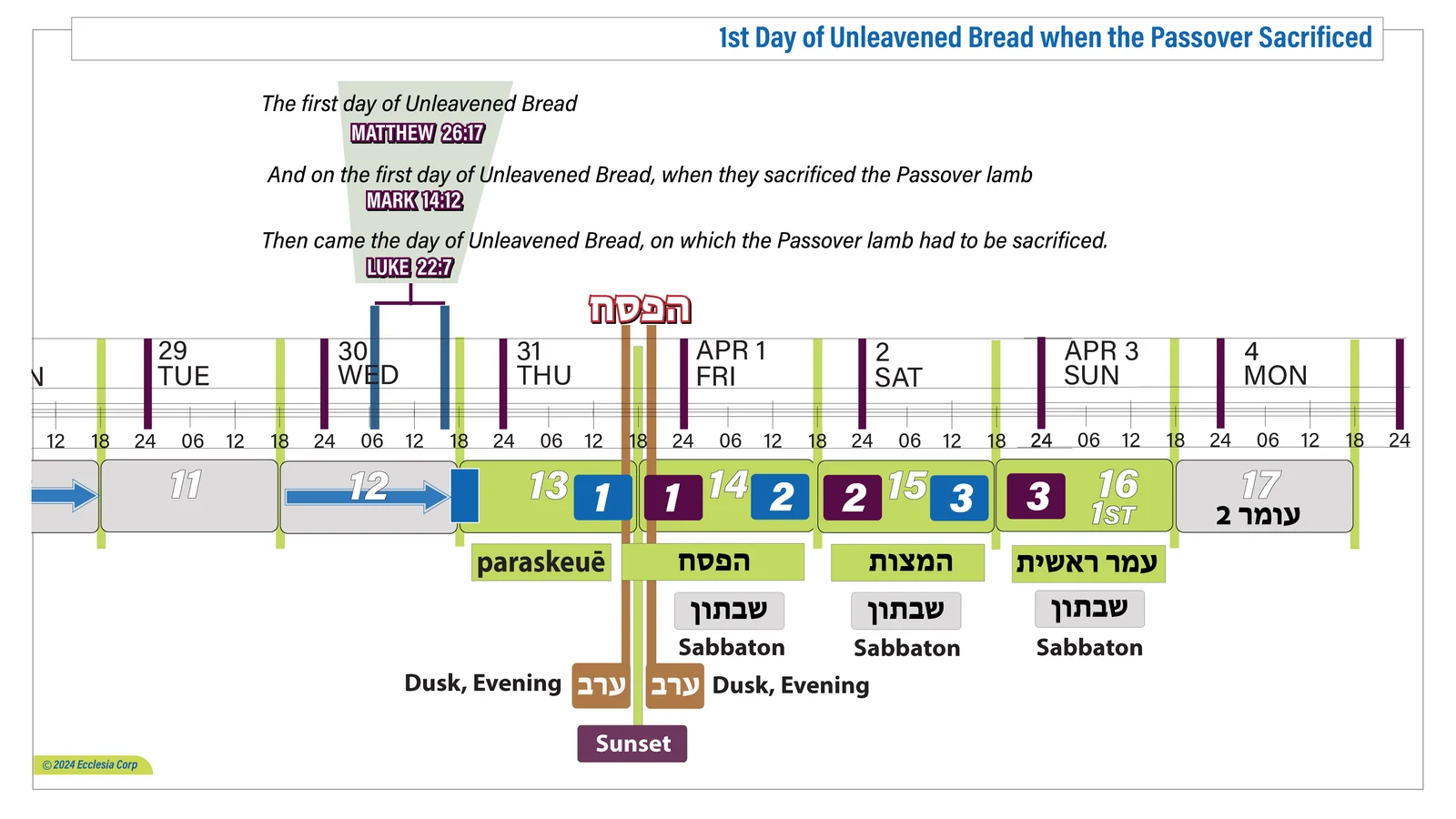
This passage is decisive. At the moment Yeshua was already arrested and being led to Pilate's headquarters in the early morning hours, the Jewish leaders still had not eaten the Passover. They feared that entering a Gentile building would render them ceremonially unclean and prevent them from eating the Passover that coming evening. This makes clear that the early morning in question was still within the daytime portion of the 13th — before the 14th (Passover) had yet begun.
4-3. John 19:14 — The Preparation Day of the Passover
John 19:14Now it was the Preparation Day of the Passover. It was about the sixth hour. Pilate said to the Jews, "Behold your King!"
When Yeshua stood before Pilate, John records that the day was "the Preparation Day of the Passover" (παρασκευὴ τοῦ πάσχα, paraskeuē tou pascha). "Preparation Day" means the Passover had not yet begun — this was the day of preparing for it.
4-4. What John's Timeline Points To
- Last Supper (John 13:1–2) — before the Passover
- Arrest (John 18) — still before the Passover
- Early morning trial (John 18:28) — the leaders have not yet eaten the Passover
- Trial before Pilate (John 19:14) — Preparation Day of the Passover, around the sixth hour
- Death on the cross (John 19) — at or around the time the Passover lambs were being slaughtered
In sum: John makes clear that the entire passion sequence was completed before the Passover (beginning with the evening of the 14th). Yeshua died at the ninth hour of the daytime of the 13th — the very hour when the Passover lambs were being offered in the Temple.
5Reconstructing Yeshua's Final Week
All the material examined so far — the Bible's definition of a day, the Torah's unleavened bread regulations, the original vocabulary of the Gospels, and John's time markers — converges into a single coherent picture of Yeshua's final week.
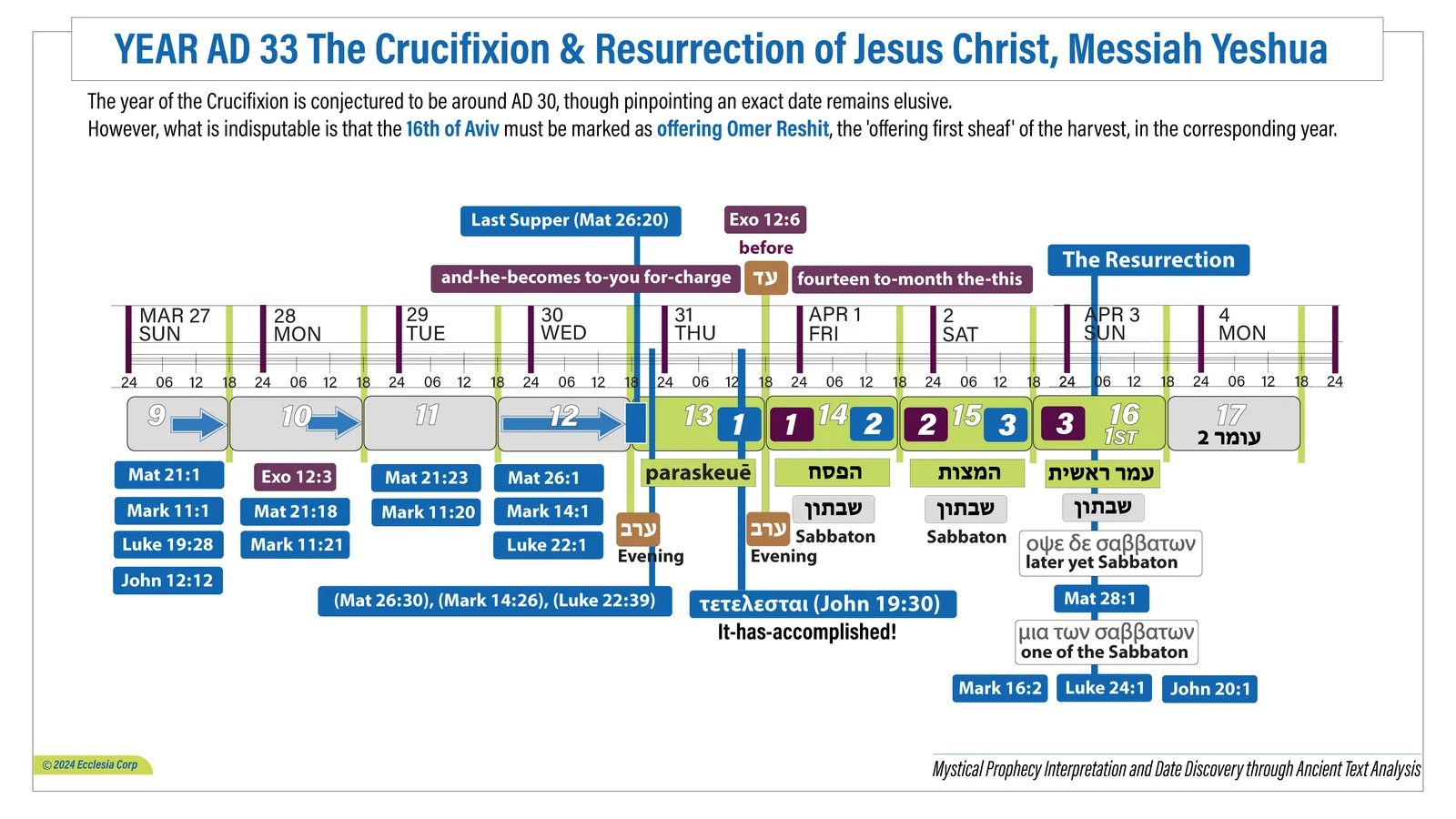
5-1. A Step-by-Step Timeline
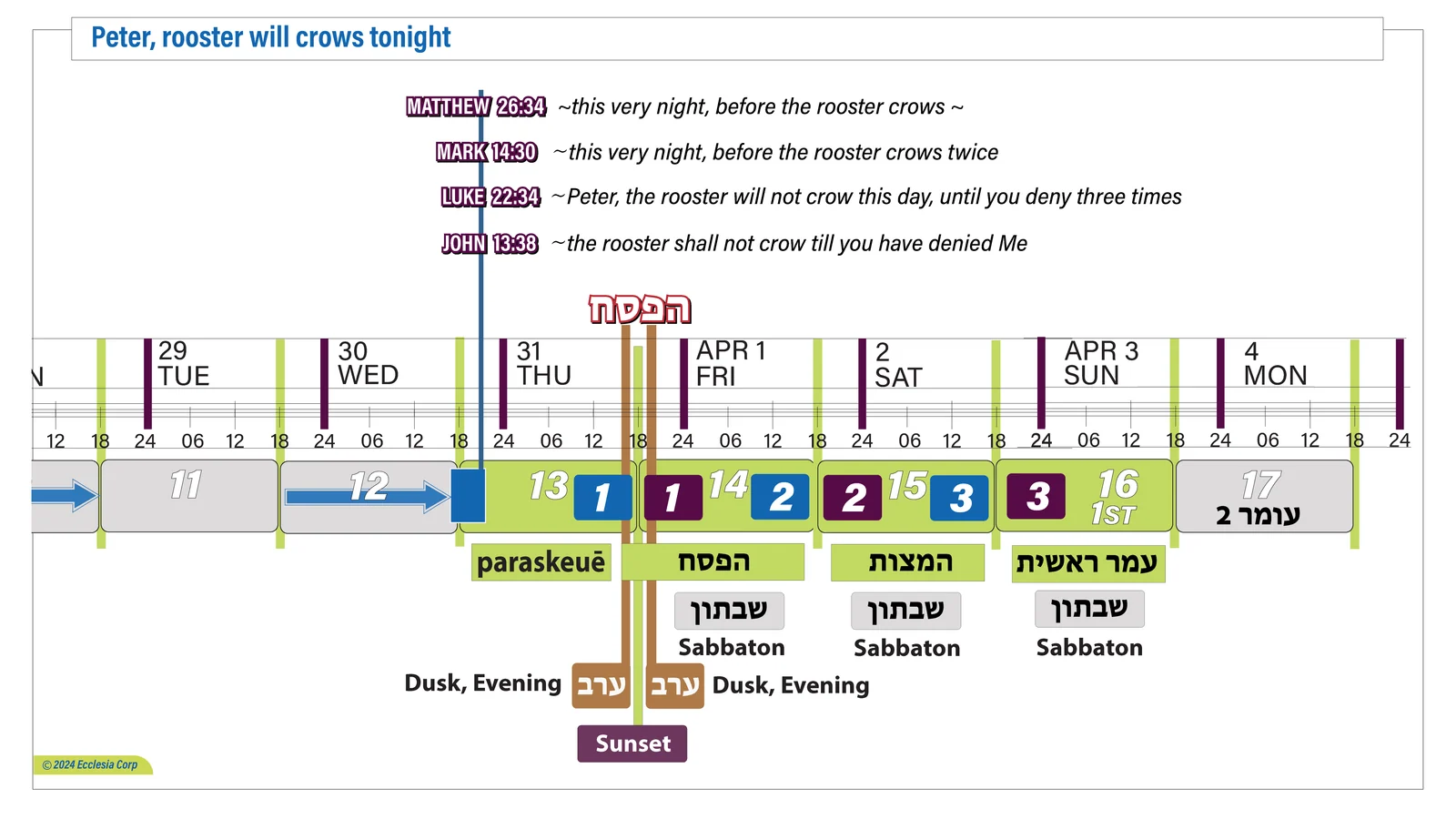
The following table reconstructs Yeshua's final week in fourteen stages. "Biblical date" follows the festival-day calendar, in which the day changes when evening arrives. The dividing lines mark the points where the date turns at the onset of evening.
| Stage | Biblical Date | Event | Count |
|---|---|---|---|
| 1 | Daytime of Abib 12 | Disciples ask Yeshua where to prepare for the meal. Preparations for the Last Supper during the day. | |
| ━ Evening arrives — 12th transitions to 13th ━ | |||
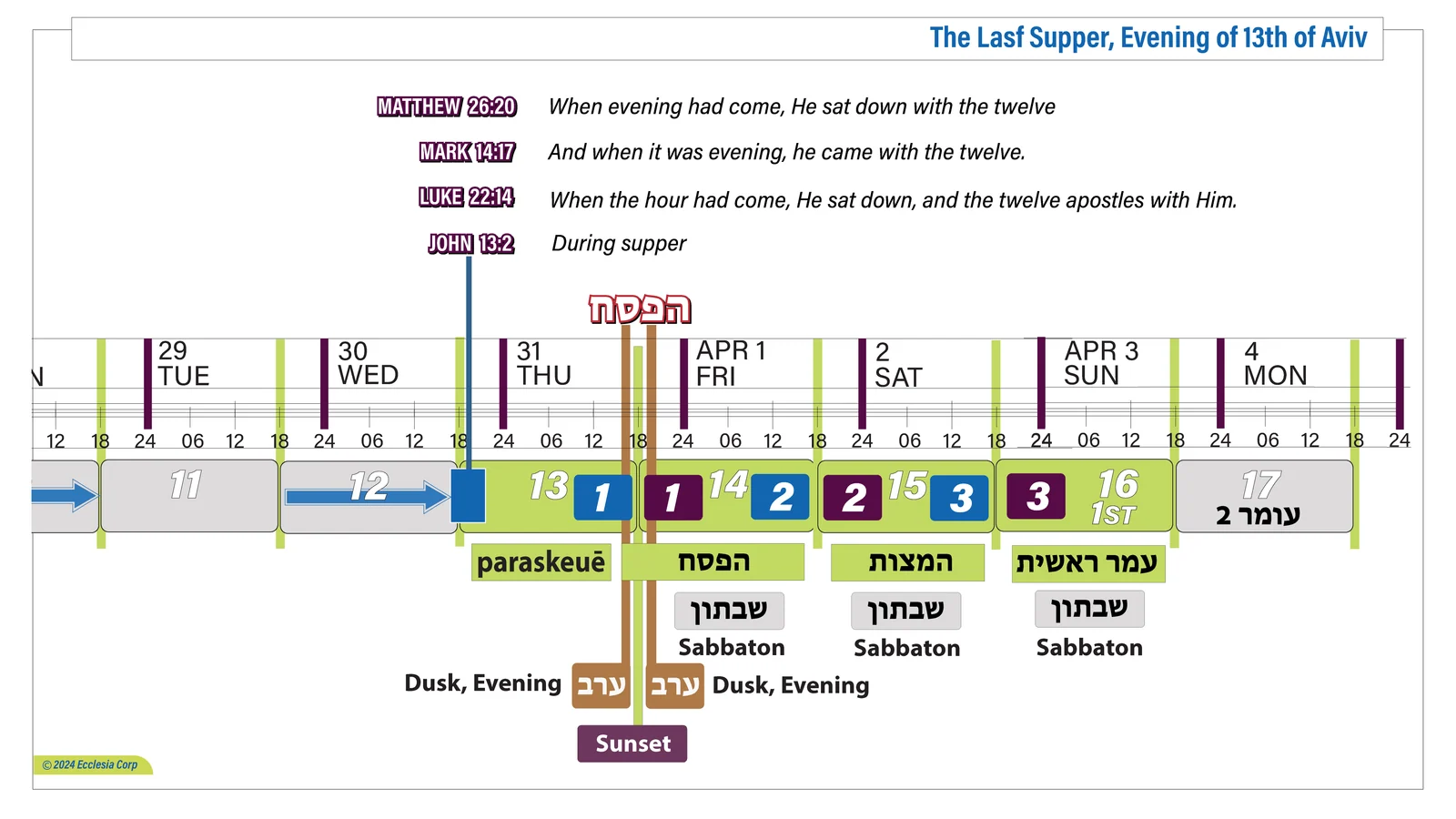
| 2 | Abib 13 begins (evening) | The Last Supper. The final leavened meal. Yeshua takes ἄρτος (ordinary bread) and says "This is my body." | |
| 3 | Night of the 13th | Prayer in Gethsemane on the Mount of Olives | |
| 4 | Late night of the 13th | The crowd led by Judas arrives; Yeshua is arrested | |
| 5 | Before dawn to morning of the 13th | Before Annas → Caiaphas → Sanhedrin → Pilate → Herod → Pilate again | |
| 6 | Morning of the 13th | Carrying the cross to Golgotha | |
| 7 | Daytime of the 13th (~9th hour) | Dies on the cross | Death |
| 8 | Daytime of the 13th | Enters into death | First Day |
| ━ Evening arrives — 13th transitions to 14th ━ | |||
| 9 | Abib 14 begins (evening) | Passover begins. The prepared sacrifice is offered. | First Night |
| 10 | Daytime of the 14th | Remains in death | Second Day |
| ━ Evening arrives — 14th transitions to 15th ━ | |||
| 11 | Abib 15 begins (evening) | Feast of Unleavened Bread begins. The Great Sabbath. (Lev 23:6–7) | Second Night |
| 12 | Daytime of the 15th | Sabbath continues | Third Day |
| ━ Evening arrives — 15th transitions to 16th ━ | |||
| 13 | Abib 16 begins (evening) | The third night begins | Third Night |
| 14 | Dawn of the 16th | Resurrection. The day of the Omer Reishit (First Sheaf) wave offering. | Resurrection |
5-2. The Fulfillment of Matthew 12:40 — "Three Days and Three Nights"
Matthew 12:40For as Jonah was three days and three nights in the belly of the great fish, so will the Son of Man be three days and three nights in the heart of the earth.
Counting from the timeline above:
- Three days: Daytime of the 13th (first day) + daytime of the 14th (second day) + daytime of the 15th (third day)
- Three nights: Night of the 14th (first night) + night of the 15th (second night) + night of the 16th (third night)
Exactly three days and three nights. And at the close of the third night — the dawn of the 16th, the morning of the Omer Reishit wave offering — Yeshua rose. By contrast, the conventional scheme of "Friday afternoon death — Sunday morning resurrection" cannot yield three days and three nights no matter how one counts.
6Yeshua Offered as the True Passover Sacrifice
We now examine the theological significance of this timeline. Yeshua's death was not simply an event — it was placed on a perfect divine schedule as the fulfillment of the entire Passover system.
6-1. The Completion of the Sacrifice Preparation
According to Exodus 12, the Passover lamb was to be selected on the 10th, confirmed unblemished before the 14th, and offered "between the two evenings" (בֵּין הָעַרְבָּיִם, bein ha'arbayim) on the 14th. A critical clarification is needed here. For two millennia, a particular way of interpreting this phrase in the Hebrew Bible has obscured the perfect harmony of the Old and New Testaments.
- The word 'ad ("until," עד) in Exodus 12:6 should be read as "kept until the 14th." The same grammatical structure appears in Genesis 3:17 — a person eats bread until death; after death, eating is no longer possible. The identical structure and use of the Hebrew 'ad demonstrates this.
- "Between the two evenings" refers to the moment of evening itself — the interval from the first appearance of the sunset glow to the lingering afterglow once the sun has crossed the horizon. Joshua 5:10 confirms this as a single erev (evening).
- The word שָׁחַט (shachat) — often translated "slaughter" — must here be understood as "offer." It is impossible for vast numbers of Israelites to have gone out in the evening to slaughter a single small lamb each. Exodus 12:6 describes bringing a ritually prepared sacrifice to be offered.
- That shachat means "offer" is confirmed by Exodus 34:25: "You shall not offer [shachat] the blood of my sacrifice with anything leavened..."
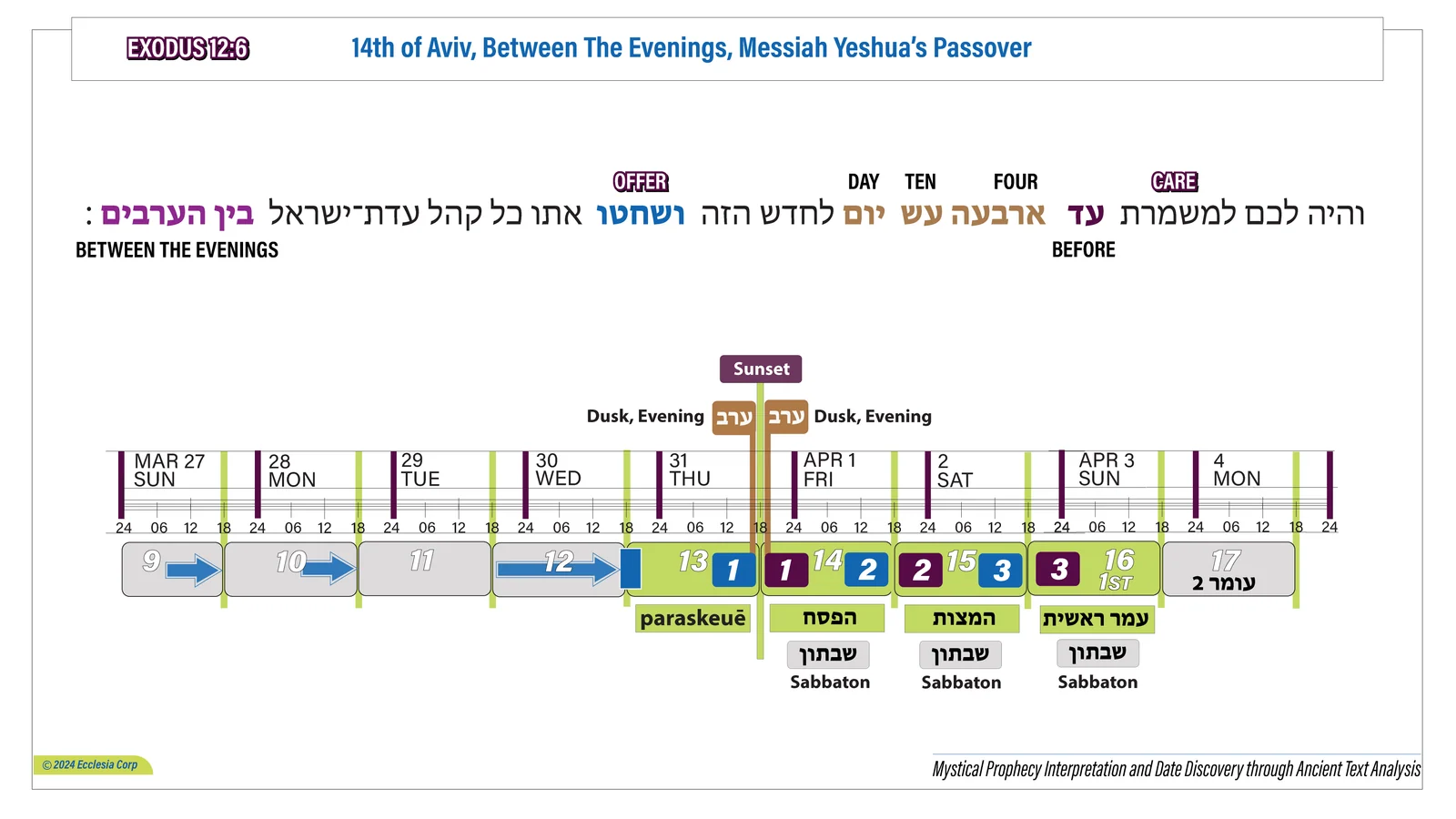
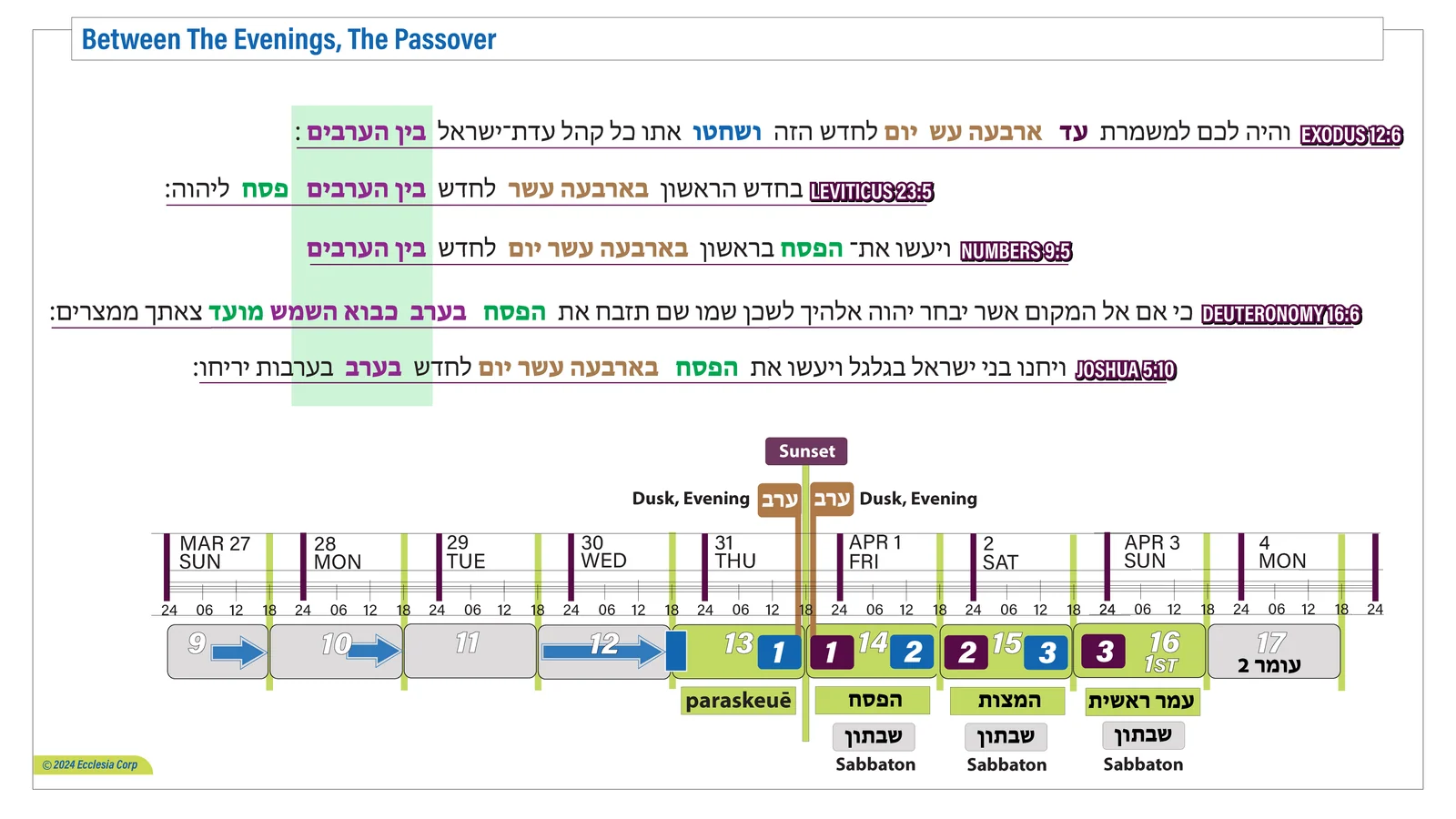
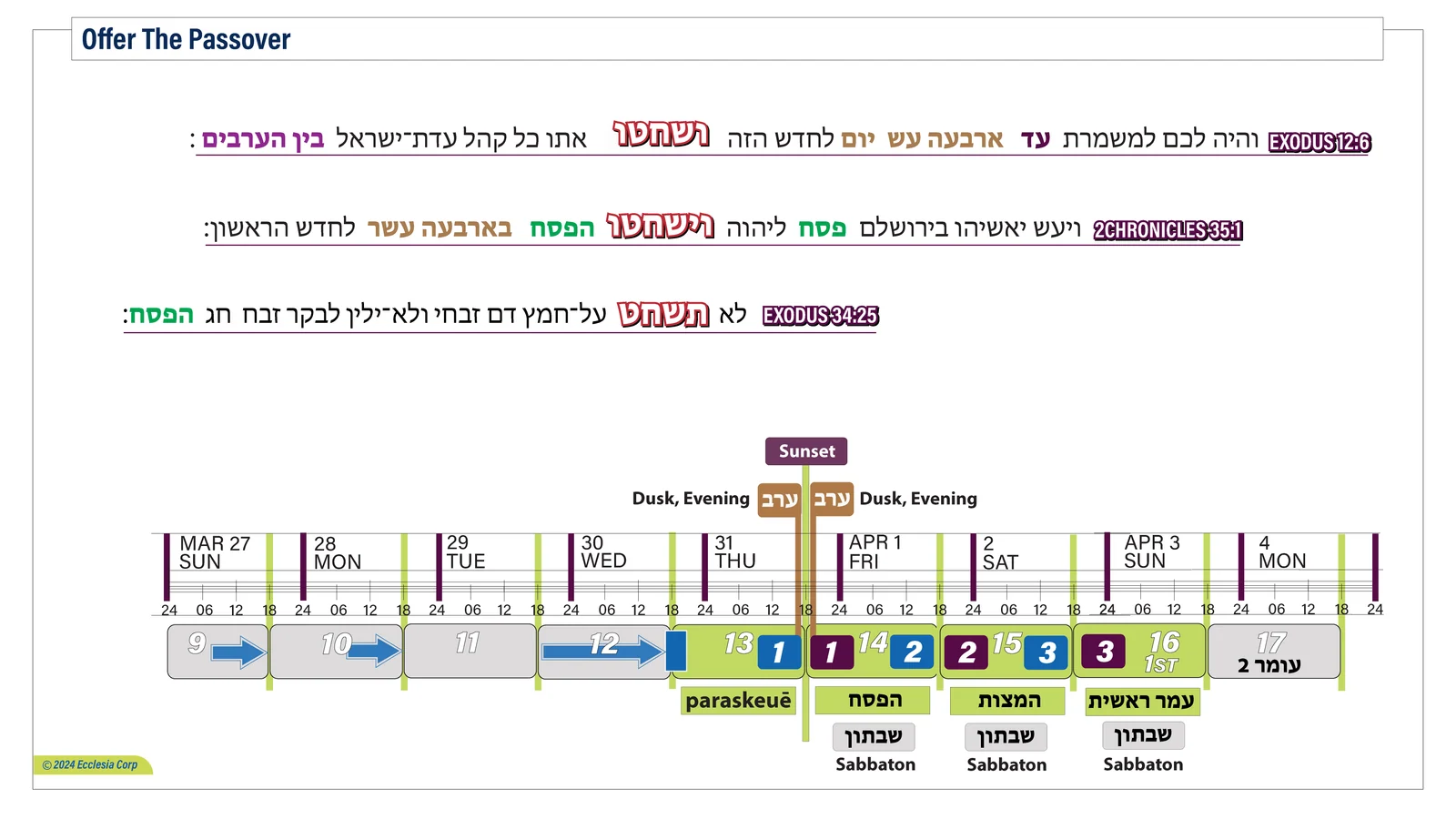
When Exodus 12:6 is read accurately, it describes all Israel offering sacrifices to the LORD at the evening of the 14th — having prepared their offering carefully in the days before. Yeshua died at the ninth hour of the daytime of the 13th — about three in the afternoon — the very hour the Passover lambs were being sacrificed at the Temple. And when evening fell and the 14th (Passover) began, Yeshua's body lay in the tomb as an offering already made.
6-2. Shadow and Substance
The institutional Passover was the shadow; Yeshua's death is the substance. Hebrews 10:1 states: "For the law has but a shadow of the good things to come instead of the true form of these realities." When Jewish households ate the roasted lamb that evening, the true Passover sacrifice — Yeshua's body — had already been offered and lay in the tomb.
6-3. The Great Sabbath of Unleavened Bread
Leviticus 23:2 declares that the entire chapter constitutes a mikra-kodesh (a holy convocation) and that all the appointed times described are the LORD's moedim (covenant-appointed times). Every one of them is designated a Shabbat Shabbaton. This is precisely what the New Testament calls the "Great Sabbath." These festival days are proclaimed as Sabbaths by virtue of the appointed time itself, regardless of whether they coincide with the weekly Sabbath. Every day that Yeshua lay in the tomb fell precisely within this Great Sabbath sequence.
6-4. The Resurrection — Omer Reishit, First Fruits of Those Who Sleep
Leviticus 23:10–11"When you come into the land that I give you and reap its harvest, you shall bring the sheaf of the firstfruits of your harvest to the priest, and he shall wave the sheaf before the LORD, so that you may be accepted. On the day after the Sabbath the priest shall wave it."
"The day after the Sabbath" refers to the day following the first day of Unleavened Bread (the 15th, the Great Sabbath) — that is, the morning of Abib 16. And it was at the dawn of this 16th, the morning of the Omer Reishit wave offering, that Yeshua rose from the tomb.
1 Corinthians 15:20"But now Christ has been raised from the dead, the firstfruits of those who have fallen asleep" (ἀπαρχή, aparchē).
The word "firstfruits" is not incidental. Paul is explicitly identifying Yeshua's resurrection as the fulfillment of the Omer Reishit offering. At the precise hour when the ancient first sheaf was waved before the LORD, Yeshua rose as "the firstfruits of those who sleep." No more perfect chronological correspondence exists.
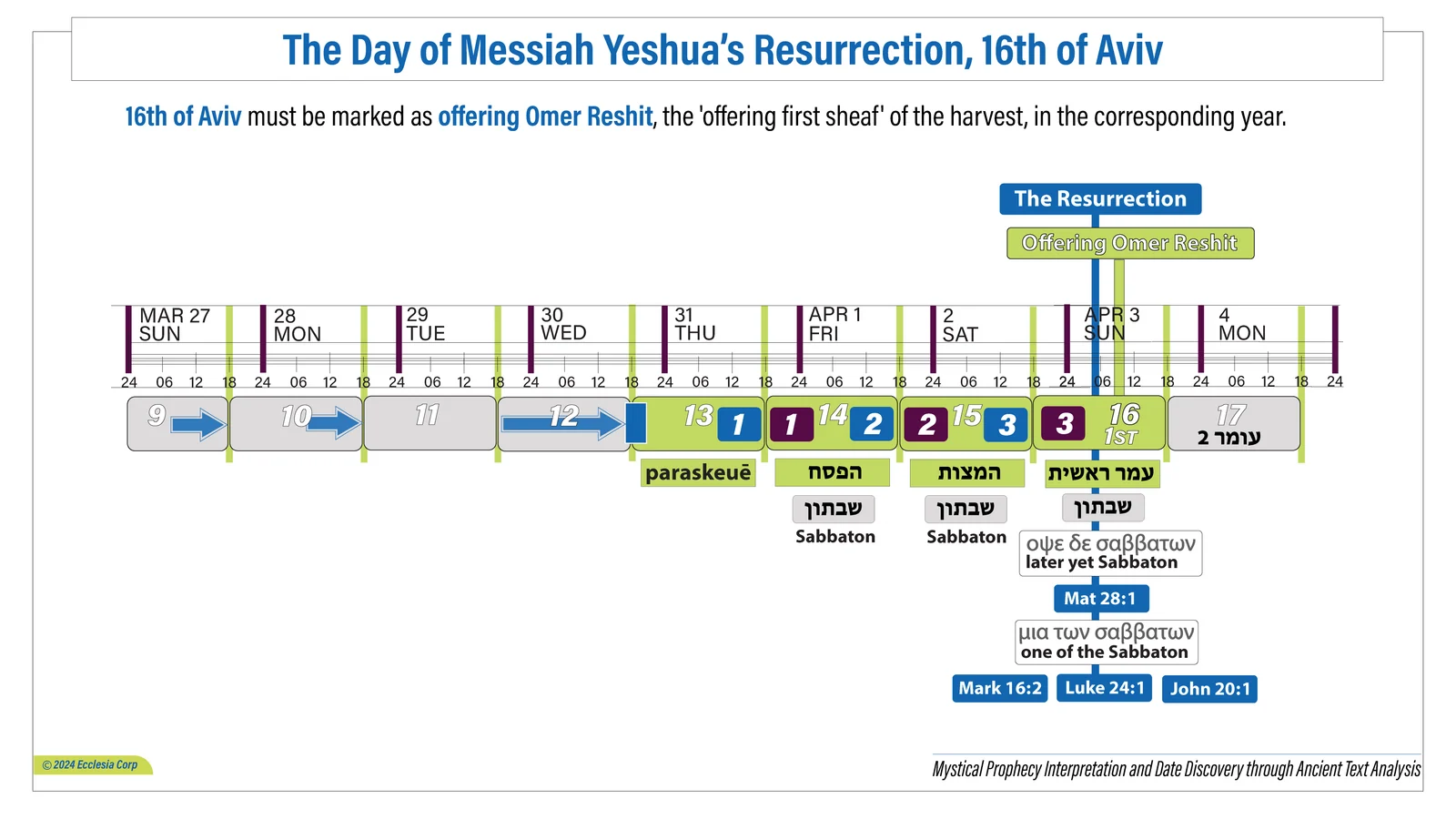
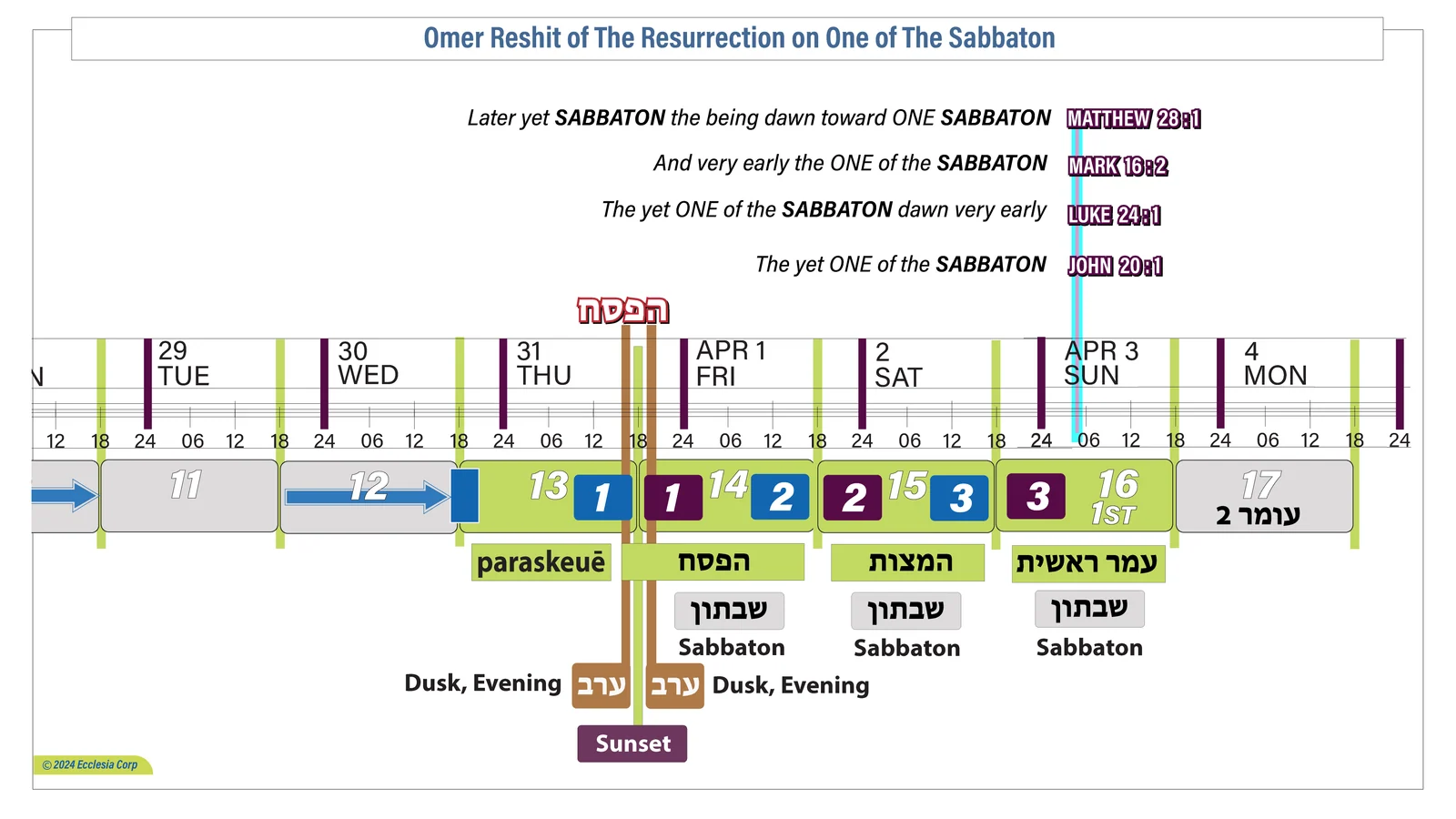
- 1. Passover (evening of the 14th): Presented as the completed offering
- 2. The Great Sabbath of Unleavened Bread (the 15th): Resting in the tomb
- 3. Omer Reishit Wave Offering Day (dawn of the 16th): Rising as the firstfruits of those who sleep
Three appointed times fulfilled in succession across three days. Not coincidence — God's precise timetable.
7The Testimony of the Ancient Church — The Quartodeciman Tradition
The timeline examined throughout this study is not merely a later reinterpretation. It is rooted in apostolic tradition, close to the original witness of the early church in the first and second centuries.
7-1. Who Were the Quartodecimans?
Quartodeciman comes from the Latin quarta decima — "the fourteenth." These were early Christian communities — centered especially in Asia Minor, Syria, and Jerusalem — who commemorated the Pascha (the Passover/Easter observance of Yeshua's death and resurrection) on the 14th of Abib regardless of what day of the week it fell on. What makes this tradition significant is that they claimed to have received it directly from the apostles. Polycarp of Smyrna (c. 69–155 AD), a disciple of the Apostle John, maintained this tradition; his disciples Irenaeus and Polycrates of Ephesus continued it.
7-2. The Testimony of Polycrates (c. 190 AD)
Around 190 AD, when Bishop Victor I of Rome ordered all churches to celebrate Easter on Sunday, Polycrates, bishop of Ephesus, sent a vigorous written protest. Quoted by Eusebius in Ecclesiastical History 5.24:
Polycrates, Letter to Victor (Eusebius, Eccl. Hist. 5.24)"We observe the exact day; neither adding, nor taking away. For in Asia also great lights have fallen asleep... All these observed the fourteenth day of the Passover according to the Gospel, deviating in no respect, but following the rule of faith."
This testimony is decisive: a second-century bishop witnesses that his tradition was received directly from the Apostle John, and that they observed the Pascha on the 14th of Abib — not on a particular day of the week.
7-3. The 14th as "The Day the People Put Away the Leaven"
Ancient sources recording the mid-second-century Passover practice in Asia Minor describe the 14th as both "the day when the Passover lamb is offered" and "the day when the people put away the leaven." This expression appears repeatedly in Eusebius and other early records. The implication is unmistakable: leaven removal had to be completed before the evening of the 14th — precisely the timeline we have traced.
7-4. The Leavened Bread Tradition of the Eastern Church
The traces of the Quartodeciman tradition survive to this day in the Eucharistic liturgy of the Eastern Orthodox Church, which has long used leavened bread (ordinary bread) in the Eucharist, citing the original Greek text's use of ἄρτος. The Western Roman Church, by contrast, shifted in the medieval period to unleavened bread. The bread question was one of the major points of contention in the Great Schism of 1054.
7-5. Calvin's Historical Testimony
Calvin, Institutes 4.17.43"History records that before the time of Alexander, Bishop of Rome, ordinary bread was used. He was the first to prefer unleavened bread, the reason for which I do not know; unless perhaps it was that in this new spectacle he might lead the people to admire what was unusual."
Calvin points out — on the basis of historical sources — that the long-standing Roman Catholic practice of unleavened Eucharistic bread was actually a change introduced by Bishop Alexander of Rome (c. 109–119 AD). Before that, the church used ordinary bread.
7-6. Quartodecimans Under Persecution
After the Council of Nicaea (325 AD), the Quartodeciman tradition was increasingly marginalized under the charge of "Judaizing." Yet it did not vanish immediately. Church historian Socrates Scholasticus records that as late as the early fifth century, Quartodecimans in Constantinople were expelled by John Chrysostom and persecuted by Nestorius — demonstrating that the apostolic Pascha tradition survived at least into the fourth and fifth centuries.
8The Meaning of the Last Supper — The Old Covenant Concluded with Leavened Bread
Bringing all this evidence together, the theological meaning of the Last Supper comes into still deeper focus. Yeshua's holding of a final leavened meal on the evening of the 13th was not incidental — it was an act placed at the very climax of the entire festival structure.
8-1. The Threshold Meal of the Festival
Passover (beginning with the evening of the 14th) and the Feast of Unleavened Bread (the 15th through the 21st) form one continuous great festival. Within its structure, the evening of the 13th is when every household consumes the last of its leavened food. The final leavened meal of the 13th evening is essentially a meal at "the threshold between the old and the new." Given that leaven (fermentation) is used in Scripture as a symbol of sin and corruption, this meal can be understood as one eaten at the very boundary where "the body of the old is put off" in preparation for entering the state of the unleavened — the state of purity.
8-2. Yeshua Identifying Himself as the Leavened Bread — "My Body"
It is at this very meal that Yeshua takes the leavened ἄρτος and says: "This is my body" (τοῦτό ἐστιν τὸ σῶμά μου). Yeshua himself was sinless and without corruption — and yet, within this festival timetable, he identifies himself with "what must end, what must be removed." Paul's words in 1 Corinthians 5:7 resonate here: "Cleanse out the old leaven that you may be a new lump, as you really are unleavened. For Christ, our Passover lamb, has been sacrificed." Yeshua's physical death is the "removal of the leaven" — the conclusion of the old, the threshold into the new lump.
8-3. The Perfect Sequence of Fulfillment
- Evening of the 13th — He takes leavened bread and identifies it with his body, giving it to his disciples.
- Daytime of the 13th — At the ninth hour (the hour of the Passover sacrifice), he breathes his last on the cross. The institutional Passover is fulfilled in its archetype.
- Evening of the 14th — Passover begins; Yeshua's body is already in the tomb, presented as the completed offering. The lamb that households eat is now merely the shadow of the reality already accomplished.
- The 15th — The Great Sabbath of Unleavened Bread. Yeshua rests in the tomb; the world enters the "unleavened" state.
- Dawn of the 16th — The Omer Reishit wave offering day. At the hour the first sheaf is waved, Yeshua rises as "the firstfruits of those who sleep."
This sequence could not have been devised by human ingenuity. That the festival ordinances of the Torah (written in the 1400s BC) were fulfilled to the precise hour in the life of Yeshua fourteen centuries later is evidence that all of this was accomplished within the perfectly prepared plan of God.
Conclusion
What this study has addressed is not merely an academic dispute about correcting a few dates. It is the story of God's perfect timetable — the timetable that emerges when we follow what the biblical text itself declares about Yeshua's final week.
For centuries, the church has taught the scheme of "Thursday supper — Friday death — Sunday resurrection" as settled fact. But this scheme cannot satisfy the sign Yeshua himself gave — "three days and three nights" — nor does it align with John's "before the Passover" timestamp, nor with the original text's use of ἄρτος.
When instead we apply the biblical definition of a day with precision and follow the Torah's festival ordinances as they stand, Yeshua's final week emerges as a complete and perfect picture: beginning with the final leavened meal on the evening of the 13th, and concluding with the resurrection at dawn on the 16th — the morning of the First Sheaf wave offering. This picture aligns with the testimony of the Quartodecimans and matches exactly the vocabulary of the original text. That Yeshua is "our Passover lamb" (1 Cor 5:7) and "the firstfruits of those who have fallen asleep" (1 Cor 15:20) is testimony that his death and resurrection were placed by divine providence on the exact timetable of the Torah's appointed times.
Appendix · Key Scripture Passages
Genesis 1:5 · The Start of the DayAnd there was evening, and there was morning — the first day.
Exodus 12:18 · The Obligation Period for Unleavened BreadIn the first month, on the fourteenth day of the month at evening, you shall eat unleavened bread, until the twenty-first day of the month at evening.
Matthew 12:40 · The Time SignFor as Jonah was three days and three nights in the belly of the great fish, so will the Son of Man be three days and three nights in the heart of the earth.
Matthew 26:26 · Ordinary Bread (ἄρτος)Now as they were eating, Yeshua took bread [ἄρτος, ordinary bread], and after blessing it broke it and gave it to the disciples, and said, "Take, eat; this is my body."
John 13:1 · A Supper Before the PassoverNow before the Feast of the Passover, when Yeshua knew that his hour had come to depart out of this world to the Father, having loved his own who were in the world, he loved them to the end.
1 Corinthians 15:20 · Firstfruits of Those Who SleepBut in fact Christ has been raised from the dead, the firstfruits of those who have fallen asleep.
1 Corinthians 5:7–8 · Yeshua = Our PassoverCleanse out the old leaven that you may be a new lump, as you really are unleavened. For Christ, our Passover lamb, has been sacrificed. Let us therefore celebrate the festival... with the unleavened bread of sincerity and truth.
To read the passage itself
Every passage these studies discuss is on this site. All 66 books, one tap away.