 BIBLE HOMES
Bible Study · Yeshua Study, Part Two
The Divine Heh
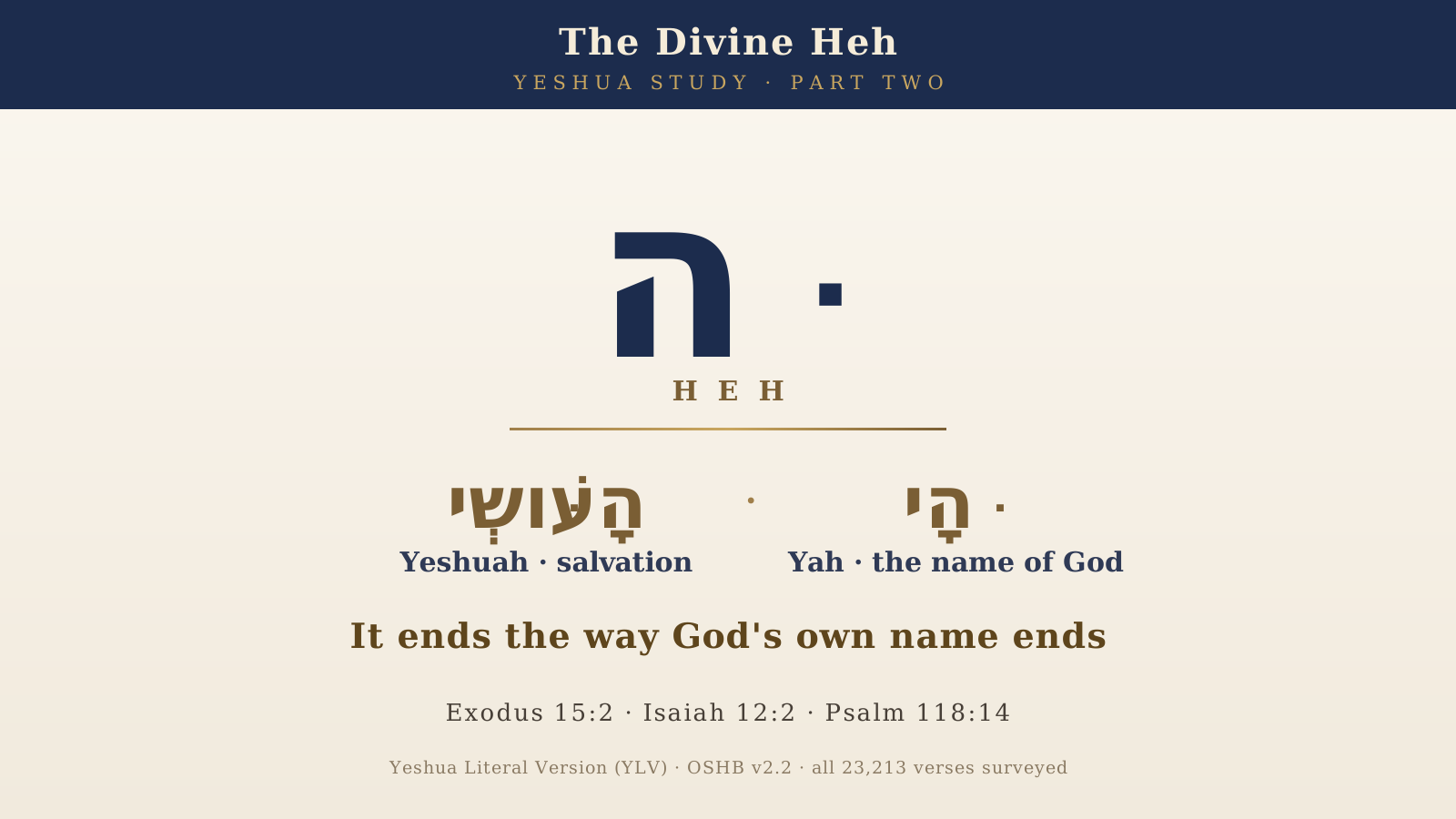
The one letter that holds a nameYah · Eloah · Yeshuah — a full survey of the final Heh (הּ)
Hebrew source · OSHB v2.2 (Westminster Leningrad Codex) · Transliteration · YLV Rulebook V69
Introduction
In the Hebrew Bible, some words end with the letter Heh (הּ). Standard lexicons and grammars generally classify that Heh as a feminine ending. Yet the same letter is also one of the consonants that make up the name of God. This study surveys every use of that single letter across the Hebrew text, setting out both what the standard classification explains and where it collides with the text itself.
Part One, “The Secret of the Name Yeshua,” distinguished Yeshuah (H3444) from the personal name Yeshua (H3442), and proposed reading the Heh of the former not as a feminine ending but as an honorific and divine marker. Because that position stands directly opposed to every existing standard lexicon, it calls for verification from the text itself. This short edition sets out the substance of that verification.
Every Hebrew word quoted here is given with its transliteration and meaning and broken down morpheme by morpheme, so the argument can be followed with no prior knowledge of Hebrew. All figures come from a survey of all 23,213 verses of OSHB v2.2, and the morphological tags are quoted from OSHB exactly as they stand.
Hebrew reads from right to left. Below is a sample word broken into its morphemes; every Hebrew word in this study is presented the same way.
1Six Kinds of Final Heh
One premise must be established first: even within standard Hebrew grammar, a Heh at the end of a word is not one single thing. This is not a matter of dispute but a basic point every grammar acknowledges.
| Category | Example | Translit. | Meaning | Relation to gender |
|---|---|---|---|---|
| Feminine singular ending | תּוֹרָה | Torah | the instruction of God | feminine |
| Directional Heh | מִצְרַיְמָה | Mitzraymah | toward Egypt | none |
| 3rd fem. sing. possessive suffix | צִדְקָהּ | tzidkah | her righteousness | feminine |
| 3rd masc. sing. possessive suffix | אָהֳלֹה | oholoh | his tent (Gen 9:21) | masculine |
| Lengthened imperative / cohortative | קוּמָה | qumah | arise! | none |
| Paragogic Heh (added Heh) | יְשׁוּעָתָה | yeshuatah | salvation | none · function unspecified |
The second entry shows this clearly. The Heh on Mitzraymah is not there because Egypt is a feminine noun; it marks direction — “toward.” The usage has nothing to do with gender, and OSHB marks it with a separate tag (Sd), recording it 1,079 times across the text.
The ending does determine gender — confirming the normal case
The reverse must also be checked. Does the ending ָה actually determine grammatical gender, or is gender determined by semantic category? Torah served as the test case. Torah carries the ending ָה; OSHB tags all 219 occurrences as a feminine noun, and both agreement and reference converge on the feminine — in Isaiah 2:3, “Torah shall go forth from Zion,” the verb תֵּצֵא tetze (“it shall go forth”) is third feminine singular; in Psalm 19:8, “the Torah of YHVH is perfect,” the adjective תְּמִימָה temimah (“perfect”) is feminine singular. There is no case of it being taken as masculine.
Could the explanation then be semantic — that words belonging to writings and documents are feminine? A full survey of words in that same semantic class shows otherwise.
| Hebrew · translit. | Meaning | Ending ָה | Gender |
|---|---|---|---|
| sepher סֵפֶר | book · scroll (185×) | no | masculine |
| davar דָּבָר | word (1,441×) | no | masculine |
| choq חֹק | statute (126×) | no | masculine |
| Torah תּוֹרָה | Torah (219×) | yes | feminine |
| megillah מְגִלָּה | scroll (21×) | yes | feminine |
| chuqqah חֻקָּה | statute (105×) | yes | feminine |
The result follows form, not meaning. Sepher, the standard word for “book,” is masculine in all 185 occurrences; and choq and chuqqah, both meaning “statute,” share a root yet split in gender purely by whether the ending is present. In the phrase rendered “the book of the law,” סֵפֶר הַתּוֹרָה sepher ha-Torah, the two words divide within a single verse — “book” masculine, “Torah” feminine.
Of the six categories, only two relate to the feminine; three have nothing to do with gender, and one in fact points to a masculine referent.
The ending is a valid marker of grammatical gender — but that gender follows form rather than semantic category, and so tells us nothing about the actual sex of the thing referred to. A scroll cannot have a gender.
An ending alone therefore does not settle the question. Which category a given word's Heh belongs to is decided together with how the word is actually used in the text, and the discussion below proceeds on that basis. Only against a normal case like Torah — where ending, agreement, and reference all converge — does the exceptional character of Yeshuah, treated from section 5 onward, become visible.
2Divine Names Ending in Heh — Yah and Eloah
The very consonant that the standard classification defines as a feminine ending is also a consonant that makes up the name of God. This is not a matter of interpretation; it is the text exactly as written.
The shortest form of the divine name ends with a mappiq Heh. The mappiq is the mark showing that this Heh is not silent but a consonant genuinely sounded. No lexicon classifies this word as feminine, and OSHB likewise tags it as a proper noun (Np). Even the familiar “Hallelujah” is, strictly, hallelu-Yah, and its final consonant is this Heh.
What is decisive for the argument is how this word is tagged. Although its final consonant is a Heh, OSHB classifies it as a masculine noun, and among its 59 occurrences there is not one classified as feminine.
A masculine divine name ending in a mappiq Heh already occurs 59 times in the text.
The bare formal fact that a word ends in Heh is therefore no ground for declaring it feminine. Eloah is the counter-example — and that counter-example sits inside the standard lexicons' own classification.
3The Three Verses Where Yah and Yeshuah Appear Together
In the whole Old Testament there are three verses where Yah (H3050) and Yeshuah (H3444) stand in the same verse, and those three verses share what is effectively one and the same sentence.
Exodus 15:2 — the song after crossing the Sea of ReedsYah is my strength and song, and He has become salvation (Yeshuah) to me. This is my God (El), and I will praise Him.
Isaiah 12:2Behold, God (El) is my salvation (Yeshuah); I will trust and not be afraid — for Yah YHVH is my strength and song, and He has become salvation (Yeshuah) to me.
Psalm 118:14Yah is my strength and song, and He has become salvation (Yeshuah) to me.
The key vocabulary shared by the three verses is as follows.
| Hebrew | Translit. | Meaning |
|---|---|---|
| עָזִּי | ozzi | my strength |
| וְזִמְרָת | ve-zimrat | and song |
| יָהּ | Yah | the name of God — ends in Heh |
| לִישׁוּעָה | li-shuah | has become salvation — ends in Heh |
In all three verses the same consonant appears twice — once at the end of God's name, and once at the end of the name of what that God became for the speaker.
And what the sentence states is that the two are one: Yah Himself became the speaker's Yeshuah.
4The Chain in Psalm 118
Of those three verses, Psalm 118 calls for separate examination, because the same root runs through the psalm four times.
| Verse | Text | The word |
|---|---|---|
| 14 | Yah is my strength and song, and He has become salvation to me | Yah · Yeshuah |
| 21 | I thank You, for You have become salvation to me | Yeshuah |
| 25 | O YHVH, save now! | Hoshiah |
| 26 | Blessed is He who comes in the name of YHVH | — |
This expression in verse 25 is precisely “Hosanna,” and in the New Testament it is these verses 25 and 26 that the crowd cried out to Yeshua as He entered Jerusalem (Matt 21:9).
Psalm 118 begins at Yah, passes through Yeshuah, arrives at hoshiah na (Hosanna), and closes with “He who comes in the name of YHVH.”
All four points are linked by the same root and the same consonant — and the crowd in the New Testament directed that cry to a person.
5The Three Verses the Standard Analysis Treated as Exceptions
Yeshuah occurs 77 times in the Old Testament, and OSHB tags every one of them as a feminine noun. That unanimity must be granted as fact. Within it, however, there are three exceptions.
In these three verses Yeshuah carries one Heh more. A Heh has been added to a word that already has a Heh classified as a feminine ending. The standard analysis could not read this second Heh as a feminine ending; and since the context carries no sense of movement, it could not be classified as a directional Heh either. The result was that it was handled as a paragogic Heh — an added Heh whose function cannot be specified.
| Verse | Hebrew | Translit. | What the context states |
|---|---|---|---|
| Jonah 2:10 | יְשׁוּעָתָה | yeshuatah | Salvation belongs to YHVH |
| Psalm 3:3 | יְשׁוּעָתָה | yeshuatah | There is no salvation for him in God (the adversaries' claim) |
| Psalm 80:3 | לִישֻׁעָתָה | li-shuatah | Come for salvation for us |
Verse numbers follow the Hebrew text; English Bibles number these Jonah 2:9, Psalm 3:2, and Psalm 80:2.
Jonah 2:10 — the closing sentence of the confession from inside the fishBut I will sacrifice to You with the voice of thanksgiving; I will pay what I have vowed. Salvation (Yeshuatah) belongs to YHVH.
The three verses state, respectively, salvation that belongs to God, salvation that is in God, and salvation that comes from God — and the cases where Yeshuah takes an added Heh are confined to these three.
That the standard analysis suspended judgment about function at exactly this point itself suggests something the existing categories do not capture. This study reads that added Heh as a divine marker: at the very places that state most strongly that salvation belongs to God, the word ends the way God's own name ends.
6Genesis 3:15 — the Text Names the Gender
Where the preceding sections argued from form and distribution, Genesis 3:15 is different in kind. Here the text itself specifies what gender it assigns to the noun in question.
Genesis 3:15 — a verse fixed by Rulebook §12.7And I will put enmity between you and the woman (ishah), and between your seed and Seed-H(Seed of YHWH) (Zarah) — He shall bruise your head, and you shall bruise His heel.
| Hebrew | Translit. | Role | Gender |
|---|---|---|---|
| זַרְעָהּ | zarah | “her seed” — the noun itself | masculine noun |
| הוּא | hu | the pronoun taking up that seed | masculine |
| יְשׁוּפְךָ | yeshuphekha | the verb that follows | masculine |
The noun, the pronoun, and the verb are all masculine; the only element analyzed as feminine is the single Heh of the ending.
In this verse the gender of the referent is not open to dispute, because the text specifies it as masculine twice — through the pronoun and through the verb.
To declare it feminine on the strength of one ending is to let a morphological analysis override what the text has explicitly stated.
7Genesis 4:1 — the Repeated Et and the Word Ish
The statement Eve made after bearing a son — having heard the promise of Genesis 3:15 — follows in the very next chapter. Here too the grammatical grounds are supplied by the text itself.
Genesis 4:1 — a verse fixed by Rulebook §12.7And Adam knew Eve his wife; and she conceived and bore Cain, and said: “I have gotten a man (ish), YHVH.”
The same word, three times over
This verse contains אֶת et three times, and all three are identical in consonants and vowel points alike.
| Occurrence | Word that follows | OSHB classification |
|---|---|---|
| ① אֶת | Eve — Adam's wife | direct object marker (H853) |
| ② אֶת | Cain — the son borne | direct object marker (H853) |
| ③ אֶת | YHVH | preposition “with” (H854) |
No marker distinguishing ① and ② from ③ exists in the text. Standing alone without a suffix, et is the direct object marker 6,461 times and “with” 253 times — 96.2 % direct object. The standard analysis and most translations treat only ③ as “with”; what this study points out is that the distinction has no basis in the text.
How ish is used
אִישׁ ish (H376) is the noun for an adult man, occurring 2,186 times in the Old Testament. A newborn is normally called בֵּן ben (son), not ish. A full survey of the 24 verses where the verb “to bear” (H3205) and ish occur in the same verse found that in none of them does ish refer to a newly born child.
Jeremiah 20:15 shows this plainly. Within one verse, the adult who brought the news is ha-ish while the newborn child is ben. Eve too used ben when she bore Seth (Gen 4:25); Genesis 4:1 is the only place she used ish.
The same et stands before Cain and before YHVH with no distinguishing marker in the text; a standalone et is the direct object marker 96.2 % of the time; and the ish in that same verse is a word never applied to a newborn. On these grounds Rulebook §4.8 reads the third et as a direct object marker, fixing the sentence as “I have gotten a man (ish), YHVH.” This is understood not as a description of an infant, but as the declaration of one who had heard the promise of Genesis 3:15.
8Weighing the Counter-Evidence
The arguments above support this study's reading. But evidence pointing the other way also exists, and it is presented and examined here alongside.
Feminine verb agreement — four verses
| Verse | Text |
|---|---|
| Isaiah 51:6 | My salvation (Yeshuah) shall be forever |
| Isaiah 59:11 | We look for salvation (Yeshuah), but it is far from us |
| Job 30:15 | My salvation (Yeshuah) has passed away like a cloud |
| Psalm 69:30 | Your salvation (Yeshuah) will set me on high |
In these four verses the verb governed by Yeshuah is feminine. This study does not deny the fact; the question is what the fact proves. Three things must be distinguished.
First, grammatical agreement does not tell us the gender of the referent. German das Mädchen (“the girl”) is a neuter noun and takes a neuter article, but the girl it refers to is not neuter. Agreement is information about a word's grammatical gender, not about the being that word refers to.
Second, the same word is also governed by a masculine verb. Isaiah 62:1 says “until her salvation burns like a torch,” and the word for “shall burn,” יִבְעָר yiv'ar, is masculine. That would not occur with a purely grammatical feminine noun.
Third, there is no case of a feminine pronoun referring to Yeshuah. A survey of all 76 verses in which Yeshuah occurs found zero such cases.
Verb agreement is present; pronominal reference is absent. The two belong to different levels. Verb agreement mechanically follows the form of a word's ending, whereas pronominal reference is a choice, revealing how the speaker understands the thing referred to.
The text attaches a feminine verb in four places by form, but it has never referred to Yeshuah as a feminine person. On the contrary, Genesis 3:15 takes it up with a masculine pronoun, and Isaiah 62:1 attaches a masculine verb.
9Summary
What the survey of the text established can be set out as follows.
| Grounds | Finding |
|---|---|
| The grammar itself | A final Heh falls into six categories; three have nothing to do with gender, and one points to a masculine referent |
| Yah · Eloah | A masculine divine name ending in Heh occurs 59 times, and Yah, the shortest form of the name, likewise ends in a mappiq Heh |
| Ex 15:2 · Isa 12:2 Ps 118:14 | Yah and Yeshuah stand within one and the same sentence, which states that the two are one |
| Psalm 118 | The chain Yah → Yeshuah → hoshiah na → the One who comes |
| Jonah 2:10 · Ps 3:3 Ps 80:3 | The three verses where the standard analysis suspended judgment about function |
| Genesis 3:15 | The text specifies the masculine through both pronoun and verb |
| Genesis 4:1 | The same et repeated, and ish — a word never applied to a newborn |
| Counter-evidence | Feminine verb agreement occurs in four verses, but feminine pronominal reference occurs zero times |
This body of evidence does not deductively prove a single proposition. What the text does show, however, is that the classification “the ending is a Heh, therefore feminine” cannot be sustained for these words.
God ended His own name with that consonant, and the name of what that God became for the speaker ends with the same consonant.
Isaiah 12:2Behold, God (El) is my salvation (Yeshuah); I will trust and not be afraid — for Yah YHVH is my strength and song, and He has become salvation (Yeshuah) to me.
To read the passage itself
Every passage these studies discuss is on this site. All 66 books, one tap away.