
Free from the Law? · Chapter 1 of 41
Ephesians 2 and the Decrees
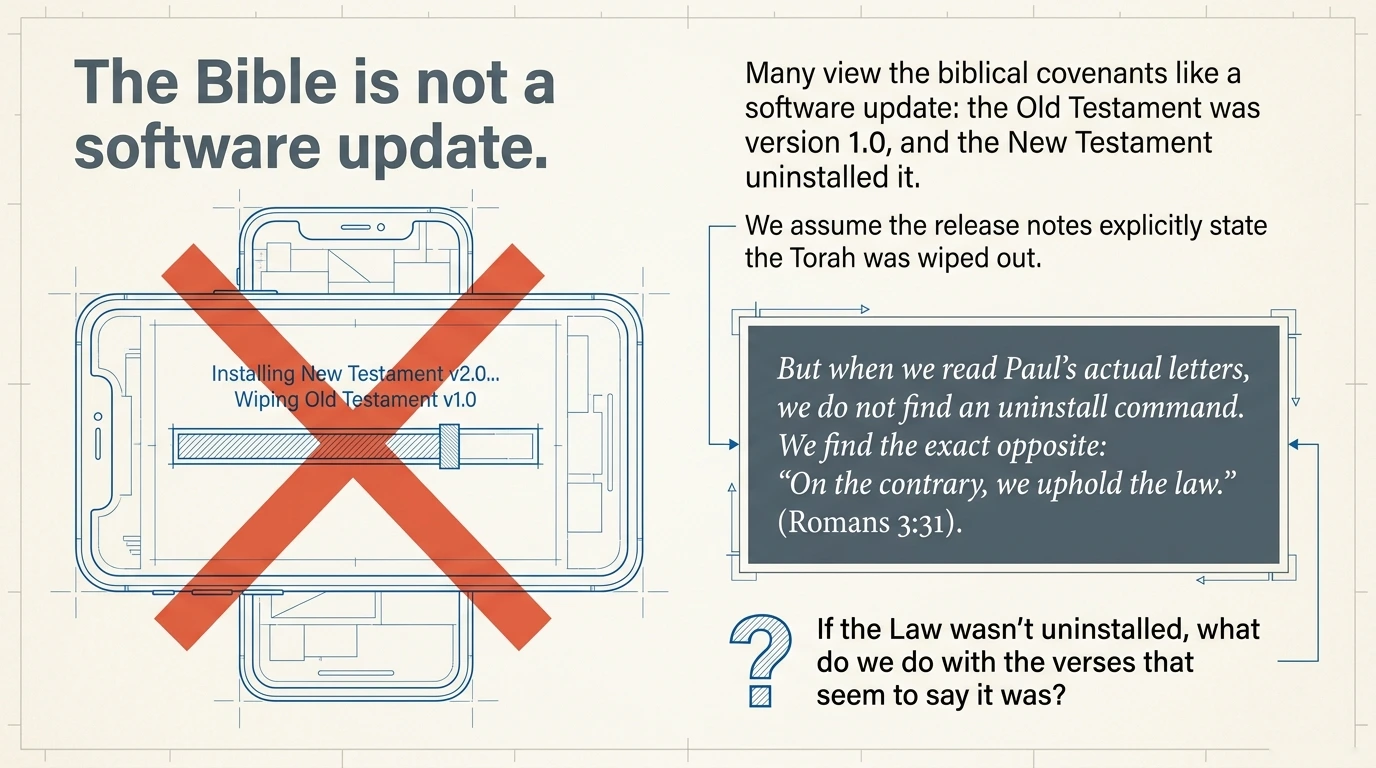
In Book 2 we used the picture of a phone that updates itself overnight and wipes out the old version. Many Christians picture the Bible in the same way: the Old Testament was version 1.0, and the New Testament replaced it. So we asked for the release notes, the line in the text that says the Torah was uninstalled. We read Paul in his own words, and we did not find it. What we found instead was Paul saying, “we uphold the nomos νόμος nom'-os(law)” (Romans 3:31).
We also said that a reader might still be holding some verses in reserve. They are the strongest ones, the verses that seem to say it in so many words. This book opens them one at a time, each in its own place, and then reads the verses that tell us to keep it.
One thing stays fixed on every page, as it did in the first two books. A sinner is made right with God by grace, through faith in the Messiah’s blood, as a gift and never by works; and the one who has been made right walks in the commandments of God. Those are two different questions, and each has its own answer. The method also stays the same. Each chapter states a common claim fairly, in its strongest form, and then opens the text.
The Claim
The first claim comes from Ephesians.
“Christ abolished the law of commandments in ordinances (Ephesians 2:15). The law ended at the cross.”
Read in an English Bible, the verse seems to close the case. Paul says “abolishing,” and he names “the nomos(law) of commandments.” It happened in Messiah’s flesh, and the next verse mentions the cross. The verse must therefore be read with the verses around it.
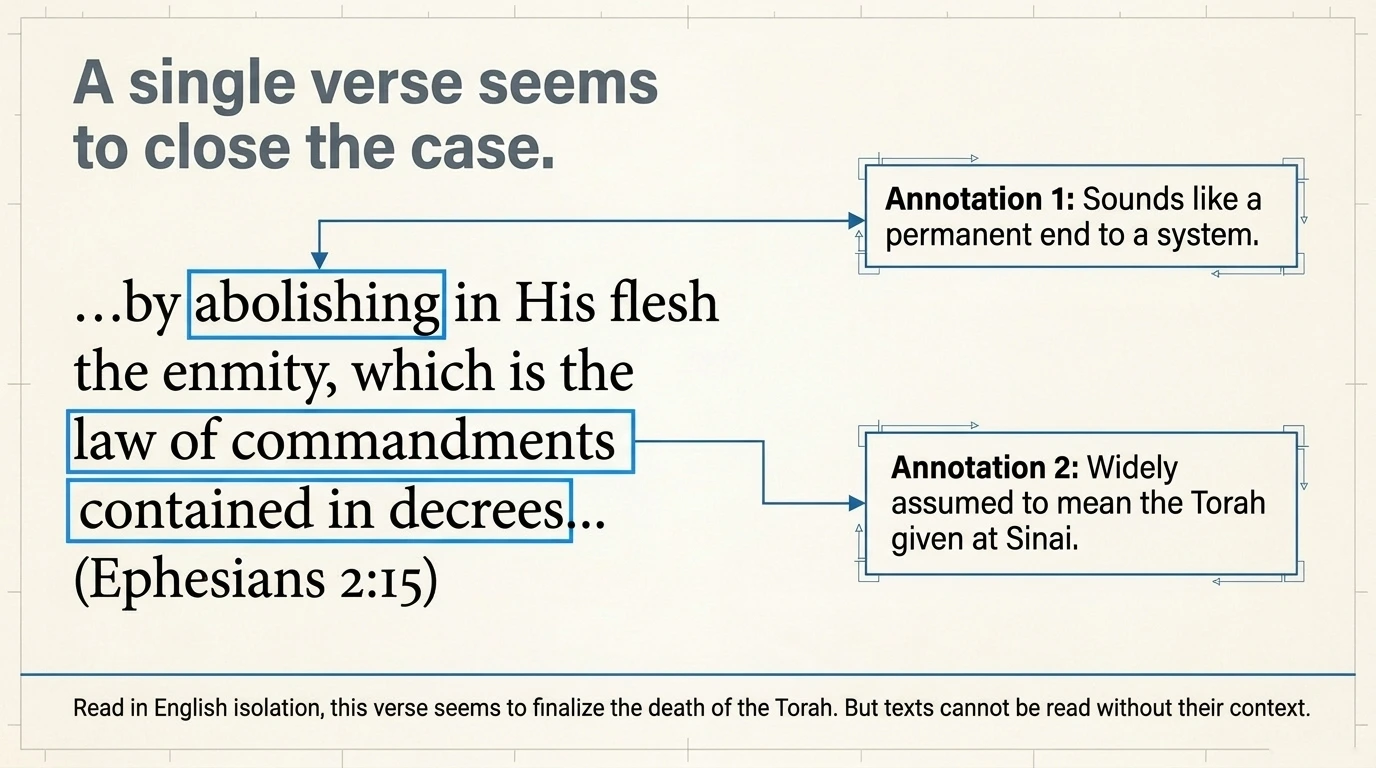
Ephesians 2:14-16 For He Himself is our eirene εἰρήνη i-ray'-nay(peace), who made both groups into one and broke down the barrier of the dividing wall, by abolishing in His sarx σάρξ sarx(flesh) the enmity, which is the nomos(law) of commandments contained in dogmata(decrees), so that in Himself He might make the two into one new man, thus establishing eirene(peace), and might reconcile them both in one body to God through the stauros σταυρός stow-ros'(cross), by it having put to death the enmity.
Before asking what was abolished, look at what the paragraph is about. “Who made both groups into one.” “Make the two into one new man.” “Reconcile them both in one body.” The word heis εἷς ice, one, runs through the whole passage. Paul is describing two groups of people who became one.
He has already said which two:
Ephesians 2:11-12 Therefore remember that formerly you, the nations in sarx(flesh), who are called "Uncircumcision" by the so-called "Circumcision" which is performed in sarx(flesh) by human hands — remember that you were at that kairos καιρός kahee-ros'(appointed-time) separate from Messiah, excluded from the commonwealth of Israel, and strangers to the diatheke διαθήκη dee-ath-ay'-kay(covenants) of promise, having no elpis ἐλπίς el-pece'(hope) and without God in the world.
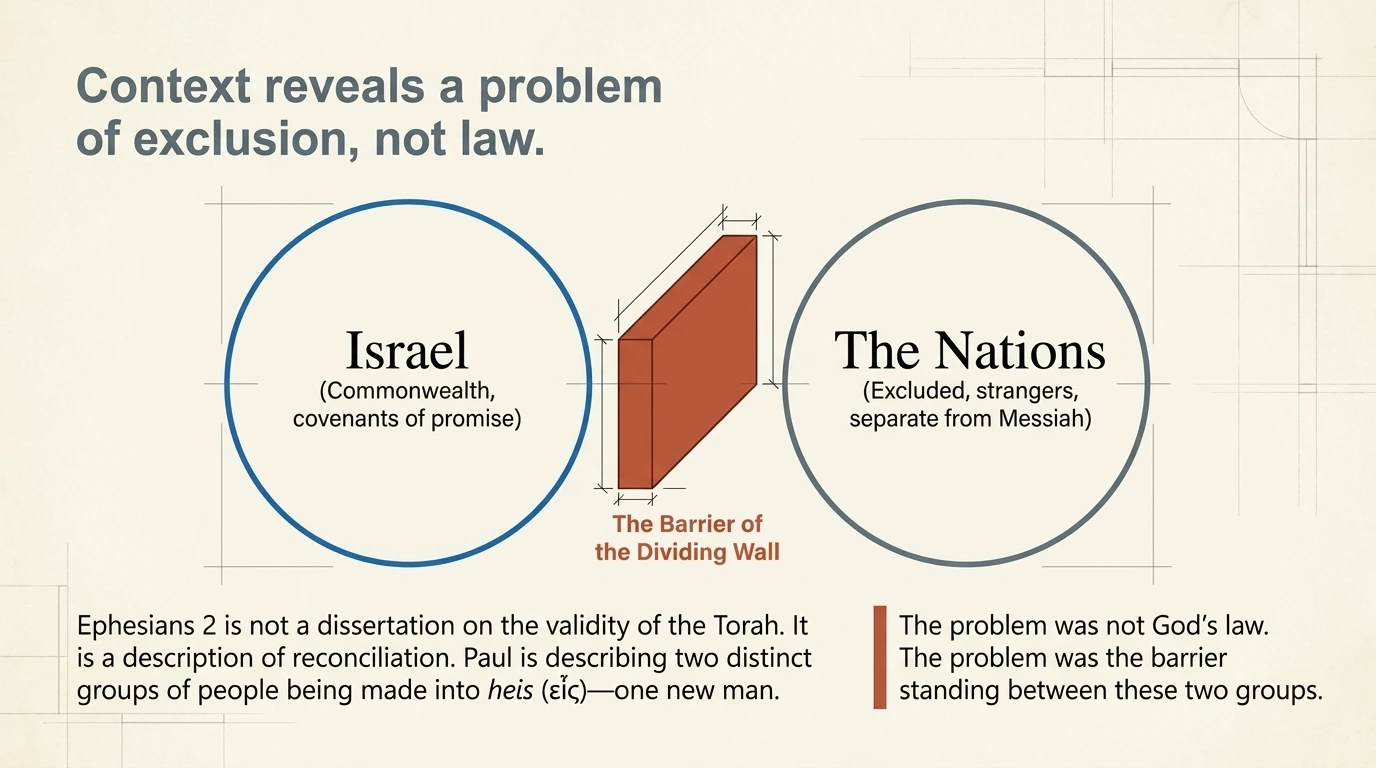
On one side stands Israel. On the other stand the nations, “excluded from the commonwealth of Israel” and “strangers to the diatheke(covenants) of promise.” Between them, Paul says, stood “the barrier of the dividing wall.”
A Word Used for Men’s Decrees
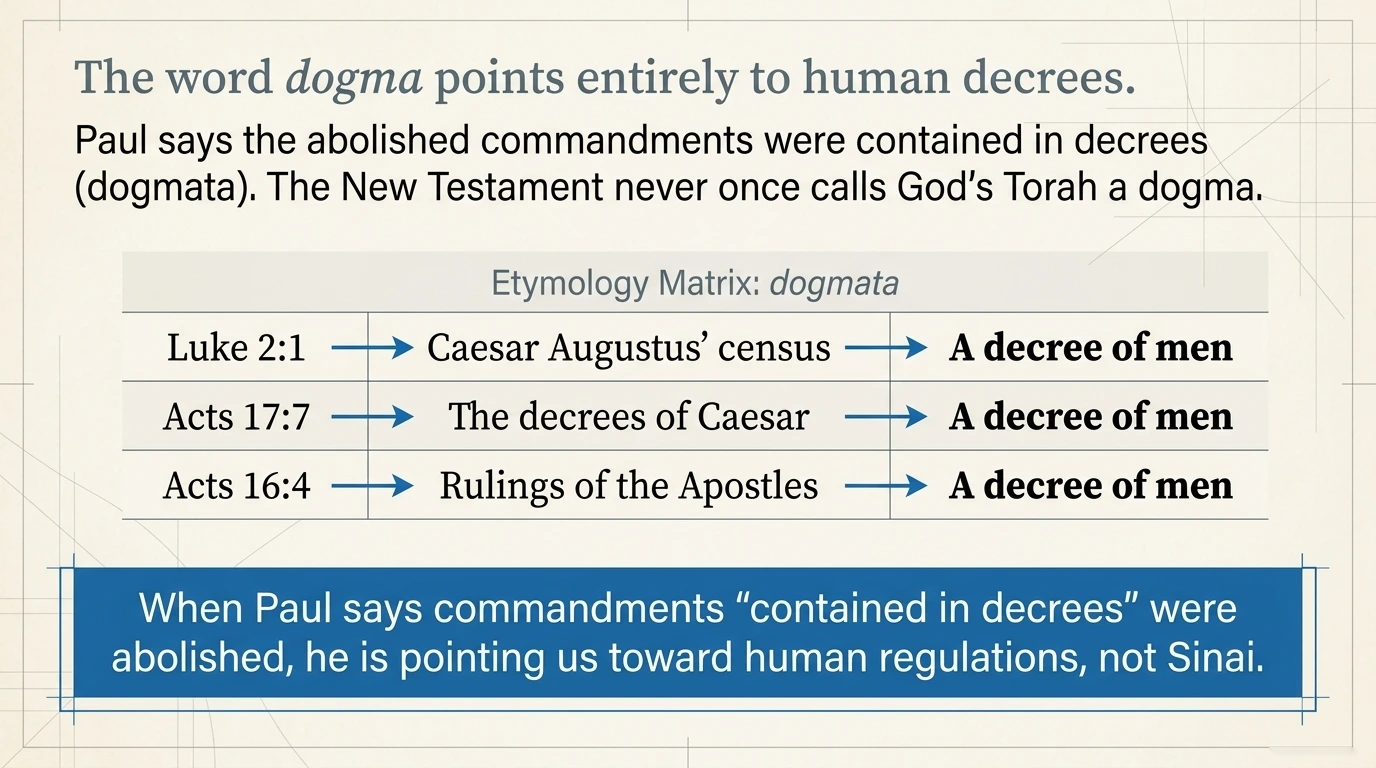
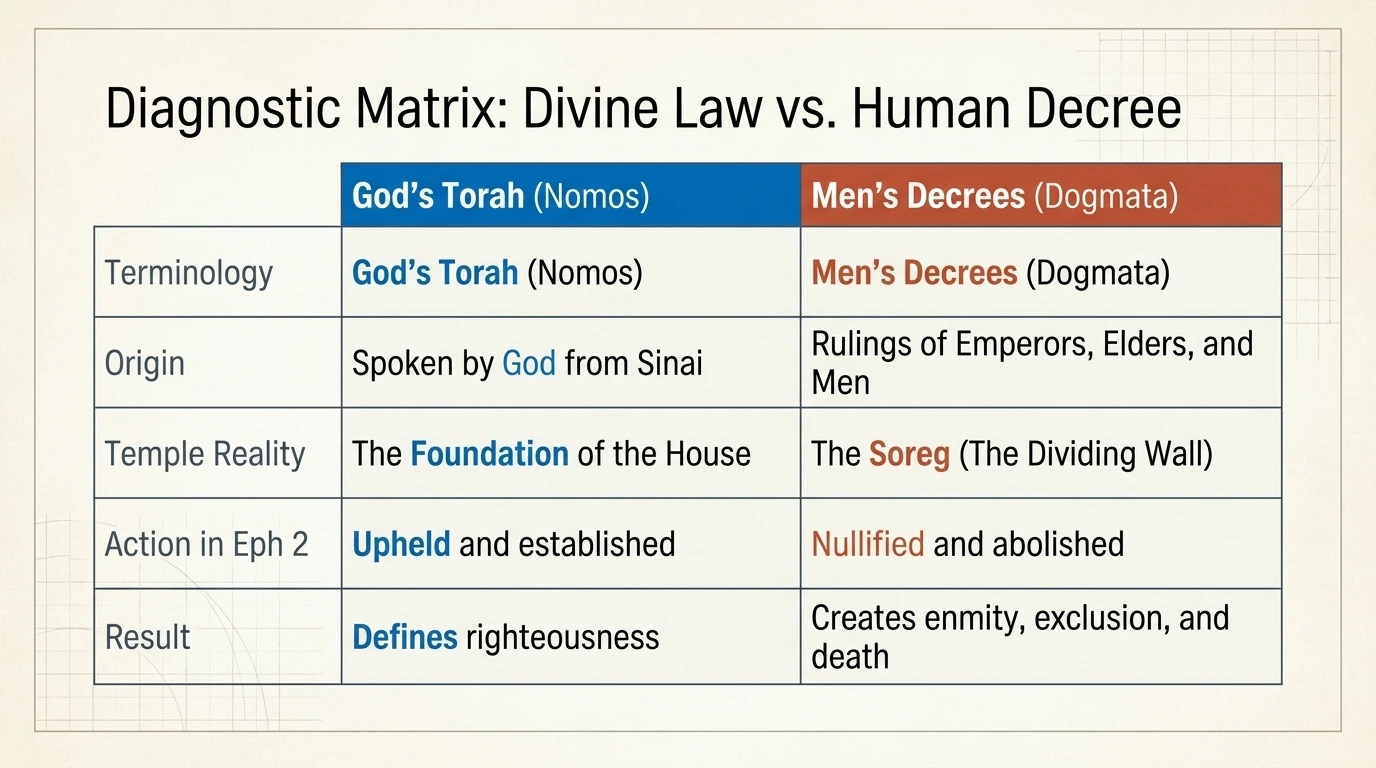
Paul describes what was abolished as “the nomos(law) of commandments contained in dogmata(decrees).” The word that tells us what kind of commands these were is dogma δόγμα dog'-mah, in the plural dogmata. In the New Testament, a dogma is a decree issued by men.
Luke 2:1 Now in those days a decree went out from Caesar Augustus that all the inhabited world should be registered.
The emperor’s order for a census is a dogma.
Acts 16:4 Now while they were passing through the cities, they were delivering the decrees that had been krino κρίνω kree'-no(decided) upon by the apostles and elders who were in Jerusalem, for them to observe.
The ruling of the apostles and elders in Jerusalem is called dogmata, and so are the “decrees of Caesar” in Acts 17:7. Those passages, with Ephesians 2:15 and Colossians 2:14, are all the places where the word appears.
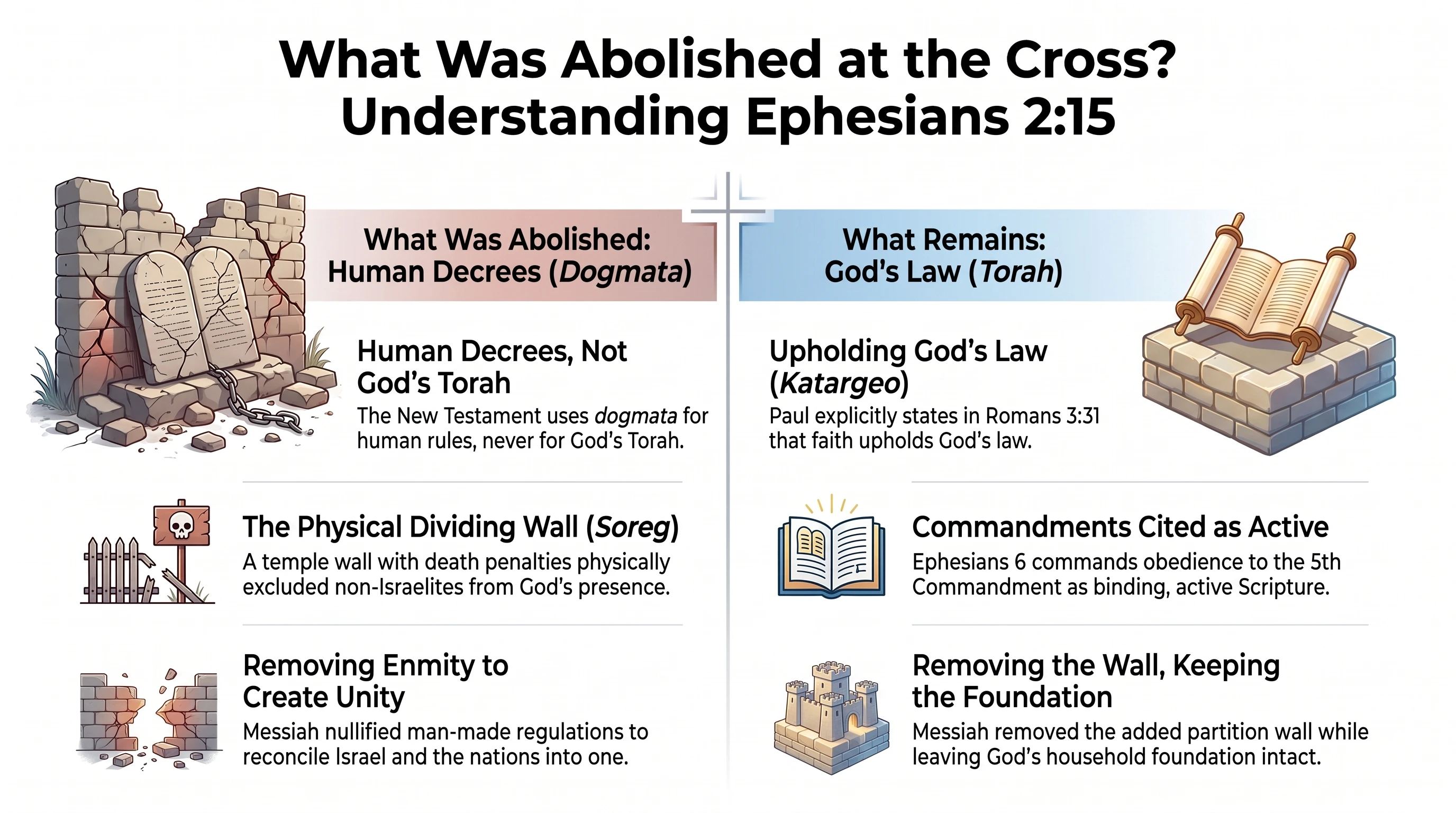
The New Testament never once calls God’s Torah a dogma. When Paul says that what was abolished was commandments “contained in dogmata(decrees),” he has told us where to look. We are to look not among the commandments God spoke from Sinai, but among the decrees of men.
A Wall with Writing on It
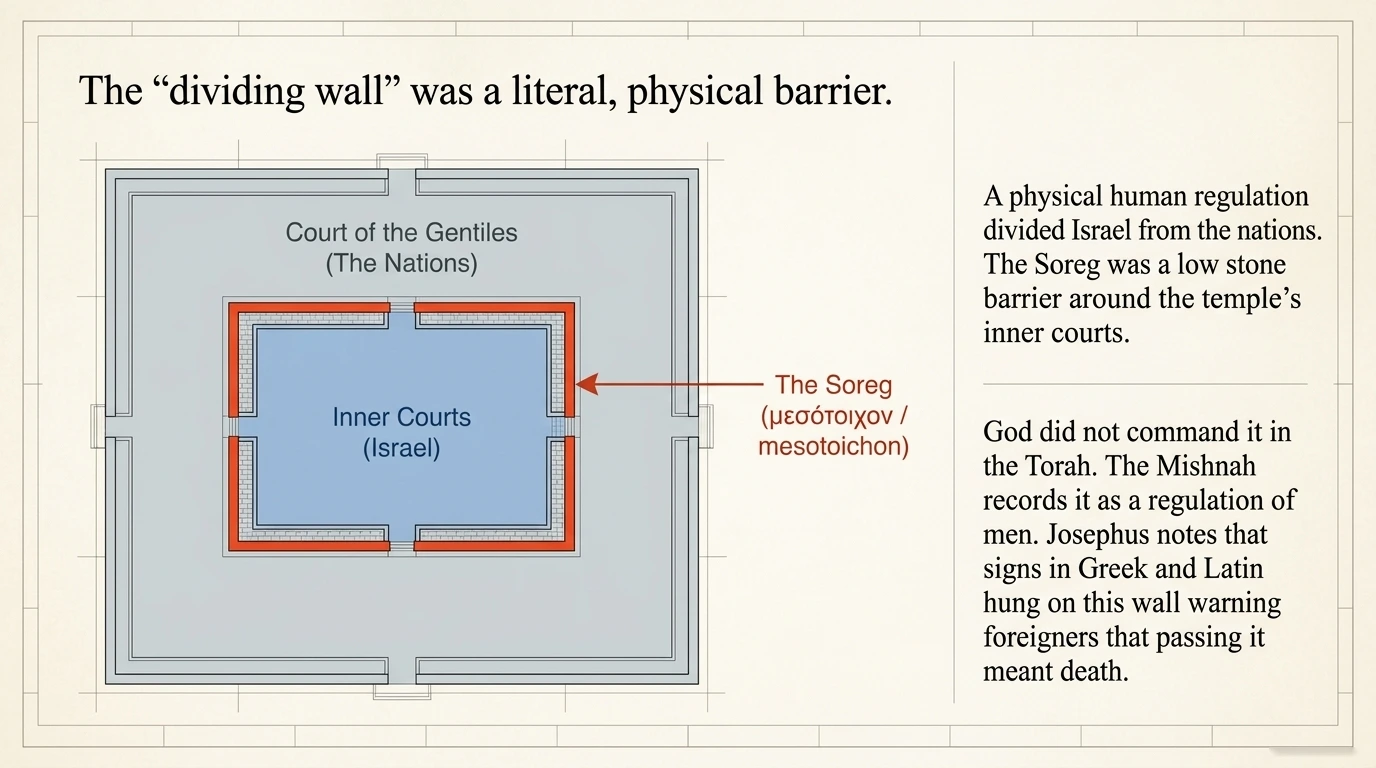
One human regulation that divided Israel from the nations stood in the temple itself.
As we saw in Book 1, the temple in Jerusalem had a low stone barrier around its inner courts. Along it, as the historian Josephus records, stood signs in Greek and Latin warning any foreigner who passed it that death would follow. Two of the Greek signs have since been found: one, complete, is in Istanbul, and a fragment of another is in Jerusalem. The Mishnah, written later, calls that barrier the soreg. God had not commanded it in the Torah. It was a regulation of men, carved in stone, with death as its penalty.
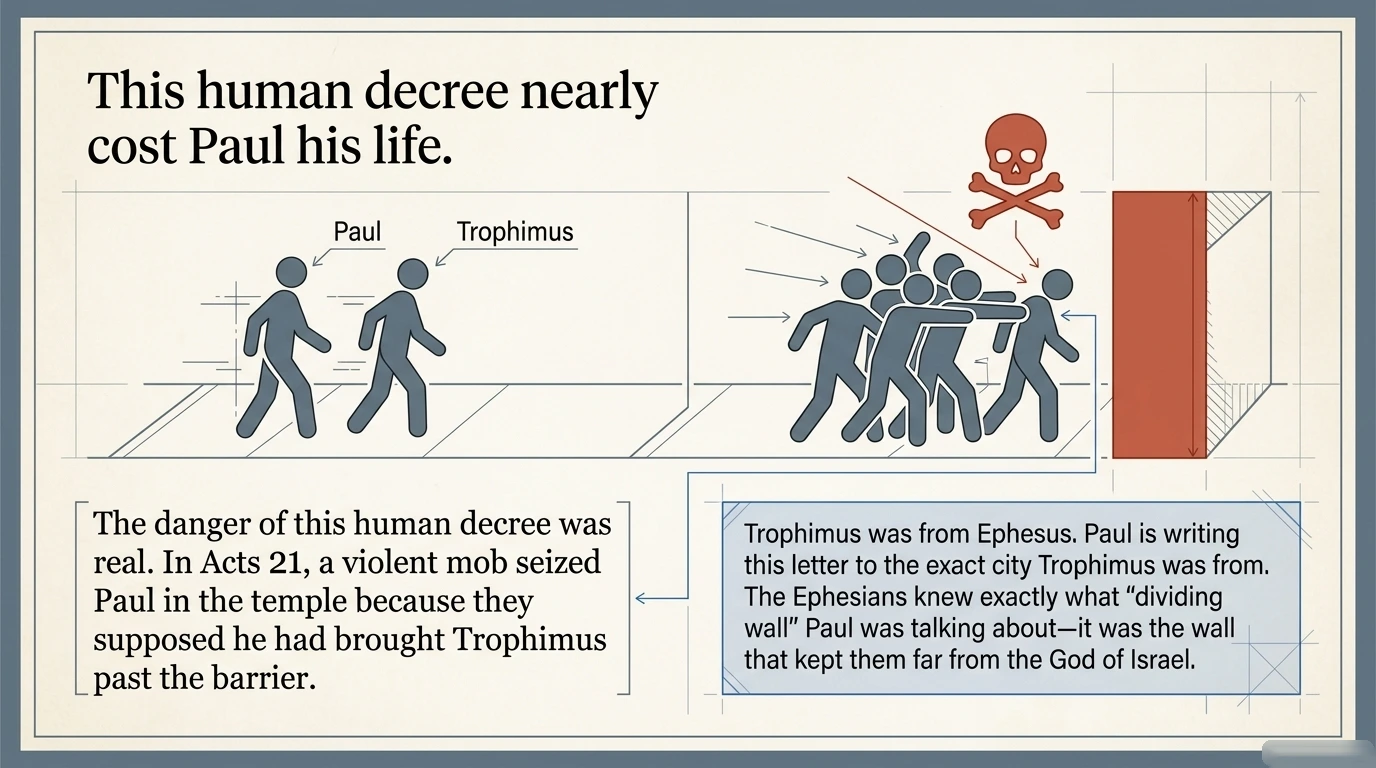
Acts shows how seriously that rule was held. When Paul was seized in the temple, the crowd shouted that he had “brought Greeks into the temple,” because “they had previously seen Trophimus the Ephesian in the city with him” (Acts 21:28-29). Trophimus came from Ephesus, the city to which this letter was written (Ephesians 1:1). He had not gone past the barrier; they only “supposed that Paul had brought him into the temple,” and that supposition was enough to provoke the whole city (Acts 21:30).
Paul’s word for what Messiah broke down is mesotoichon μεσότοιχον mes-ot'-oy-khon, the dividing wall in the middle. It was built of human rules that kept the nations far from the God of Israel, and Messiah broke it down, “so that in Himself He might make the two into one new man.” What fell was the human regulation that kept the nations outside the people of God.
The Same Verb, Turned the Other Way
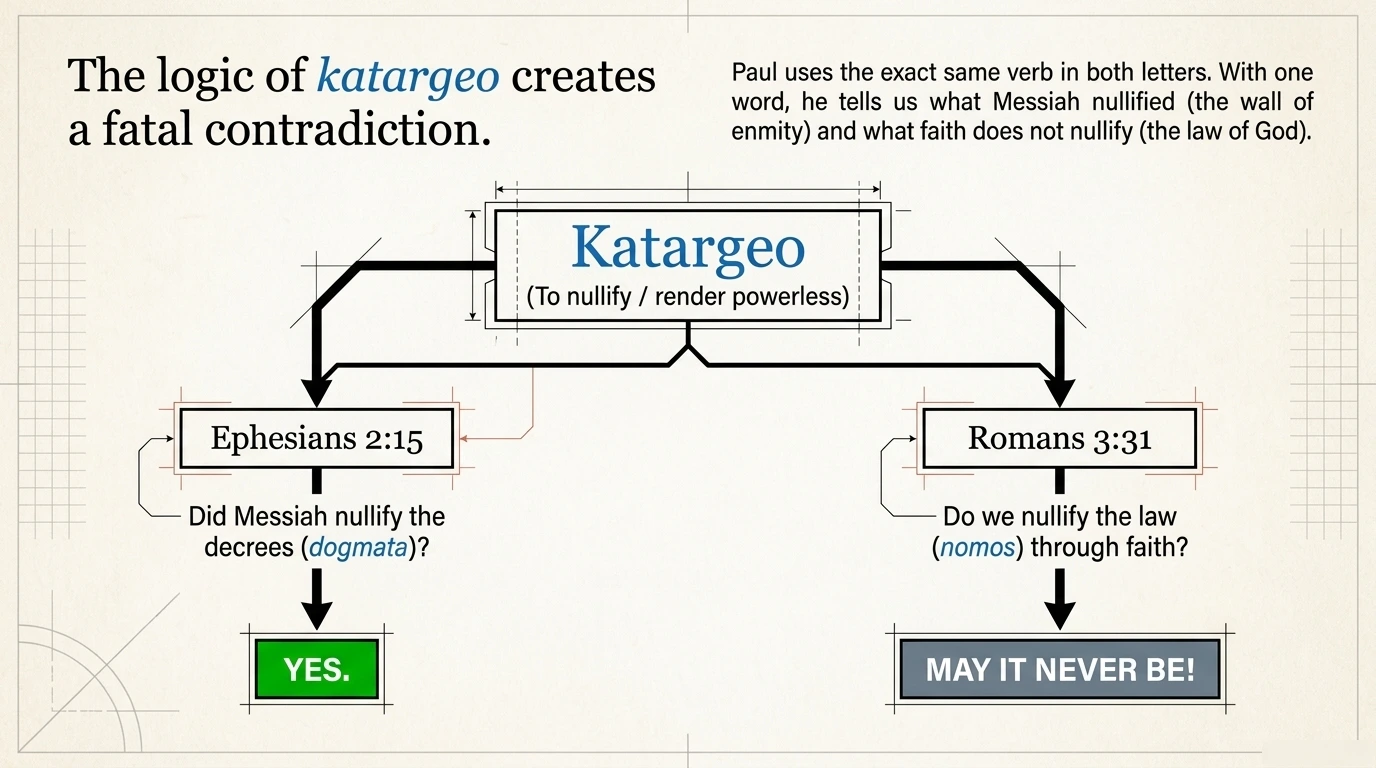
One detail is easy to miss in English. The word for “abolishing” in Ephesians 2:15 is katargeo καταργέω kat-arg-eh'-o, to render powerless, to nullify. Paul used that same verb in another letter when he wrote about the Torah itself, and there “nullify” is katargeo:
Romans 3:31 Do we then nullify the nomos(law) through faith? May it never be! On the contrary, we uphold the nomos(law).
With one word, then, Paul has told us both what Messiah nullified and what faith does not nullify. The decrees of men that built a wall of enmity were nullified, and the nomos of God is upheld. If Ephesians 2:15 meant that God’s law was nullified at the cross, Paul would be answering yes in one letter to the very question he answered with “May it never be!” in the other.
Four Chapters Later
A second test comes from the same letter, written to the same church.
Ephesians 6:1-3 Children, obey your parents in the Lord, for this is right. "Honor your father and mother" — which is the first commandment with a promise — "so that it may be well with you, and that you may live long on the earth."
“Honor your father and mother” is the fifth of the Ten Commandments, quoted word for word. Paul does not quote it as a fond memory of a former age. He commands it to the children of Ephesus, and he adds that it is “the first commandment with a promise.”
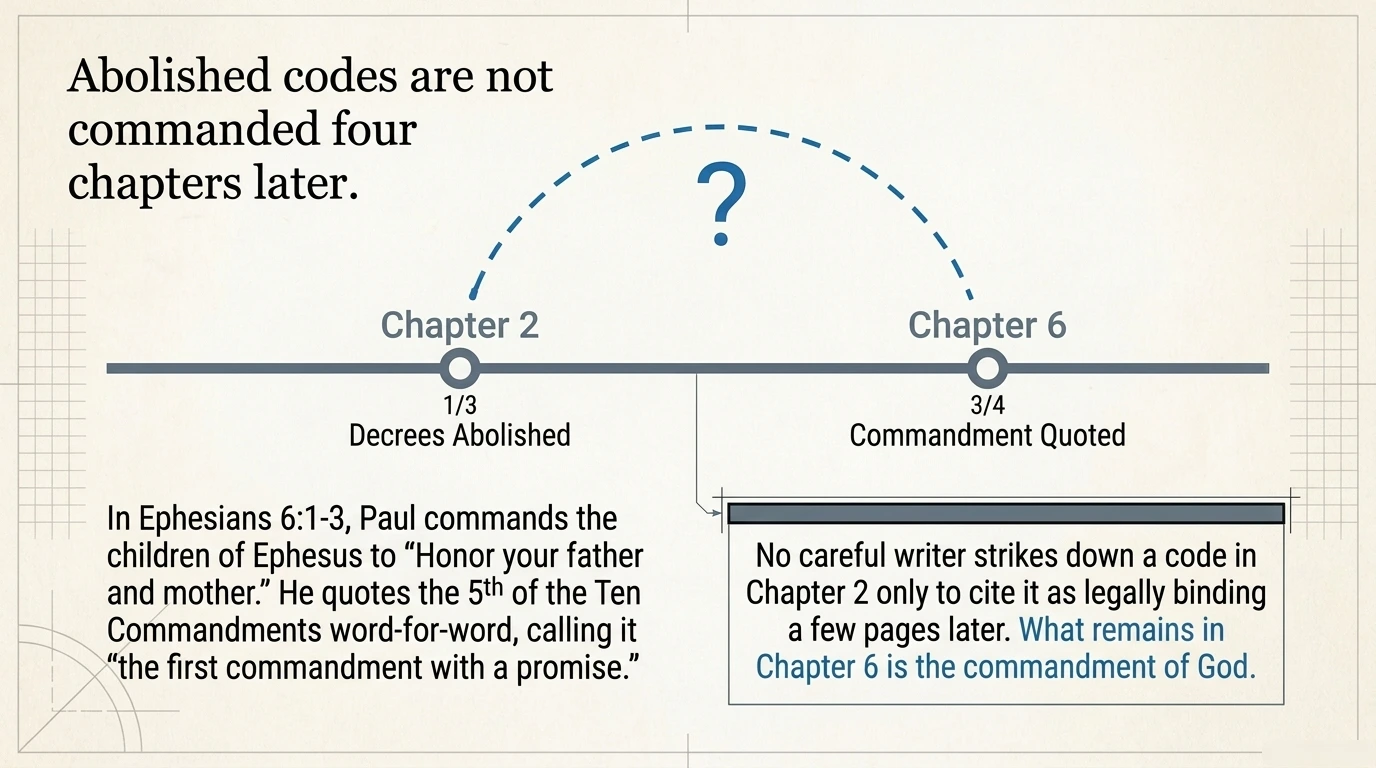
If God’s commandments had been abolished in chapter 2, Paul would be commanding in chapter 6 what he had abolished four chapters earlier. No careful writer strikes down a code in one chapter and cites it as binding a few pages later. The letter holds together in only one way: what was abolished in chapter 2 was the decree of men, and what remains in chapter 6 is the commandment of God.
Renovating a House
Picture a family that buys an old house. Long ago someone put up a partition through the middle of the living room. It was never part of the original plan, and it cut the room in two. The new owners call in a builder, the partition comes down, and the room is whole again, as it was always meant to be.
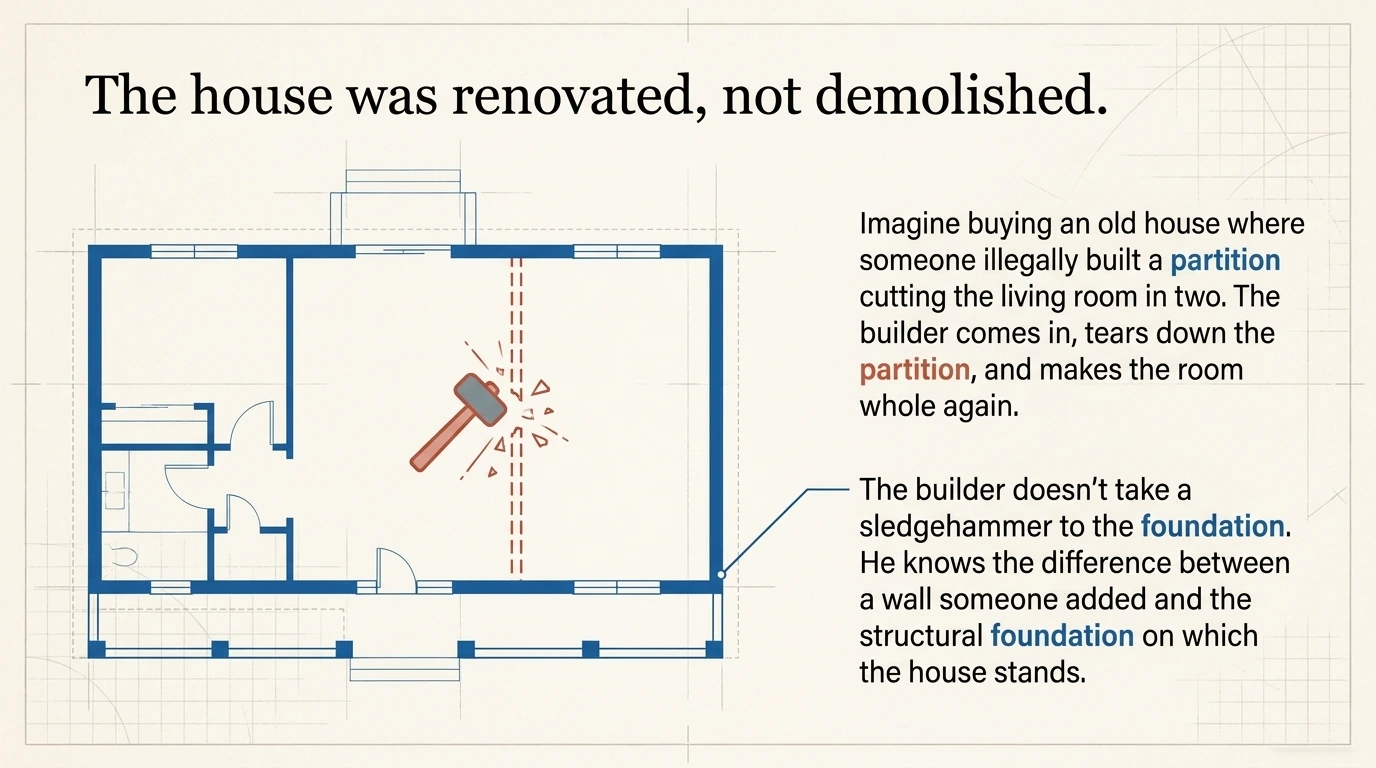
No one takes a sledgehammer to the foundation. The builder knows the difference between a wall someone added and the structure on which the house stands.
Paul draws the same distinction. Right after the wall comes down, he says what the house is built on:
Ephesians 2:19-20 So then you are no longer strangers and aliens, but you are fellow citizens with the hagioi ἅγιοι hag'-ee-os(holy ones), and are of God's household, having been built on the foundation of the apostles and prophets, Messiah Yeshua Himself being the corner stone,
“No longer strangers and aliens, but … fellow citizens with the hagioi(holy ones).” The nations who were “excluded from the commonwealth of Israel” are now inside it. The household they have joined stands on “the foundation of the apostles and prophets, Messiah Yeshua Himself being the corner stone.” The prophets are part of that foundation, and Paul goes on to say that the building is “growing into a hagio(holy) temple in the Lord” (Ephesians 2:21).
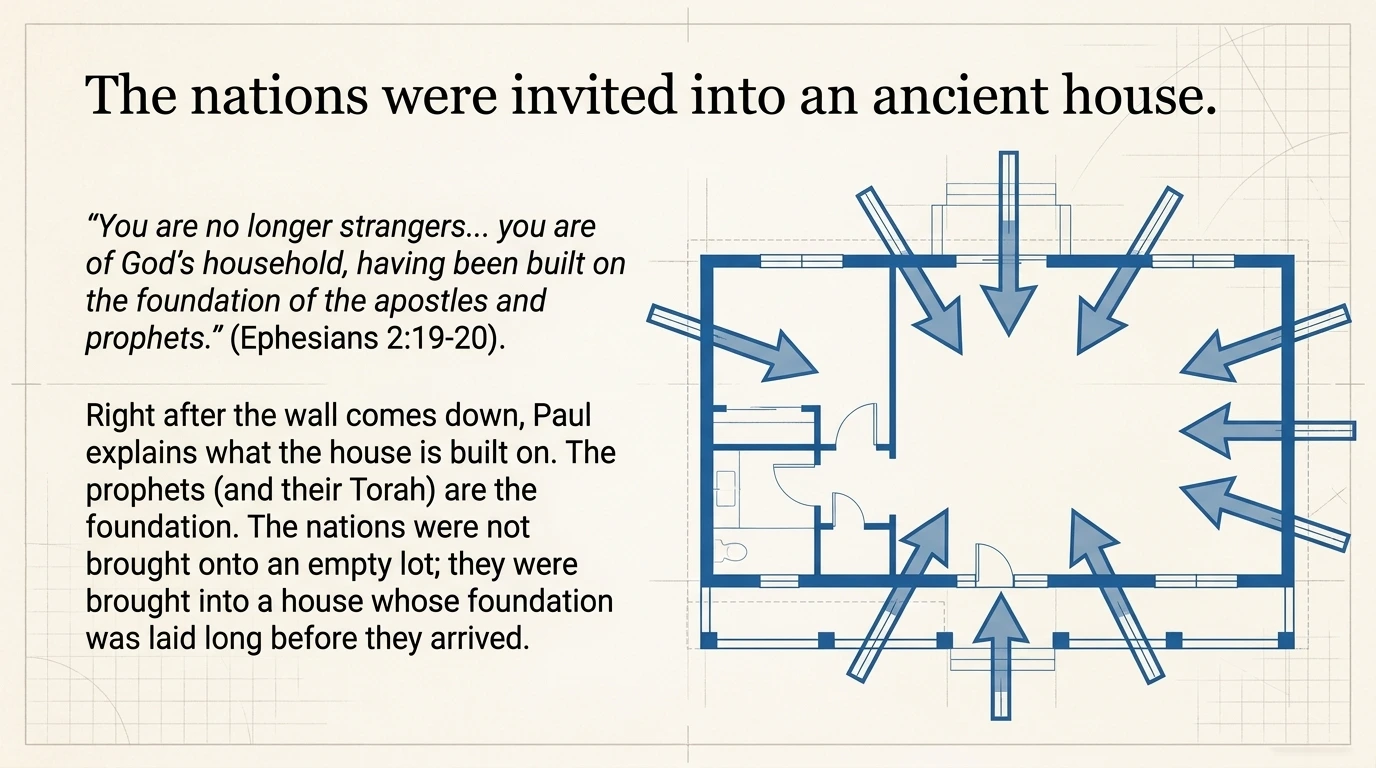
A partition came down, and the foundation stayed. The nations were not brought onto an empty lot. They were brought into a house whose foundation had been laid long before they arrived.
What This Verse Says
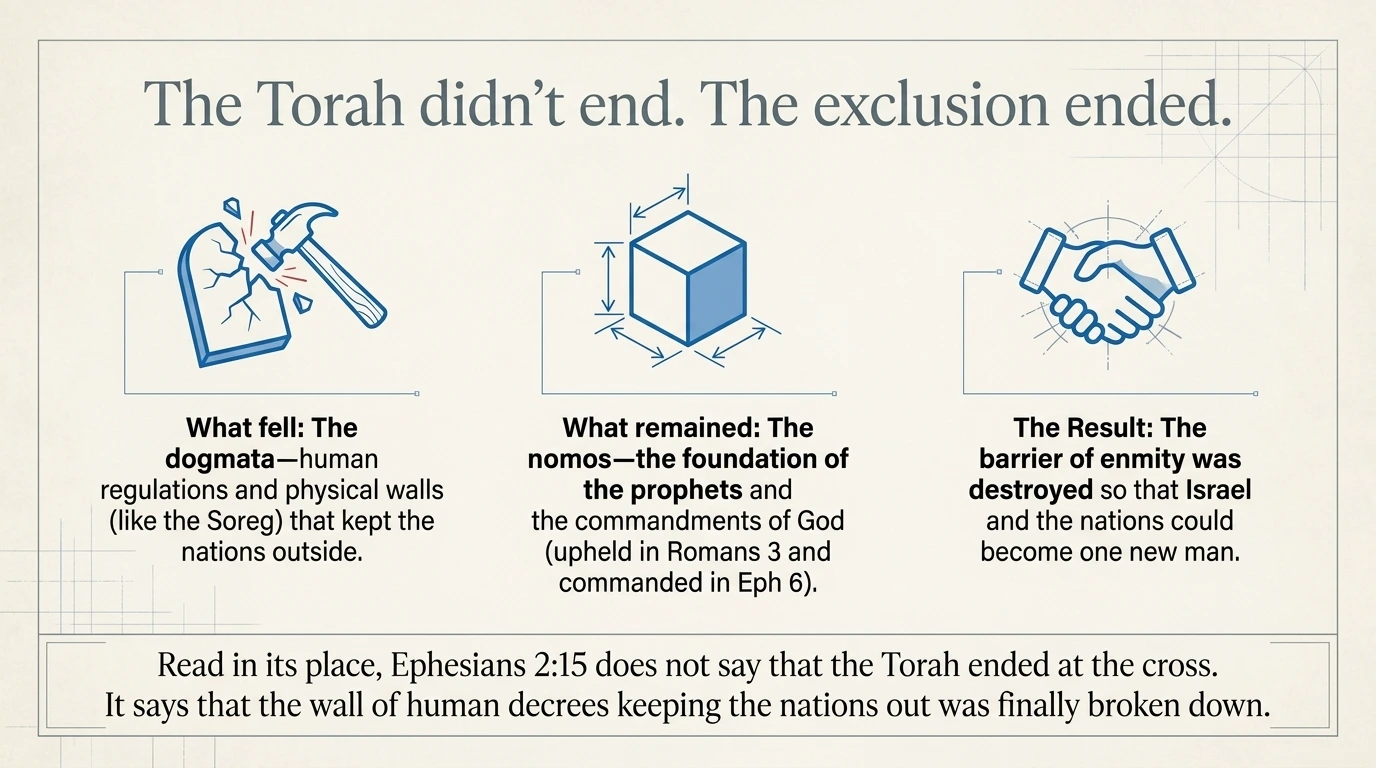
Read in its place, Ephesians 2:15 does not say that the Torah ended at the cross. It says that Messiah, by His death, broke down the wall of human decrees that kept the nations outside, so that Israel and the nations could become one new man. The word dogmata tells us what was abolished, and Romans 3:31 and Ephesians 6 tell us what was not.
The same word dogmata appears in one more place in Paul’s letters, in the verse that says something was nailed to the cross.